Museum of Vertebrate Zoology and Department of Integrative Biology, 3101 Valley Life Science Building, University of California, Berkeley, CA 94720-3160, USA.
BMC Evol Biol. 2011 May 3;11:117. doi: 10.1186/1471-2148-11-117.
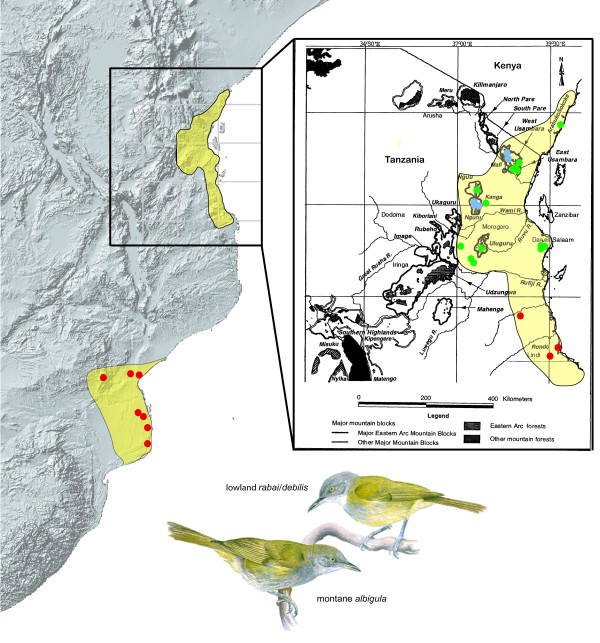
The Eastern Arc Mountains of Africa have become one of the focal systems with which to explore the patterns and mechanisms of diversification among montane species and populations. One unresolved question is the extent to which populations inhabiting montane forest interact with those of adjacent lowland forest abutting the coast of eastern Africa. The Tiny Greenbul (Phyllastephus debilis) represents the only described bird species within the Eastern Arc/coastal forest mosaic, which is polytypic across an altitudinal gradient: the subspecies albigula (green head) is distributed in the montane Usambara and Nguru Mountains whereas the subspecies rabai (grey head) is found in Tanzanian lowland and foothill forest. Using a combination of morphological and genetic data, we aim to establish if the pattern of morphological differentiation in the Tiny Greenbul (Phyllastrephus debilis) is the result of disruptive selection along an altitudinal gradient or a consequence of secondary contact following population expansion of two differentiated lineages.
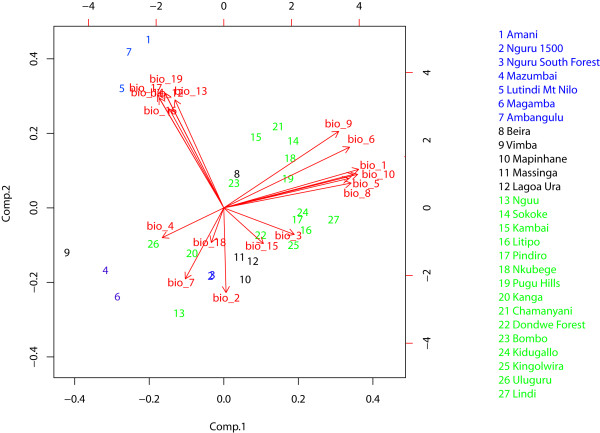
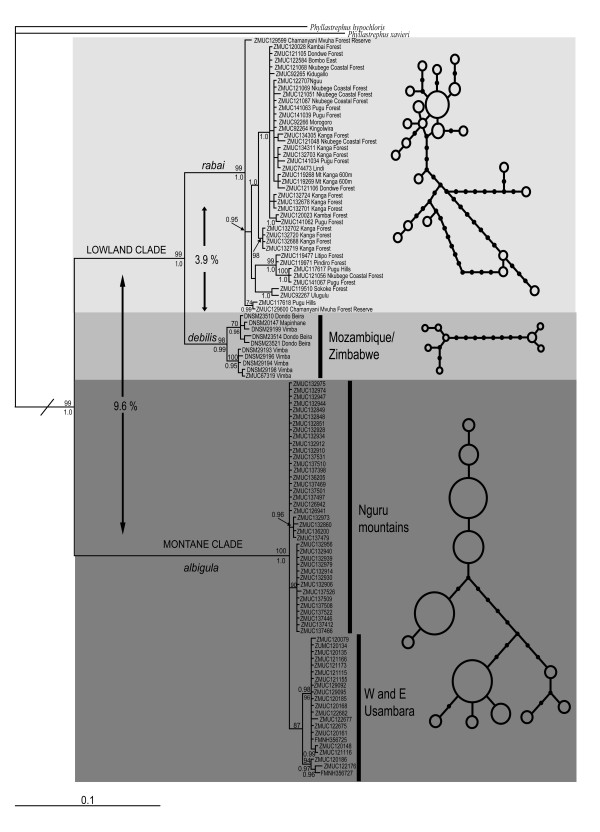
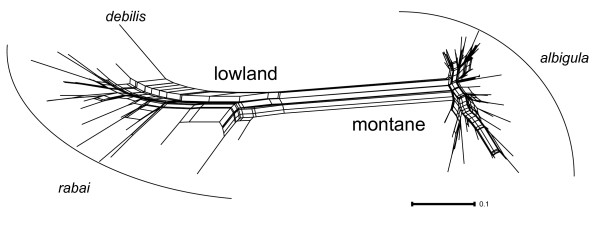
We found significant biometric differences between the lowland (rabai) and montane (albigula) populations in Tanzania. The differences in shape are coupled with discrete differences in the coloration of the underparts. Using multi-locus data gathered from 124 individuals, we show that lowland and montane birds form two distinct genetic lineages. The divergence between the two forms occurred between 2.4 and 3.1 Myrs ago.Our coalescent analyses suggest that limited gene flow, mostly from the subspecies rabai to albigula, is taking place at three mid-altitude localities, where lowland and montane rainforest directly abut. The extent of this introgression appears to be limited and is likely a consequence of the recent expansion of rabai further inland.
The clear altitudinal segregation in morphology found within the Tiny Greenbul is the result of secondary contact of two highly differentiated lineages rather than disruptive selection in plumage pattern across an altitudinal gradient. Based on our results, we recommend albigula be elevated to species rank.
东非弧形山脉已成为探索山地物种和种群多样化模式和机制的焦点系统之一。一个悬而未决的问题是,居住在山地森林中的种群与毗邻东非海岸的低地森林中的种群相互作用的程度。微小绿雀(Phyllastephus debilis)是东非弧形/沿海森林镶嵌体中唯一描述的鸟类物种,它在海拔梯度上呈现多态性:亚种 albigula(绿头)分布在山地的乌桑巴拉山脉和恩古鲁山脉,而亚种 rabai(灰头)则分布在坦桑尼亚的低地和山麓森林中。本研究结合形态学和遗传数据,旨在确定微小绿雀(Phyllastrephus debilis)形态分化的模式是由于沿着海拔梯度的干扰选择,还是由于两个分化谱系的种群扩张后的二次接触所致。
我们发现坦桑尼亚的低地(rabai)和山地(albigula)种群在生物计量学上存在显著差异。这些差异在形状上与下体颜色的离散差异有关。使用从 124 个个体中收集的多基因数据,我们表明低地和山地鸟类形成了两个不同的遗传谱系。两种形式的分化发生在 2.4 到 3.1 百万年前之间。我们的聚类分析表明,在三个中海拔地区,即低地和山地雨林直接相邻的地区,存在有限的基因流,主要是从亚种 rabai 到 albigula。这种基因渗入的程度似乎有限,可能是 rabai 进一步向内陆扩张的结果。
微小绿雀内部发现的明显的垂直形态隔离是两个高度分化谱系的二次接触的结果,而不是在垂直梯度上的羽毛图案的干扰选择。基于我们的研究结果,我们建议将 albigula 提升为独立的物种。