Laboratory of Molecular Carcinogenesis, National Institute of Environmental Health Sciences, National Institutes of Health, Department of Health and Human Services, Research Triangle Park, North Carolina, United States of America.
PLoS One. 2011 Apr 25;6(4):e18707. doi: 10.1371/journal.pone.0018707.
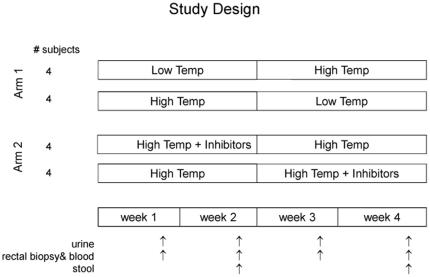
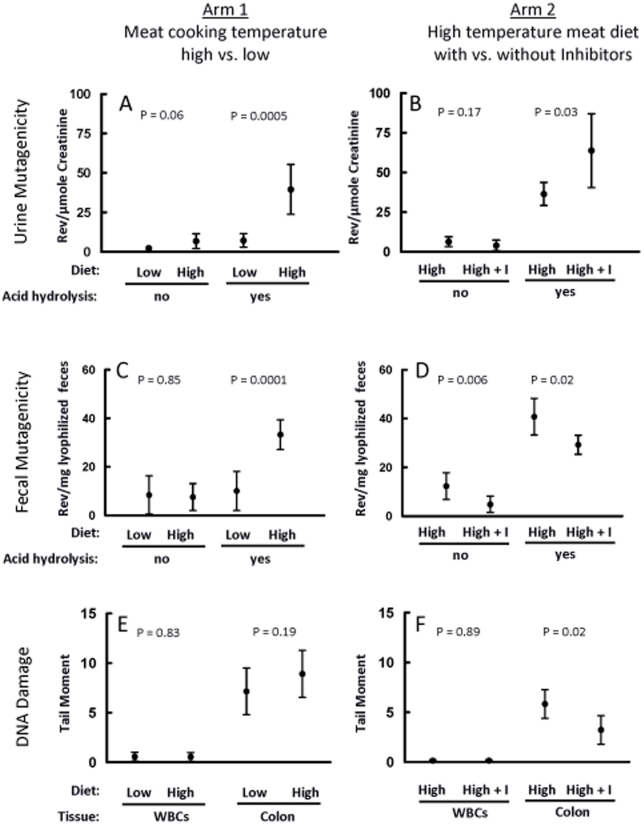
Dietary exposures implicated as reducing or causing risk for colorectal cancer may reduce or cause DNA damage in colon tissue; however, no one has assessed this hypothesis directly in humans. Thus, we enrolled 16 healthy volunteers in a 4-week controlled feeding study where 8 subjects were randomly assigned to dietary regimens containing meat cooked at either low (100°C) or high temperature (250°C), each for 2 weeks in a crossover design. The other 8 subjects were randomly assigned to dietary regimens containing the high-temperature meat diet alone or in combination with 3 putative mutagen inhibitors: cruciferous vegetables, yogurt, and chlorophyllin tablets, also in a crossover design. Subjects were nonsmokers, at least 18 years old, and not currently taking prescription drugs or antibiotics. We used the Salmonella assay to analyze the meat, urine, and feces for mutagenicity, and the comet assay to analyze rectal biopsies and peripheral blood lymphocytes for DNA damage. Low-temperature meat had undetectable levels of heterocyclic amines (HCAs) and was not mutagenic, whereas high-temperature meat had high HCA levels and was highly mutagenic. The high-temperature meat diet increased the mutagenicity of hydrolyzed urine and feces compared to the low-temperature meat diet. The mutagenicity of hydrolyzed urine was increased nearly twofold by the inhibitor diet, indicating that the inhibitors enhanced conjugation. Inhibitors decreased significantly the mutagenicity of un-hydrolyzed and hydrolyzed feces. The diets did not alter the levels of DNA damage in non-target white blood cells, but the inhibitor diet decreased nearly twofold the DNA damage in target colorectal cells. To our knowledge, this is the first demonstration that dietary factors can reduce DNA damage in the target tissue of fried-meat associated carcinogenesis.
ClinicalTrials.gov NCT00340743.
饮食暴露被认为可以降低或引起结直肠癌的风险,可能会减少或引起结肠组织中的 DNA 损伤;然而,目前还没有人在人类中直接评估这一假设。因此,我们招募了 16 名健康志愿者参加了一项为期 4 周的对照喂养研究,其中 8 名志愿者被随机分配到两种饮食方案中,一种方案中食用的肉是在低温(100°C)下烹饪的,另一种方案中食用的肉是在高温(250°C)下烹饪的,两种方案各持续 2 周,采用交叉设计。另外 8 名志愿者被随机分配到含有高温肉饮食的方案中或含有高温肉饮食与 3 种潜在致突变抑制剂的方案中,致突变抑制剂包括十字花科蔬菜、酸奶和叶绿酸片剂,同样采用交叉设计。志愿者均为不吸烟人群,年龄至少 18 岁,且目前未服用处方药或抗生素。我们使用沙门氏菌检测法分析肉、尿液和粪便中的致突变性,使用彗星检测法分析直肠活检和外周血淋巴细胞中的 DNA 损伤。低温肉中的杂环胺(HCAs)含量可检测不到,且无致突变性,而高温肉中的杂环胺含量很高,具有高度致突变性。与低温肉饮食相比,高温肉饮食增加了水解尿液和粪便的致突变性。抑制剂饮食使水解尿液的致突变性增加了近两倍,表明抑制剂增强了结合。抑制剂显著降低了未水解和水解粪便的致突变性。这些饮食方案并未改变非目标白细胞的 DNA 损伤水平,但抑制剂饮食使目标结直肠细胞的 DNA 损伤降低了近两倍。据我们所知,这是首次证明饮食因素可以降低与油炸肉相关致癌作用的靶组织中的 DNA 损伤。
ClinicalTrials.gov NCT00340743。