
儿童和青少年的久坐行为及其与心血管代谢健康的量、模式和类型:一项横断面研究。
Volume, patterns, and types of sedentary behavior and cardio-metabolic health in children and adolescents: a cross-sectional study.
机构信息
School of Kinesiology and Health Studies, Queen's University, Kingston, ON, Canada.
出版信息
BMC Public Health. 2011 May 4;11:274. doi: 10.1186/1471-2458-11-274.
BACKGROUND
Cardio-metabolic risk factors are becoming more prevalent in children and adolescents. A lack of moderate-to-vigorous intensity physical activity (MVPA) is an established determinant of cardio-metabolic risk factors in children and adolescents. Less is known about the relationship between sedentary behavior and cardio-metabolic health. Therefore, the objective was to examine the independent associations between volume, patterns, and types of sedentary behavior with cardio-metabolic risk factors among children and adolescents.
METHODS
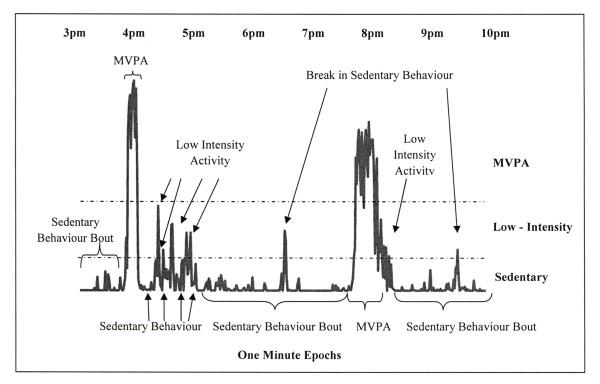
The results are based on 2527 children and adolescents (6-19 years old) from the 2003/04 and 2005/06 National Health and Nutrition Examination Surveys (NHANES). A cardio-metabolic risk score (CRS) was calculated based on age- and sex-adjusted waist circumference, systolic blood pressure, non-high-density lipoprotein cholesterol, and C-reactive protein values. Volume and patterns of sedentary behavior and moderate-to-vigorous physical activity (MVPA) were measured objectively using accelerometers. Types of sedentary behavior were measured by questionnaire. A series of logistic regression models were used to examine associations.
RESULTS
Volume and patterns of sedentary behavior were not predictors of high CRS after adjusting for MVPA and other confounders (P > 0.1). For types of sedentary behavior, high TV use, but not high computer use, was a predictor of high CRS after adjustment for MVPA and other confounders. Children and adolescents who watched ≥4 hours per day of TV were 2.53 (95% confidence interval: 1.45-4.42) times more likely to have high CRS than those who watched <1 hour per day. MVPA predicted high CRS after adjusting for all sedentary behavior measures and other confounders. After adjustment for waist circumference, MVPA also predicted high non-obesity CRS; however, the same relationship was not seen with TV use.
CONCLUSION
No association was observed between overall volume and patterns of sedentary behavior with cardio-metabolic risk factors in this large sample of children and adolescents. Conversely, high TV use and low MVPA were independently associated with cardio-metabolic risk factors. However, the association between high TV use and clustered cardio-metabolic risk factors appears to be mediated or confounded by obesity. Thus, TV and MVPA appear to be two separate behaviors that need to be targeted with different interventions and policies.
背景
心血管代谢危险因素在儿童和青少年中越来越普遍。缺乏中等到剧烈强度的身体活动(MVPA)是儿童和青少年心血管代谢危险因素的一个既定决定因素。关于久坐行为与心血管代谢健康之间的关系知之甚少。因此,本研究的目的是研究儿童和青少年久坐行为的量、模式和类型与心血管代谢危险因素之间的独立关系。
方法
本研究结果基于 2003/04 年和 2005/06 年全国健康和营养检查调查(NHANES)中的 2527 名儿童和青少年(6-19 岁)。根据年龄和性别调整的腰围、收缩压、非高密度脂蛋白胆固醇和 C 反应蛋白值计算心血管代谢风险评分(CRS)。使用加速度计客观测量久坐行为的量、模式和中等到剧烈强度的身体活动(MVPA)。久坐行为的类型通过问卷测量。使用一系列逻辑回归模型来检查关联。
结果
在调整 MVPA 和其他混杂因素后,久坐行为的量和模式不是高 CRS 的预测因素(P > 0.1)。对于久坐行为的类型,高电视使用量而不是高计算机使用量是调整 MVPA 和其他混杂因素后高 CRS 的预测因素。每天观看≥4 小时电视的儿童和青少年患高 CRS 的可能性是每天观看<1 小时的儿童和青少年的 2.53 倍(95%置信区间:1.45-4.42)。在调整所有久坐行为测量和其他混杂因素后,MVPA 预测高 CRS。在调整腰围后,MVPA 也预测了非肥胖高 CRS;然而,电视使用量与非肥胖高 CRS 之间没有相同的关系。
结论
在这个大型儿童和青少年样本中,没有观察到总体久坐行为量和模式与心血管代谢危险因素之间存在关联。相反,高电视使用量和低 MVPA 与心血管代谢危险因素独立相关。然而,高电视使用量与聚集的心血管代谢危险因素之间的关联似乎被肥胖所中介或混杂。因此,电视和 MVPA 似乎是两种需要通过不同的干预措施和政策来针对的不同行为。
 Zotero 插件