School of Public Health, Rutgers, The State University of New Jersey, Piscataway, NJ, United States of America.
Department of Surgical Oncology, Rutgers Cancer Institute of New Jersey Rutgers, The State University of New Jersey, New Brunswick, NJ, United States of America.
PLoS One. 2020 Feb 14;15(2):e0228934. doi: 10.1371/journal.pone.0228934. eCollection 2020.
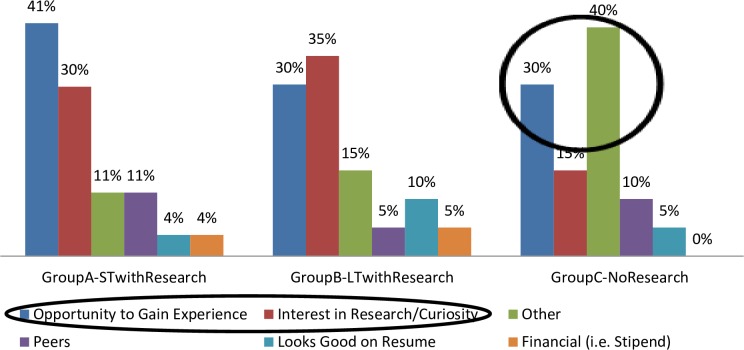
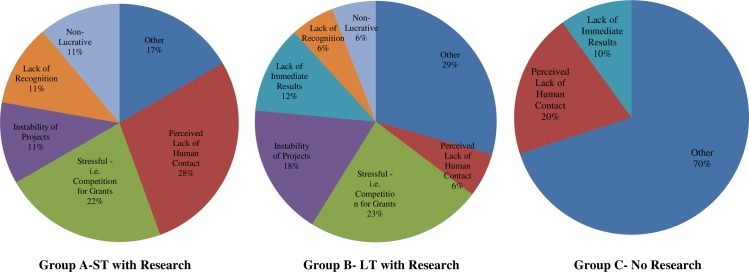
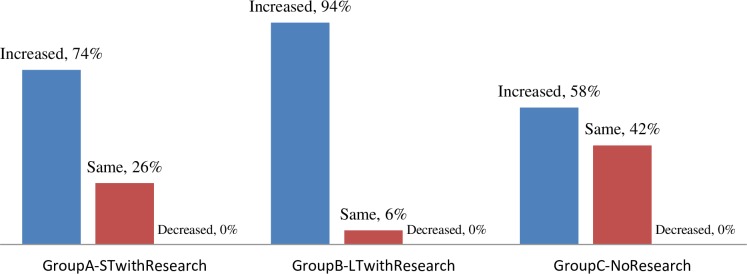
Limited empirical data exists on why women and minority students enter Biomedical Career Enrichment Programs (BCEPs) and how program variables-such as duration of research-influence their intention to pursue research careers. This exploratory study reports motivators for participation in BCEPs among women and racial/ethnic minority students-historically underrepresented groups-and the influence of program and personal variables on their research-career intent and self-efficacy beliefs. We studied the program variables of research experience, research duration, and mentor influence; and the personal variables of race, gender, family, and peers. Using the conceptual framework of planned behavior theory and social cognitive career theory, we interviewed students from underrepresented groups participating in BCEPs that offered research experience for short duration (Group A), long duration (Group B), and no research experience (Group C). We utilized Atlas Ti, a qualitative methodological software tool, to analyze the interview responses. Students choosing a BCEP with research experience cited "opportunity to gain experience" and "interest or curiosity in research" as motivators. Duration of research experience had a positive relationship with enhancement in research skills and self-efficacy beliefs, but did not change the initial research-career intent of these BCEP participants. The study revealed an interesting and unexpected theme of "perceived deterrents" to a career in research that included stress of competition (e.g. grants), the instability of projects, and the isolation of scientific research. Importantly, the study findings indicate the need to reform program design and science policies that challenge the current biomedical workforce and dissuade interested students from underrepresented groups from entering the field.
关于女性和少数族裔学生为何进入生物医学职业强化计划(BCEPs)以及计划变量(如研究时间长短)如何影响他们从事研究职业的意图,目前仅有有限的经验数据。本探索性研究报告了女性和少数族裔学生(历史上代表性不足的群体)参与 BCEPs 的动机,以及计划和个人变量对他们的研究职业意图和自我效能信念的影响。我们研究了研究经验、研究时间长短和导师影响力等计划变量,以及种族、性别、家庭和同龄人等个人变量。我们运用计划行为理论和社会认知职业理论的概念框架,对参加 BCEPs 的代表性不足的学生进行了访谈,这些学生提供了短期(A 组)、长期(B 组)和无研究经验(C 组)的研究经验。我们使用 Atlas Ti 这一定性方法学软件工具分析了访谈回复。选择有研究经验的 BCEP 的学生将“获得经验的机会”和“对研究的兴趣或好奇心”作为动机。研究经验的持续时间与研究技能和自我效能信念的提高呈正相关,但并未改变这些 BCEP 参与者最初的研究职业意图。研究揭示了一个有趣且出乎意料的研究职业障碍主题,包括竞争压力(例如拨款)、项目的不稳定性和科学研究的孤立感。重要的是,研究结果表明需要改革计划设计和科学政策,以挑战当前的生物医学劳动力队伍,并劝阻来自代表性不足群体的有兴趣的学生进入该领域。