Vaccine and Immunisation Research Group, Murdoch Childrens Research Institute, Royal Children's Hospital, Parkville, Victoria, Australia.
PLoS Comput Biol. 2011 Apr;7(4):e1002026. doi: 10.1371/journal.pcbi.1002026. Epub 2011 Apr 28.
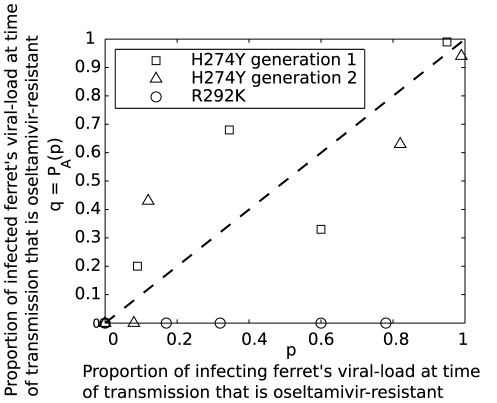
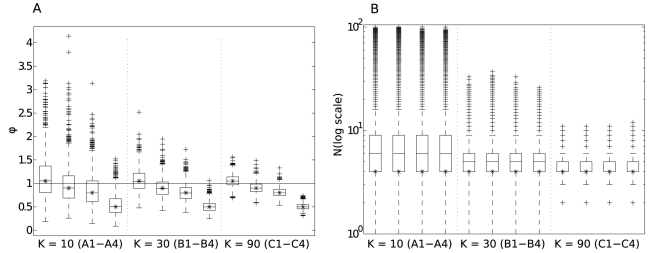
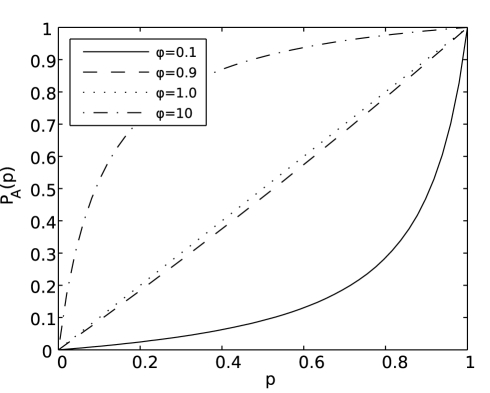
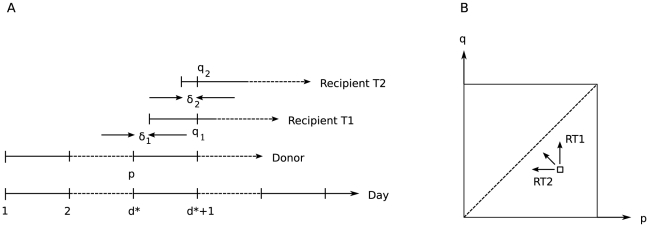
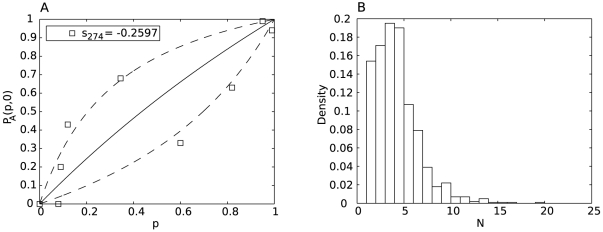
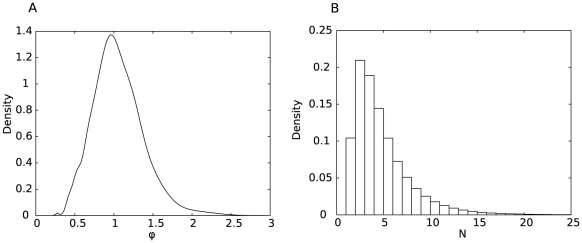
We present a method to measure the relative transmissibility ("transmission fitness") of one strain of a pathogen compared to another. The model is applied to data from "competitive mixtures" experiments in which animals are co-infected with a mixture of two strains. We observe the mixture in each animal over time and over multiple generations of transmission. We use data from influenza experiments in ferrets to demonstrate the approach. Assessment of the relative transmissibility between two strains of influenza is important in at least three contexts: 1) Within the human population antigenically novel strains of influenza arise and compete for susceptible hosts. 2) During a pandemic event, a novel sub-type of influenza competes with the existing seasonal strain(s). The unfolding epidemiological dynamics are dependent upon both the population's susceptibility profile and the inherent transmissibility of the novel strain compared to the existing strain(s). 3) Neuraminidase inhibitors (NAIs), while providing significant potential to reduce transmission of influenza, exert selective pressure on the virus and so promote the emergence of drug-resistant strains. Any adverse outcome due to selection and subsequent spread of an NAI-resistant strain is exquisitely dependent upon the transmission fitness of that strain. Measurement of the transmission fitness of two competing strains of influenza is thus of critical importance in determining the likely time-course and epidemiology of an influenza outbreak, or the potential impact of an intervention measure such as NAI distribution. The mathematical framework introduced here also provides an estimate for the size of the transmitted inoculum. We demonstrate the framework's behaviour using data from ferret transmission studies, and through simulation suggest how to optimise experimental design for assessment of transmissibility. The method introduced here for assessment of mixed transmission events has applicability beyond influenza, to other viral and bacterial pathogens.
我们提出了一种方法来衡量一种病原体菌株相对于另一种菌株的相对传染性(“传播适应性”)。该模型应用于“竞争混合物”实验的数据,其中动物同时感染两种菌株的混合物。我们观察每个动物随时间和多代传播的混合物。我们使用来自雪貂流感实验的数据来演示该方法。评估两种流感菌株之间的相对传染性至少有三个重要方面:1)在人群中,具有抗原性的新型流感菌株出现并争夺易感宿主。2)在大流行期间,新型流感亚型与现有季节性菌株竞争。展开的流行病学动态取决于人群的易感性特征和新型菌株相对于现有菌株的固有传染性。3)神经氨酸酶抑制剂(NAI)虽然为减少流感传播提供了巨大潜力,但对病毒施加了选择性压力,从而促进了耐药菌株的出现。由于选择和随后传播抗 NAI 菌株而产生的任何不良后果,都极其取决于该菌株的传播适应性。因此,测量两种竞争流感菌株的传播适应性对于确定流感爆发的可能时间进程和流行病学,或 NAI 分布等干预措施的潜在影响至关重要。这里介绍的数学框架还提供了对传播接种剂量大小的估计。我们使用雪貂传播研究的数据来展示该框架的行为,并通过模拟建议如何优化评估传染性的实验设计。这里介绍的用于评估混合传播事件的方法不仅适用于流感,还适用于其他病毒和细菌病原体。