Pulmonary Function and Clinical Exercise Physiology Unit (SEFICE), Respiratory Division, Department of Medicine, Federal University of São Paulo, São Paulo, Brazil.
Clinics (Sao Paulo). 2011;66(3):401-6. doi: 10.1590/s1807-59322011000300006.
High-frequency neuromuscular electrical stimulation increases exercise tolerance in patients with advanced chronic obstructive pulmonary disease (COPD patients). However, it is conceivable that its benefits are more prominent in patients with better-preserved peripheral muscle function and structure.
To investigate the effects of high-frequency neuromuscular electrical stimulation in COPD patients with better-preserved peripheral muscle function.
Prospective and cross-over study.
Thirty COPD patients were randomly assigned to either home-based, high-frequency neuromuscular electrical stimulation or sham stimulation for six weeks. The training intensity was adjusted according to each subject's tolerance. Fat-free mass, isometric strength, six-minute walking distance and time to exercise intolerance (Tlim) were assessed.
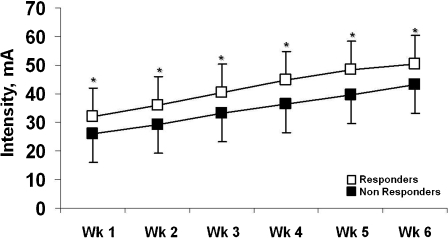
Thirteen (46.4%) patients responded to high-frequency neuromuscular electrical stimulation; that is, they had a post/pre Δ Tlim >10% after stimulation (unimproved after sham stimulation). Responders had a higher baseline fat-free mass and six-minute walking distance than their seventeen (53.6%) non-responding counterparts. Responders trained at higher stimulation intensities; their mean amplitude of stimulation during training was significantly related to their fat-free mass (r = 0.65; p<0.01). Logistic regression revealed that fat-free mass was the single independent predictor of Tlim improvement (odds ratio [95% CI] = 1.15 [1.04-1.26]; p<0.05).
We conclude that high-frequency neuromuscular electrical stimulation improved the exercise capacity of COPD patients with better-preserved fat-free mass because they tolerated higher training stimulus levels. These data suggest that early training with high-frequency neuromuscular electrical stimulation before tissue wasting begins might enhance exercise tolerance in patients with less advanced COPD.
高频神经肌肉电刺激可提高晚期慢性阻塞性肺疾病(COPD 患者)的运动耐量。然而,可以想象的是,其益处在周围肌肉功能和结构保存较好的患者中更为显著。
探讨高频神经肌肉电刺激对周围肌肉功能保存较好的 COPD 患者的影响。
前瞻性交叉研究。
30 例 COPD 患者被随机分为家庭高频神经肌肉电刺激组或假刺激组,进行 6 周治疗。根据每位患者的耐受情况调整训练强度。评估无脂肪质量、等长力量、6 分钟步行距离和运动不耐受时间(Tlim)。
13 例(46.4%)患者对高频神经肌肉电刺激有反应;即刺激后 Tlim 较刺激前增加了 10%(假刺激后无改善)。有反应者的无脂肪质量和 6 分钟步行距离均高于 17 例(53.6%)无反应者。有反应者的刺激强度更高;其训练期间的平均刺激幅度与无脂肪质量显著相关(r=0.65;p<0.01)。逻辑回归显示,无脂肪质量是 Tlim 改善的唯一独立预测因素(比值比[95%CI] = 1.15[1.04-1.26];p<0.05)。
我们得出结论,高频神经肌肉电刺激改善了无脂肪质量保存较好的 COPD 患者的运动能力,因为他们能够耐受更高的训练刺激水平。这些数据表明,在组织耗竭开始之前,早期使用高频神经肌肉电刺激进行训练可能会提高病情较轻的 COPD 患者的运动耐量。