1 REVAL - Rehabilitation Research Center, BIOMED - Biomedical Research Institute, Faculty of Medicine and Life Sciences, Hasselt University, Diepenbeek, Belgium.
2 Department of Research and Education, CIRO, Center of Expertise for Chronic Organ Failure, Horn, the Netherlands.
Chron Respir Dis. 2018 May;15(2):182-219. doi: 10.1177/1479972317709642. Epub 2017 Jun 5.
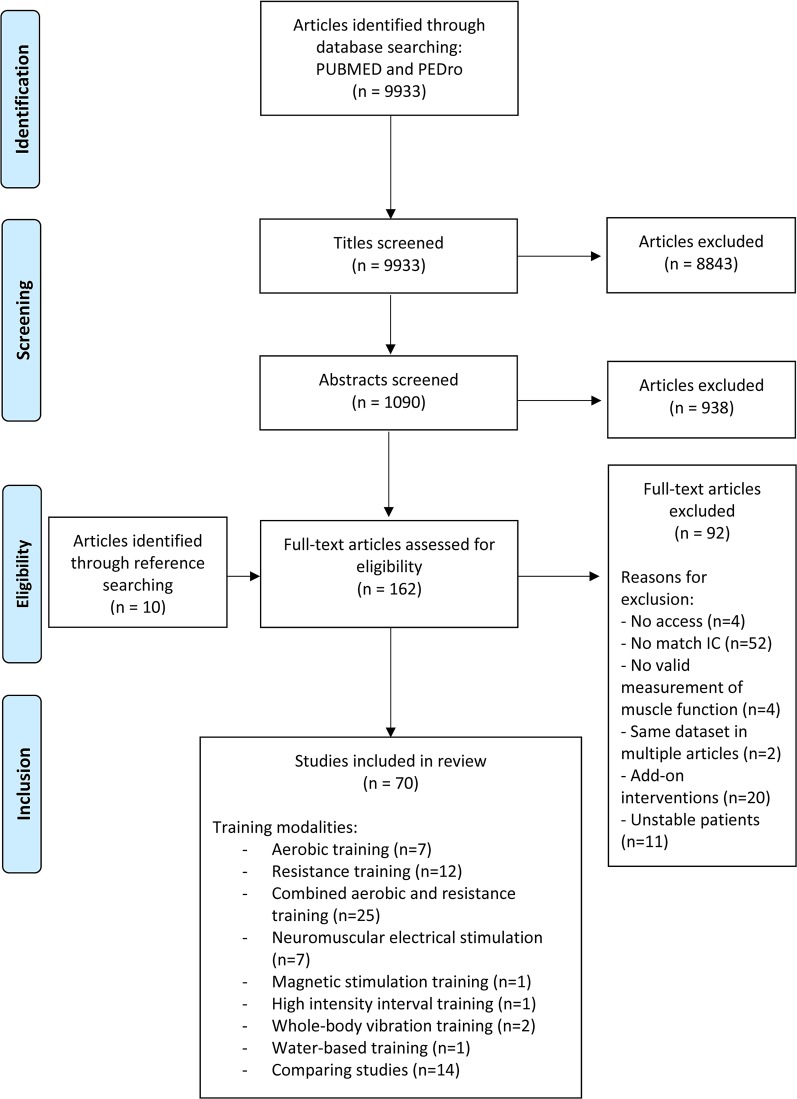
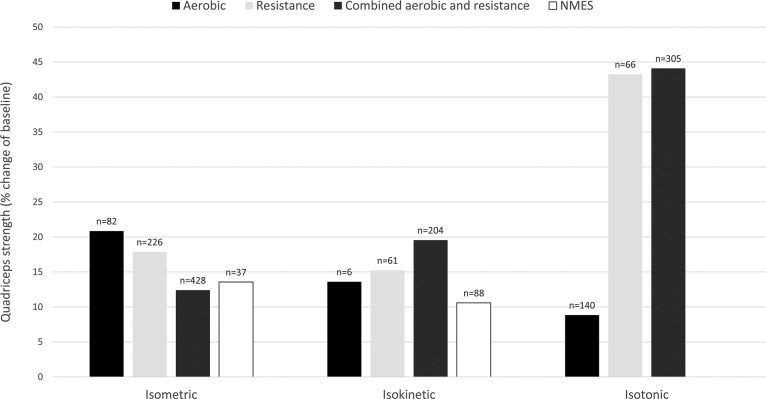
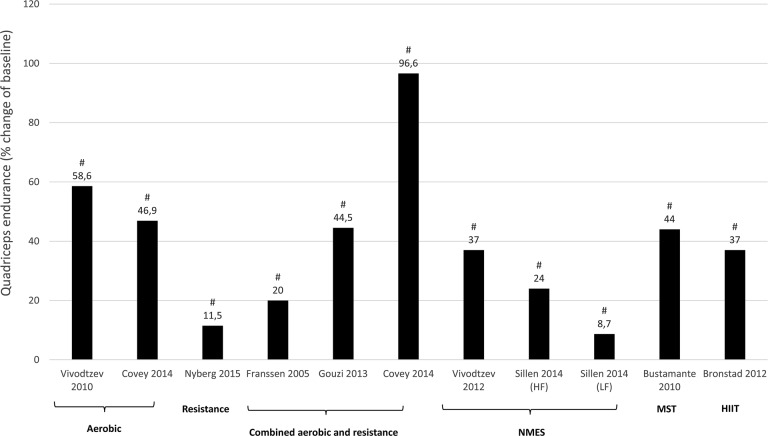
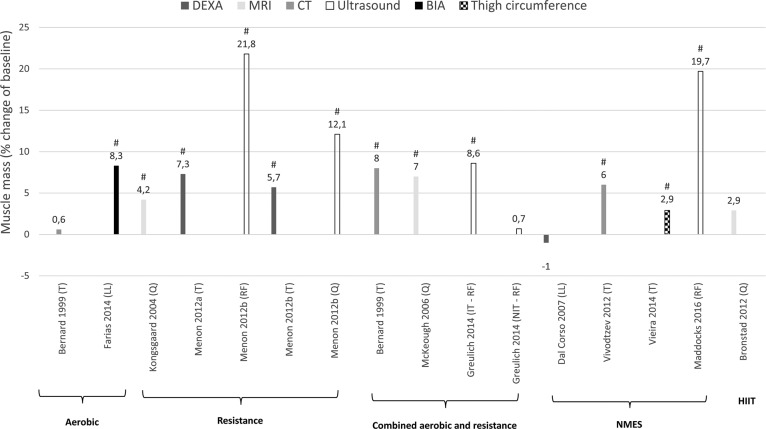
Chronic obstructive pulmonary disease (COPD) patients often experience lower limb muscle dysfunction and wasting. Exercise-based training has potential to improve muscle function and mass, but literature on this topic is extensive and heterogeneous including numerous interventions and outcome measures. This review uses a detailed systematic approach to investigate the effect of this wide range of exercise-based interventions on muscle function and mass. PUBMED and PEDro databases were searched. In all, 70 studies ( n = 2504 COPD patients) that implemented an exercise-based intervention and reported muscle strength, endurance, or mass in clinically stable COPD patients were critically appraised. Aerobic and/or resistance training, high-intensity interval training, electrical or magnetic muscle stimulation, whole-body vibration, and water-based training were investigated. Muscle strength increased in 78%, muscle endurance in 92%, and muscle mass in 88% of the cases where that specific outcome was measured. Despite large heterogeneity in exercise-based interventions and outcome measures used, most exercise-based trials showed improvements in muscle strength, endurance, and mass in COPD patients. Which intervention(s) is (are) best for which subgroup of patients remains currently unknown. Furthermore, this literature review identifies gaps in the current knowledge and generates recommendations for future research to enhance our knowledge on exercise-based interventions in COPD patients.
慢性阻塞性肺疾病(COPD)患者常出现下肢肌肉功能障碍和消耗。基于运动的训练有改善肌肉功能和质量的潜力,但该主题的文献广泛且存在异质性,包括许多干预措施和结果测量。本综述采用详细的系统方法来研究广泛的基于运动的干预措施对肌肉功能和质量的影响。我们在 PUBMED 和 PEDro 数据库中进行了检索。共纳入了 70 项研究(n=2504 例 COPD 患者),这些研究实施了基于运动的干预措施,并报告了稳定期 COPD 患者的肌肉力量、耐力或质量。我们调查了有氧运动和/或抗阻训练、高强度间歇训练、电或磁肌肉刺激、全身振动和水基训练。在有具体结果测量的情况下,78%的研究显示肌肉力量增加,92%的研究显示肌肉耐力增加,88%的研究显示肌肉质量增加。尽管使用的基于运动的干预措施和结果测量存在很大的异质性,但大多数基于运动的试验显示 COPD 患者的肌肉力量、耐力和质量得到了改善。目前仍不清楚哪种干预措施最适合哪些亚组患者。此外,本文献综述确定了目前知识中的空白,并为未来的研究提出了建议,以增强我们对 COPD 患者基于运动的干预措施的认识。