Department of Health, Nutrition, and Exercise Sciences, North Dakota State University Fargo, ND 58108-6050, USA.
Nutr J. 2011 May 9;10:44. doi: 10.1186/1475-2891-10-44.
Obesity leads to an increase in inflammation and insulin resistance. This study determined antioxidant activity of flaxseed and its role in inflammation and insulin resistance in obese glucose intolerant people.
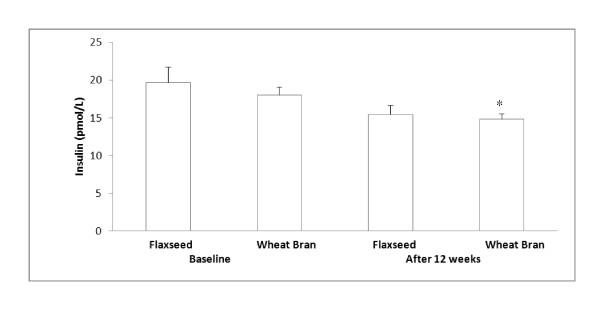
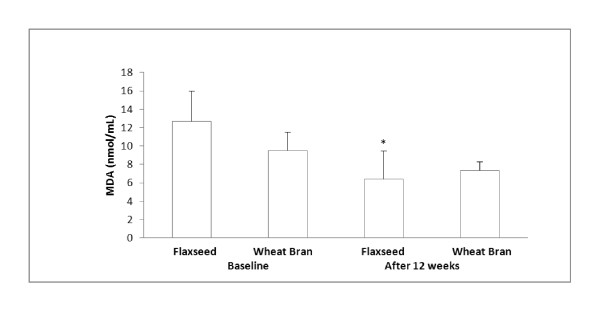
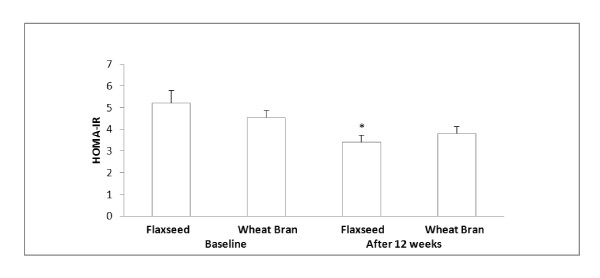
Using a randomized crossover design, nine obese glucose intolerant people consumed 40 g ground flaxseed or 40 g wheat bran daily for 12 weeks with a 4-week washout period. Plasma inflammation biomarkers (CRP, TNF-α, and IL-6), glucose, insulin, and thiobaribituric acid reactive substance (TBARS) were measured before and after of each supplementation.
Flaxseed supplementation decreased TBARS (p = 0.0215) and HOMA-IR (p = 0.0382). Flaxseed or wheat bran supplementation did not change plasma inflammatory biomarkers. A positive relationship was found between TBARS and HOMA-IR (r = 0.62, p = 0.0003).
The results of the study weakly support that decreased insulin resistance might have been secondary to antioxidant activity of flaxseed. However, the mechanism(s) of decreased insulin resistance by flaxseed should be further determined using flaxseed lignan.
肥胖会导致炎症和胰岛素抵抗增加。本研究旨在确定亚麻籽的抗氧化活性及其在肥胖糖耐量受损人群炎症和胰岛素抵抗中的作用。
采用随机交叉设计,9 名肥胖糖耐量受损者每天分别食用 40 克磨碎的亚麻籽或 40 克麦麸,持续 12 周,洗脱期为 4 周。在每次补充前后测量血浆炎症生物标志物(CRP、TNF-α 和 IL-6)、血糖、胰岛素和硫代巴比妥酸反应物质(TBARS)。
亚麻籽补充剂降低了 TBARS(p = 0.0215)和 HOMA-IR(p = 0.0382)。亚麻籽或麦麸补充剂并未改变血浆炎症生物标志物。TBARS 与 HOMA-IR 之间存在正相关关系(r = 0.62,p = 0.0003)。
研究结果弱支持亚麻籽的抗氧化活性可能是降低胰岛素抵抗的原因。然而,应该进一步使用亚麻籽木脂素确定亚麻籽降低胰岛素抵抗的机制。