Huntsman Cancer Institute, University of Utah, Salt Lake City, UT 84112, USA.
J Cell Biol. 2011 May 16;193(4):667-76. doi: 10.1083/jcb.201010075. Epub 2011 May 9.
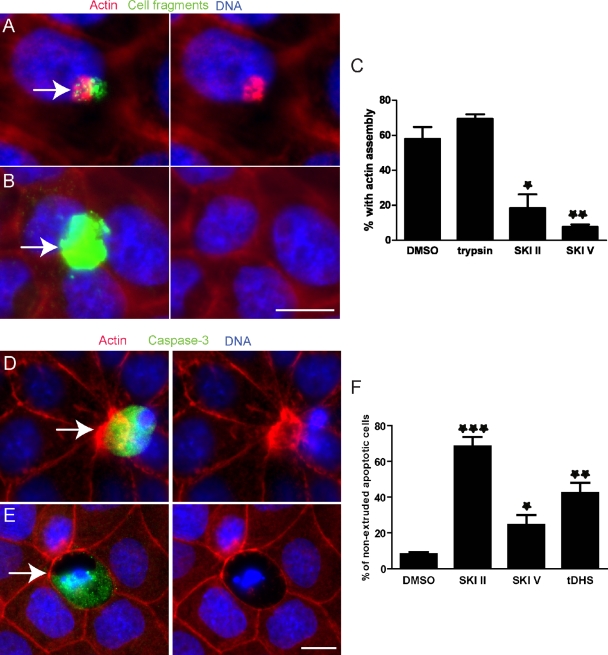
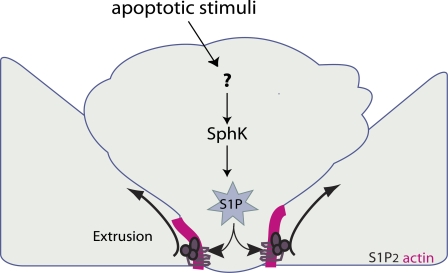
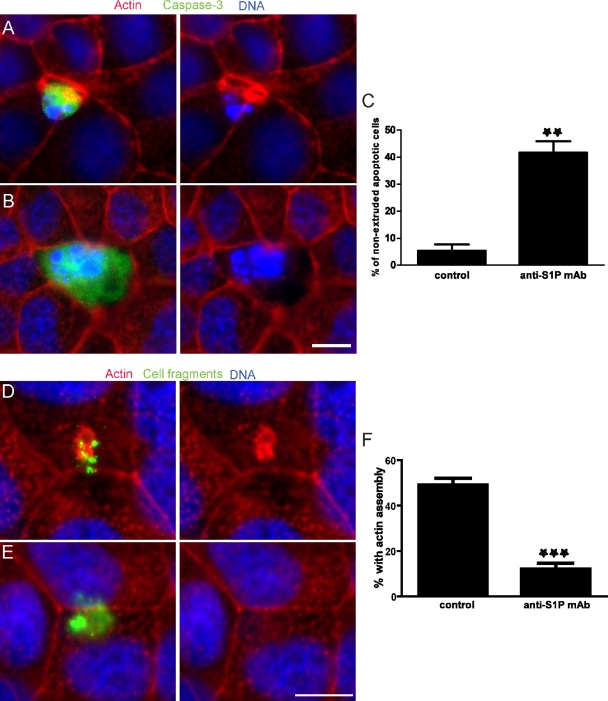
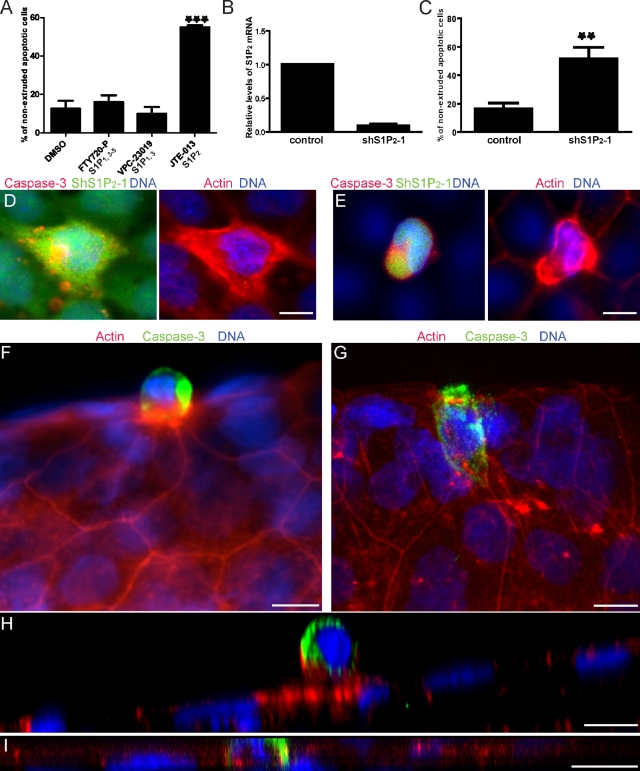
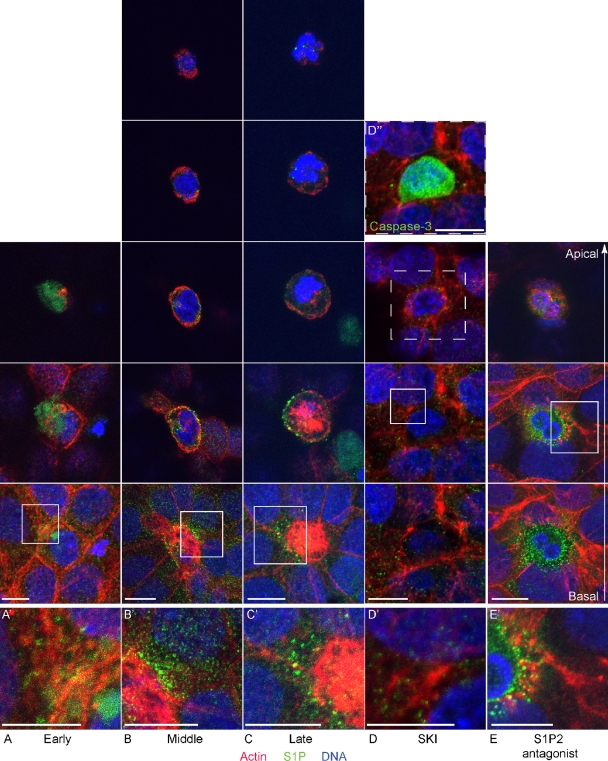
To maintain an intact barrier, epithelia eliminate dying cells by extrusion. During extrusion, a cell destined for apoptosis signals its neighboring cells to form and contract a ring of actin and myosin, which squeezes the dying cell out of the epithelium. Here, we demonstrate that the signal produced by dying cells to initiate this process is sphingosine-1-phosphate (S1P). Decreasing S1P synthesis by inhibiting sphingosine kinase activity or by blocking extracellular S1P access to its receptor prevented apoptotic cell extrusion. Extracellular S1P activates extrusion by binding the S1P(2) receptor in the cells neighboring a dying cell, as S1P(2) knockdown in these cells or its loss in a zebrafish mutant disrupted cell extrusion. Because live cells can also be extruded, we predict that this S1P pathway may also be important for driving delamination of stem cells during differentiation or invasion of cancer cells.
为了保持完整的屏障,上皮细胞通过挤出的方式来消除死亡的细胞。在挤出过程中,即将凋亡的细胞会向其邻近细胞发出信号,形成并收缩肌动蛋白和肌球蛋白的环,将死亡的细胞从上皮细胞中挤出。在这里,我们证明了由死亡细胞产生的信号来启动这个过程的是鞘氨醇-1-磷酸(S1P)。通过抑制鞘氨醇激酶活性或阻断细胞外 S1P 与其受体的接触来减少 S1P 的合成,可防止凋亡细胞的挤出。细胞外 S1P 通过与邻近死亡细胞的 S1P(2)受体结合来激活挤出,因为在这些细胞中敲低 S1P(2)或在斑马鱼突变体中缺失 S1P(2)会破坏细胞挤出。因为活细胞也可以被挤出,我们预测这个 S1P 途径在干细胞分化或癌细胞侵袭过程中推动细胞分层时也可能很重要。