Laboratory of Zoonotic Pathogens, National Institute of Allergy and Infectious Diseases, National Institutes of Health, Hamilton, Montana, United States of America.
PLoS One. 2011 Apr 29;6(4):e19267. doi: 10.1371/journal.pone.0019267.
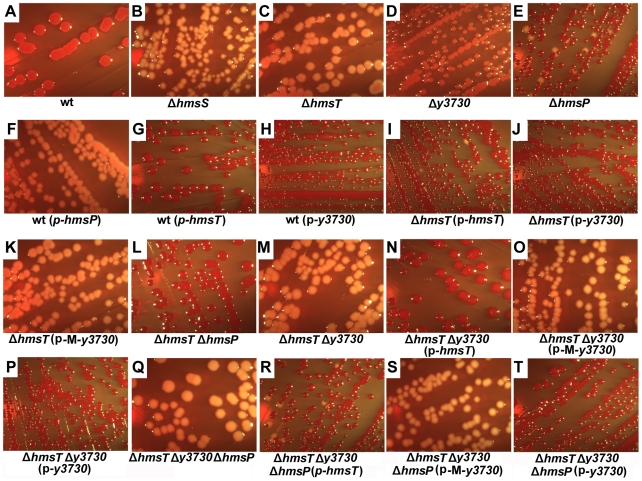
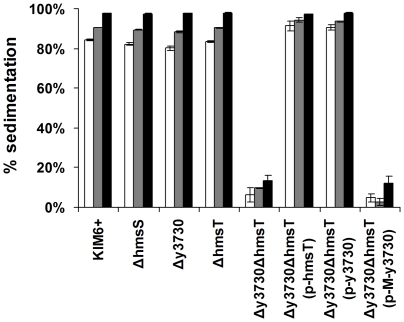
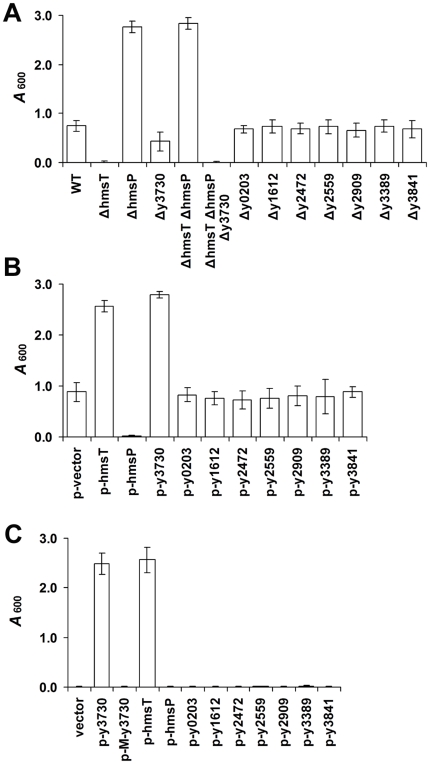
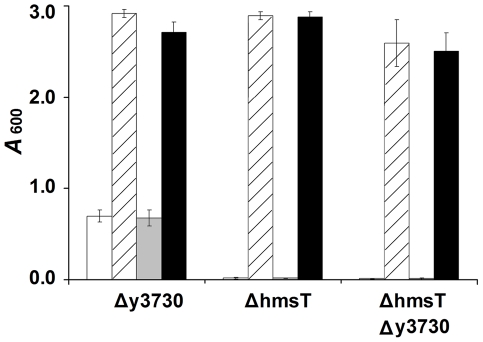
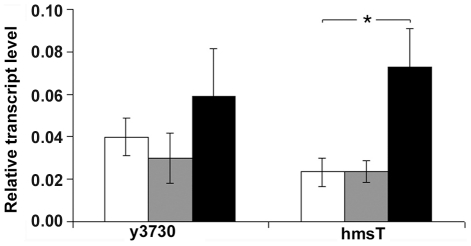
Yersinia pestis forms a biofilm in the foregut of its flea vector that promotes transmission by flea bite. As in many bacteria, biofilm formation in Y. pestis is controlled by intracellular levels of the bacterial second messenger c-di-GMP. Two Y. pestis diguanylate cyclase (DGC) enzymes, encoded by hmsT and y3730, and one phosphodiesterase (PDE), encoded by hmsP, have been shown to control biofilm production in vitro via their opposing c-di-GMP synthesis and degradation activities, respectively. In this study, we provide further evidence that hmsT, hmsP, and y3730 are the only three genes involved in c-di-GMP metabolism in Y. pestis and evaluated the two DGCs for their comparative roles in biofilm formation in vitro and in the flea vector. As with HmsT, the DGC activity of Y3730 depended on a catalytic GGDEF domain, but the relative contribution of the two enzymes to the biofilm phenotype was influenced strongly by the environmental niche. Deletion of y3730 had a very minor effect on in vitro biofilm formation, but resulted in greatly reduced biofilm formation in the flea. In contrast, the predominant effect of hmsT was on in vitro biofilm formation. DGC activity was also required for the Hms-independent autoaggregation phenotype of Y. pestis, but was not required for virulence in a mouse model of bubonic plague. Our results confirm that only one PDE (HmsP) and two DGCs (HmsT and Y3730) control c-di-GMP levels in Y. pestis, indicate that hmsT and y3730 are regulated post-transcriptionally to differentially control biofilm formation in vitro and in the flea vector, and identify a second c-di-GMP-regulated phenotype in Y. pestis.
鼠疫耶尔森氏菌在其跳蚤载体的前肠中形成生物膜,促进通过跳蚤叮咬的传播。与许多细菌一样,鼠疫耶尔森氏菌的生物膜形成受细菌第二信使 c-di-GMP 的细胞内水平控制。已经表明,两种鼠疫耶尔森氏菌双鸟苷酸环化酶(DGC)酶,由 hmsT 和 y3730 编码,和一种磷酸二酯酶(PDE),由 hmsP 编码,通过它们各自的 c-di-GMP 合成和降解活性来控制体外生物膜的产生。在这项研究中,我们提供了进一步的证据表明,hmsT、hmsP 和 y3730 是鼠疫耶尔森氏菌中唯一涉及 c-di-GMP 代谢的三个基因,并评估了这两个 DGC 在体外生物膜形成和跳蚤载体中的比较作用。与 HmsT 一样,Y3730 的 DGC 活性取决于催化 GGDEF 结构域,但两种酶对生物膜表型的相对贡献强烈受到环境小生境的影响。y3730 的缺失对体外生物膜形成的影响很小,但导致跳蚤中的生物膜形成大大减少。相比之下,hmsT 的主要作用是体外生物膜形成。DGC 活性也需要鼠疫耶尔森氏菌的 Hms 独立自聚集表型,但在鼠疫的小鼠模型中不需要毒力。我们的结果证实,只有一种 PDE(HmsP)和两种 DGC(HmsT 和 Y3730)控制鼠疫耶尔森氏菌中的 c-di-GMP 水平,表明 hmsT 和 y3730 是转录后调节的,以差异控制体外和跳蚤载体中的生物膜形成,并确定鼠疫耶尔森氏菌中的第二个 c-di-GMP 调节表型。