Department of Bioorganic Chemistry, Faculty of Chemistry, Wrocław University of Technology, Wybrzeże Wyspiańskiego 27, 50-370, Wrocław, Poland.
Amino Acids. 2012 May;42(5):1937-45. doi: 10.1007/s00726-011-0920-4. Epub 2011 May 11.
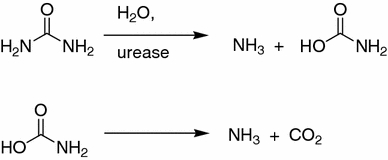
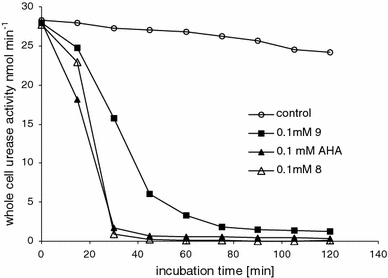
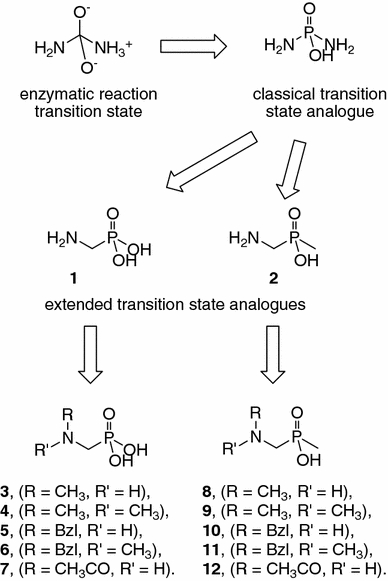
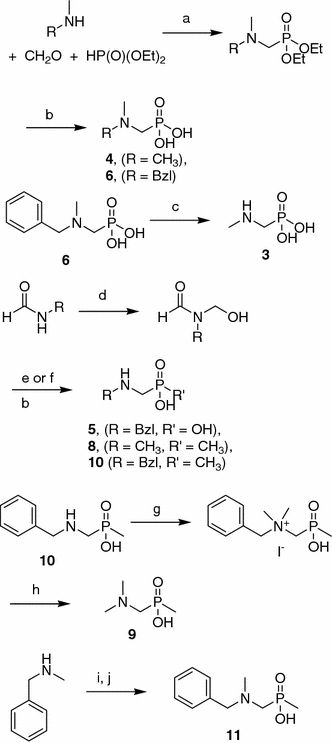
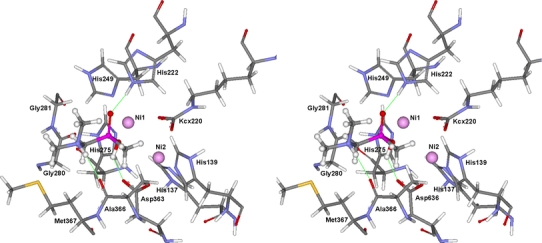
Small unextended molecules based on the diamidophosphate structure with a covalent carbon-to-phosphorus bond to improve hydrolytic stability were developed as a novel group of inhibitors to control microbial urea decomposition. Applying a structure-based inhibitor design approach using available crystal structures of bacterial urease, N-substituted derivatives of aminomethylphosphonic and P-methyl-aminomethylphosphinic acids were designed and synthesized. In inhibition studies using urease from Bacillus pasteurii and Canavalia ensiformis, the N,N-dimethyl derivatives of both lead structures were most effective with dissociation constants in the low micromolar range (Ki=13±0.8 and 0.62±0.09 μM, respectively). Whole-cell studies on a ureolytic strain of Proteus mirabilis showed the high efficiency of N,N-dimethyl and N-methyl derivatives of aminomethane-P-methylphosphinic acids for urease inhibition in pathogenic bacteria. The high hydrolytic stability of selected inhibitors was confirmed over a period of 30 days using NMR technique.
基于二氨基磷酸结构的小分子,通过共价碳-磷键连接,提高了水解稳定性,被开发为一种新型的抑制剂,用于控制微生物尿素分解。应用基于结构的抑制剂设计方法,利用细菌脲酶的现有晶体结构,设计并合成了氨基甲基膦酸和 P-甲基-氨基甲基膦酸的 N-取代衍生物。在使用巴斯德氏芽孢杆菌和刀豆脲酶的抑制研究中,两种主要结构的 N,N-二甲基衍生物的抑制效果最为显著,其离解常数均在低微摩尔范围内(Ki=13±0.8 和 0.62±0.09 μM)。对变形杆菌属溶脲菌的全细胞研究表明,氨基甲烷-P-甲基膦酸的 N,N-二甲基和 N-甲基衍生物对致病菌脲酶的抑制作用非常高效。通过 NMR 技术在 30 天的时间内证实了选定抑制剂的高水解稳定性。