Division of Adult and Community Health, National Center for Chronic Disease Prevention and Health Promotion, Centers for Disease Control and Prevention, 4770 Buford Highway NE, Mailstop K-67, Atlanta, GA 30041, USA.
BMC Public Health. 2011 May 10;11:295. doi: 10.1186/1471-2458-11-295.
Over the past 50 years, the average sleep duration for adults in the United States has decreased while the prevalence of obesity and associated outcomes has increased. The objective of this study was to determine whether perceived insufficient sleep was associated with body mass index (BMI) in a national sample.
We analyzed data from the 2008 Behavioral Risk Factor Surveillance System (BRFSS) survey (N=384,541) in which respondents were asked, "During the past 30 days, for about how many days have you felt you did not get enough rest or sleep?" We divided respondents into six BMI categories and used multivariable linear regression and logistic regression analyses to assess the association between BMI categories and days of insufficient sleep after adjusting for sociodemographic variables, smoking, physical activity, and frequent mental distress.
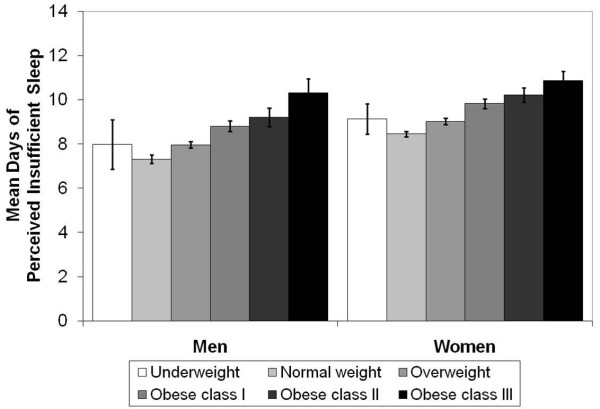
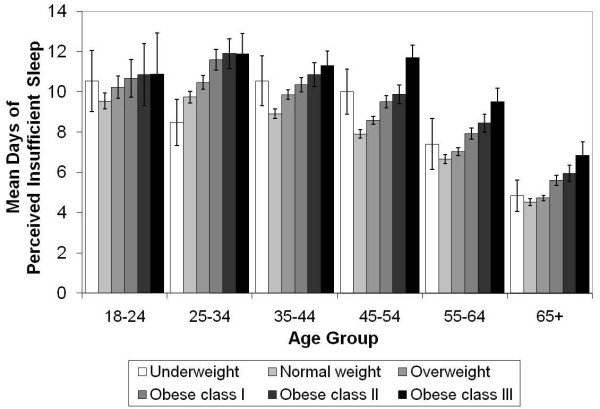
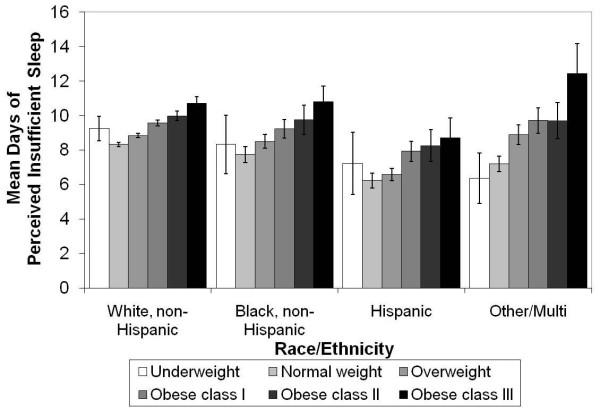
Adjusted mean days of insufficient sleep ranged from 7.9 (95% confidence interval [CI]: 7.8, 8.0) days for people of normal weight to 10.5 (95% CI: 10.2, 10.9) days for those in the highest weight category (BMI≥40). Days of perceived insufficient sleep followed a linear trend across BMI categories. The likelihood of reporting ≥14 days of insufficient sleep in the previous 30 days was higher for respondents in the highest weight category than for those who were normal weight (34.9% vs. 25.2%; adjusted odds ratio=1.7 (95% CI: 1.5, 1.8]).
Among U.S. adults, days of insufficient rest or sleep strongly correlated with BMI. Sleep sufficiency should be an important consideration in the assessment of the health of overweight and obese people and should be considered by developers of weight-reduction programs.
在过去的 50 年中,美国成年人的平均睡眠时间减少,而肥胖症及其相关后果的患病率却有所增加。本研究旨在确定在全国样本中,是否感觉到睡眠不足与体重指数(BMI)有关。
我们分析了 2008 年行为风险因素监测系统(BRFSS)调查的数据(N=384541),其中要求受访者回答:“在过去的 30 天中,您大约有多少天感到休息或睡眠不足?”我们将受访者分为六个 BMI 类别,并使用多变量线性回归和逻辑回归分析来评估 BMI 类别与睡眠不足天数之间的关联,同时调整了社会人口统计学变量、吸烟、身体活动和频繁的精神困扰。
调整后的平均睡眠不足天数从正常体重人群的 7.9 天(95%置信区间[CI]:7.8,8.0)到最高体重人群的 10.5 天(95%CI:10.2,10.9)。在 BMI 类别中,感觉到的睡眠不足天数呈线性趋势。在过去的 30 天内,报告睡眠不足≥14 天的可能性在最高体重类别中的受访者中高于体重正常的受访者(34.9%比 25.2%;调整后的优势比=1.7(95%CI:1.5,1.8))。
在美国成年人中,休息或睡眠不足的天数与 BMI 密切相关。在评估超重和肥胖人群的健康状况时,睡眠充足应该是一个重要的考虑因素,并且应该由体重减轻计划的制定者考虑。