Holt James B, Zhang Xingyou, Sizov Natalia, Croft Janet B
Centers for Disease Control and Prevention, 4770 Buford Hwy NE, Mailstop F-78, Atlanta, GA 30341-3717. Email:
Centers for Disease Control and Prevention, Atlanta, Georgia.
Prev Chronic Dis. 2015 Apr 16;12:E49. doi: 10.5888/pcd12.140551.
Sleep insufficiency is a major health risk factor. Exposure to environmental noise may affect sleep duration and quality. The objective of this study was to assess the relationship between airport noise exposure and insufficient sleep in the United States by using data from the Behavioral Risk Factor Surveillance System (BRFSS).
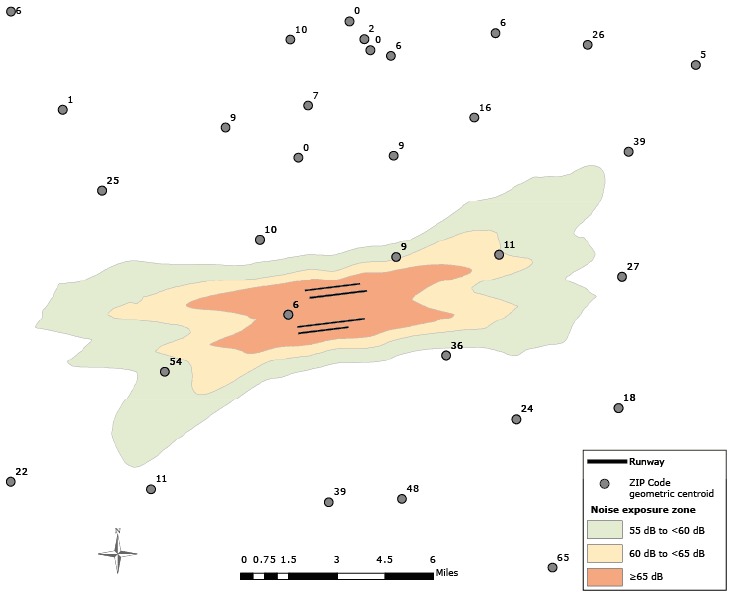
Data on the number of days without enough rest or sleep for approximately 750,000 respondents to the 2008 and 2009 BRFSS were linked with data on noise exposure modeled using the US Federal Aviation Administration's (FAA's) Integrated Noise Model for 95 major US airports for corresponding years. Noise exposure data were stratified into 3 groups depending on noise levels. People living outside airport noise exposure zones were included as a reference category.
We found 8.6 mean days of insufficient sleep in the previous 30 days among 745,868 adults; 10.8% reported insufficient sleep for all 30 days; and 30.1% reported no days of insufficient sleep. After controlling for individual sociodemographics and ZIP Code-level socioeconomic status, we found no significant differences in sleep insufficiency between the 3 noise exposure zones and the zone outside.
This research demonstrates the feasibility of conducting a national study of airport noise and sleep using an existing public health surveillance dataset and recommends methods for improving the accuracy of such studies; some of these recommendations were implemented in recent FAA-sponsored studies. Validation of BRFSS sleep measures and refined ways of collecting data are needed to determine the optimal measures of sleep for such a large-scale survey and to establish the relationship between airport noise and sleep.
睡眠不足是一个主要的健康风险因素。暴露于环境噪声中可能会影响睡眠时间和质量。本研究的目的是利用行为风险因素监测系统(BRFSS)的数据,评估美国机场噪声暴露与睡眠不足之间的关系。
将2008年和2009年BRFSS中约75万名受访者的休息或睡眠时间不足天数的数据,与使用美国联邦航空管理局(FAA)的综合噪声模型为美国95个主要机场模拟的相应年份噪声暴露数据相链接。根据噪声水平,将噪声暴露数据分为3组。将居住在机场噪声暴露区以外的人群作为参照组。
我们在745868名成年人中发现,过去30天平均有8.6天睡眠不足;10.8%的人报告30天睡眠均不足;30.1%的人报告没有睡眠不足的天数。在控制了个体社会人口统计学和邮政编码级别的社会经济地位后,我们发现3个噪声暴露区与外部区域在睡眠不足方面没有显著差异。
本研究证明了利用现有的公共卫生监测数据集开展全国性机场噪声与睡眠研究的可行性,并推荐了提高此类研究准确性的方法;美国联邦航空管理局最近资助的一些研究已实施了其中一些建议。需要对BRFSS睡眠测量方法进行验证,并改进数据收集方式,以确定如此大规模调查的最佳睡眠测量方法,并建立机场噪声与睡眠之间的关系。