Ministry of Health and Social Welfare, Monrovia, Liberia.
Hum Resour Health. 2011 May 12;9:11. doi: 10.1186/1478-4491-9-11.
Following twenty years of economic and social growth, Liberia's fourteen-year civil war destroyed its health system, with most of the health workforce leaving the country. Following the inauguration of the Sirleaf administration in 2006, the Ministry of Health & Social Welfare (MOHSW) has focused on rebuilding, with an emphasis on increasing the size and capacity of its human resources for health (HRH). Given resource constraints and the high maternal and neonatal mortality rates, MOHSW concentrated on its largest cadre of health workers: nurses.
Based on results from a post-war rapid assessment of health workers, facilities and community access, MOHSW developed the Emergency Human Resources (HR) Plan for 2007-2011. MOHSW established a central HR Unit and county-level HR officers and prioritized nursing cadres in order to quickly increase workforce numbers, improve equitable distribution of workers and enhance performance. Strategies included increasing and standardizing salaries to attract workers and prevent outflow to the private sector; mobilizing donor funds to improve management capacity and fund incentive packages in order to retain staff in hard to reach areas; reopening training institutions and providing scholarships to increase the pool of available workers.
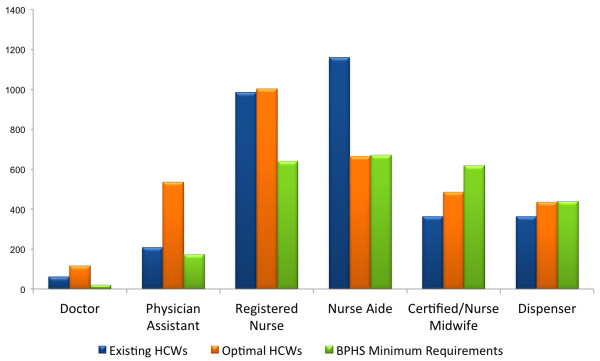
MOHSW has increased the total number of clinical health workers from 1396 in 1998 to 4653 in 2010, 3394 of which are nurses and midwives. From 2006 to 2010, the number of nurses has more than doubled. Certified midwives and nurse aides also increased by 28% and 31% respectively. In 2010, the percentage of the clinical workforce made up by nurses and nurse aides increased to 73%. While the nursing cadre numbers are strong and demonstrate significant improvement since the creation of the Emergency HR Plan, equitable distribution, retention and performance management continue to be challenges.
This paper illustrates the process, successes, ongoing challenges and current strategies Liberia has used to increase and improve HRH since 2006, particularly the nursing workforce. The methods used here and lessons learned might be applied in other similar settings.
在经历了二十年的经济和社会增长之后,利比里亚长达十四年的内战摧毁了其医疗体系,大部分医疗工作者都离开了这个国家。2006 年,瑟利夫政府就职后,卫生部和社会福利部(MOHSW)专注于重建工作,重点是增加其卫生人力(HRH)的规模和能力。鉴于资源有限以及高孕产妇和新生儿死亡率,MOHSW 集中精力培养其最大的卫生工作者群体:护士。
根据战后对卫生工作者、设施和社区获得情况的快速评估结果,MOHSW 制定了 2007-2011 年紧急人力资源(HR)计划。MOHSW 设立了中央人力资源股和县级人力资源干事,并优先考虑护理干部,以快速增加劳动力人数,改善工作人员的公平分配,并提高绩效。策略包括提高和规范工资以吸引工人并防止流向私营部门;调动捐助资金以提高管理能力并为难以到达的地区的工作人员提供一揽子激励措施;重新开放培训机构并提供奖学金以增加可用工人人数。
MOHSW 已将临床卫生工作者的总数从 1998 年的 1396 人增加到 2010 年的 4653 人,其中 3394 人为护士和助产士。从 2006 年到 2010 年,护士人数增加了一倍多。认证助产士和护士助手也分别增加了 28%和 31%。2010 年,临床工作人员中护士和护士助手的比例增加到 73%。虽然护理干部人数强劲,并且自紧急人力资源计划创建以来显示出显著改善,但公平分配、留用和绩效管理仍然是挑战。
本文说明了利比里亚自 2006 年以来为增加和改善人力资源(尤其是护理人员)而采取的过程、成功、持续挑战和当前战略。此处使用的方法和经验教训可能适用于其他类似情况。