Accident and Emergency Medicine Academic Unit, Chinese University of Hong Kong, Hong Kong, China.
Collaborating Centre for Oxford University and Chinese University of Hong Kong for Disaster and Medical Humanitarian Response (CCOUC), School of Public Health and Primary Care, The Chinese University of Hong Kong, Hong Kong, China.
Int J Environ Res Public Health. 2021 Mar 24;18(7):3382. doi: 10.3390/ijerph18073382.
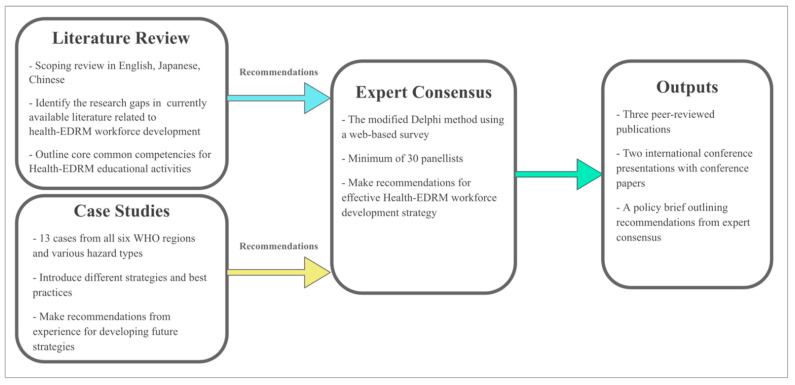
The Sendai Framework for Disaster Risk Reduction 2015-2030 placed human health at the centre of disaster risk reduction, calling for the global community to enhance local and national health emergency and disaster risk management (Health EDRM). The Health EDRM Framework, published in 2019, describes the functions required for comprehensive disaster risk management across prevention, preparedness, readiness, response, and recovery to improve the resilience and health security of communities, countries, and health systems. Evidence-based Health EDRM workforce development is vital. However, there are still significant gaps in the evidence identifying common competencies for training and education programmes, and the clarification of strategies for workforce retention, motivation, deployment, and coordination. Initiated in June 2020, this project includes literature reviews, case studies, and an expert consensus (modified Delphi) study. Literature reviews in English, Japanese, and Chinese aim to identify research gaps and explore core competencies for Health EDRM workforce training. Thirteen Health EDRM related case studies from six WHO regions will illustrate best practices (and pitfalls) and inform the consensus study. Consensus will be sought from global experts in emergency and disaster medicine, nursing, public health and related disciplines. Recommendations for developing effective health workforce strategies for low- and middle-income countries and high-income countries will then be disseminated.
《2015-2030 年仙台减少灾害风险框架》将人类健康置于减少灾害风险的核心位置,呼吁全球社会加强地方和国家卫生应急和灾害风险管理(卫生应急和灾害风险管理)。2019 年发布的《卫生应急和灾害风险管理框架》描述了在预防、准备、备灾、应对和恢复等方面全面管理灾害风险所需的职能,以提高社区、国家和卫生系统的复原力和健康保障。基于证据的卫生应急和灾害风险管理劳动力发展至关重要。然而,在确定培训和教育计划共同能力的证据方面,以及在明确劳动力留用、激励、部署和协调战略方面,仍然存在重大差距。该项目于 2020 年 6 月启动,包括文献综述、案例研究和专家共识(修改后的德尔菲法)研究。英文、日文和中文的文献综述旨在确定研究差距,并探讨卫生应急和灾害风险管理劳动力培训的核心能力。来自世卫组织六个区域的 13 个卫生应急和灾害管理相关案例研究将说明最佳做法(和陷阱),并为共识研究提供信息。将向紧急和灾害医学、护理、公共卫生和相关学科的全球专家征求意见。然后将为中低收入国家和高收入国家制定有效的卫生人力战略提出建议。