Laboratory of Malaria and Vector Research, National Institutes of Allergy and Infectious Diseases, National Institutes of Health, Rockville, Maryland, United States of America.
PLoS Negl Trop Dis. 2011 May 10;5(5):e1139. doi: 10.1371/journal.pntd.0001139.
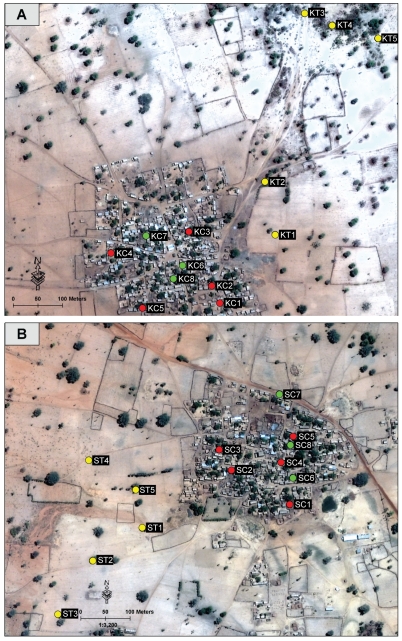
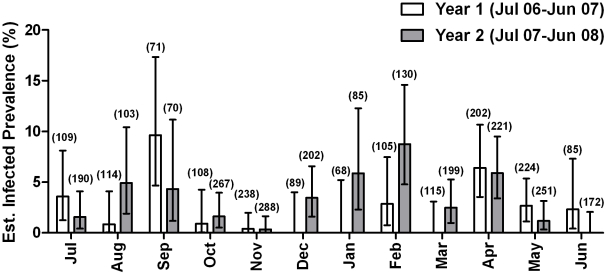
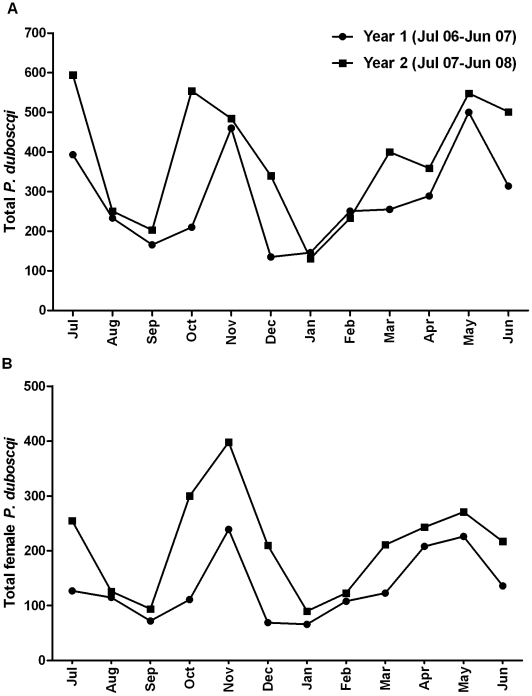
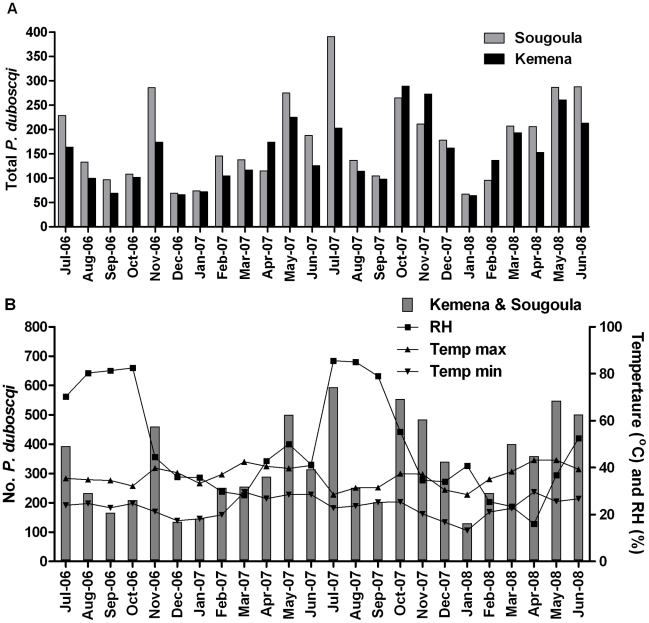
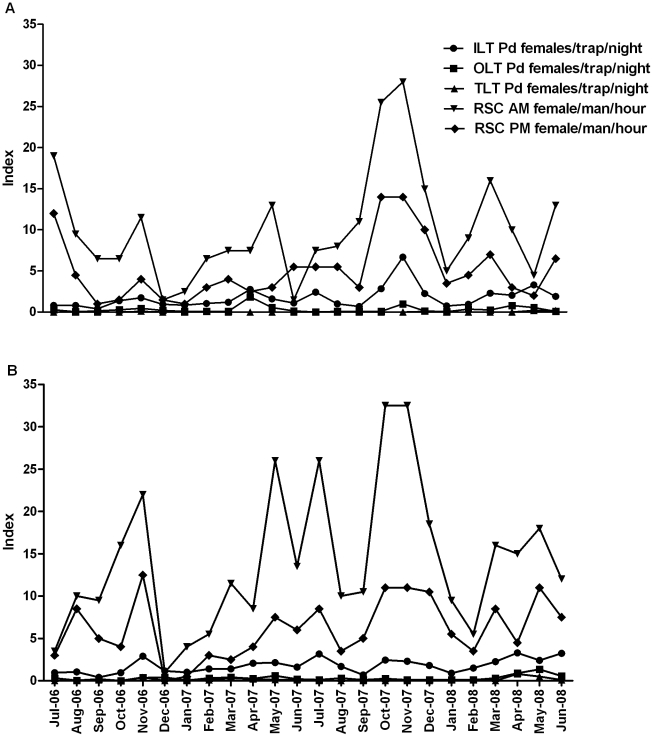
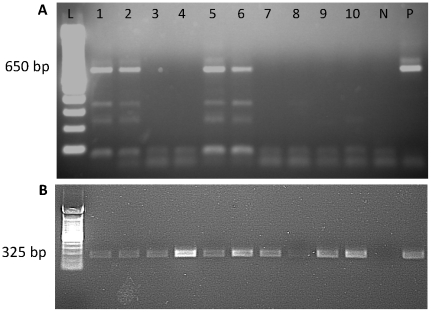
Phlebotomus duboscqi is the principle vector of Leishmania major, the causative agent of cutaneous leishmaniasis (CL), in West Africa and is the suspected vector in Mali. Although found throughout the country the seasonality and infection prevalence of P. duboscqi has not been established in Mali. We conducted a three year study in two neighboring villages, Kemena and Sougoula, in Central Mali, an area with a leishmanin skin test positivity of up to 45%. During the first year, we evaluated the overall diversity of sand flies. Of 18,595 flies collected, 12,952 (69%) belonged to 12 species of Sergentomyia and 5,643 (31%) to two species of the genus Phlebotomus, P. duboscqi and P. rodhaini. Of those, P. duboscqi was the most abundant, representing 99% of the collected Phlebotomus species. P. duboscqi was the primary sand fly collected inside dwellings, mostly by resting site collection. The seasonality and infection prevalence of P. duboscqi was monitored over two consecutive years. P. dubsocqi were collected throughout the year. Using a quasi-Poisson model we observed a significant annual (year 1 to year 2), seasonal (monthly) and village effect (Kemena versus Sougoula) on the number of collected P. duboscqi. The significant seasonal effect of the quasi-Poisson model reflects two seasonal collection peaks in May-July and October-November. The infection status of pooled P. duboscqi females was determined by PCR. The infection prevalence of pooled females, estimated using the maximum likelihood estimate of prevalence, was 2.7% in Kemena and Sougoula. Based on the PCR product size, L. major was identified as the only species found in flies from the two villages. This was confirmed by sequence alignment of a subset of PCR products from infected flies to known Leishmania species, incriminating P. duboscqi as the vector of CL in Mali.
在西非,白蛉属的杜氏白蛉是导致皮肤利什曼病(CL)的主要病媒,也是马里疑似病媒。尽管在全国各地都有发现,但杜氏白蛉的季节性和感染流行率在马里尚未确定。我们在马里中部的两个邻近村庄 Kemena 和 Sougoula 进行了为期三年的研究,该地区的利什曼皮肤试验阳性率高达 45%。在第一年,我们评估了沙蝇的整体多样性。在所收集的 18595 只苍蝇中,12952 只(69%)属于 12 种塞氏白蛉属,5643 只(31%)属于 2 种白蛉属,即杜氏白蛉和罗哈尼白蛉。其中,杜氏白蛉最为丰富,占所收集的白蛉种类的 99%。杜氏白蛉是在住宅内收集到的主要沙蝇,主要通过休息点收集。在接下来的两年里,监测了杜氏白蛉的季节性和感染流行率。杜氏白蛉全年都有采集。使用拟泊松模型,我们观察到收集到的杜氏白蛉数量存在显著的年度(第 1 年到第 2 年)、季节性(每月)和村庄效应(Kemena 与 Sougoula)。拟泊松模型的显著季节性效应反映了 5 月至 7 月和 10 月至 11 月的两个季节性采集高峰。混合雌性杜氏白蛉的感染状况通过 PCR 确定。使用流行率最大似然估计估计的混合雌性白蛉的感染流行率在 Kemena 和 Sougoula 分别为 2.7%。根据 PCR 产物大小,鉴定出只有两种物种在来自两个村庄的苍蝇中发现,通过将感染苍蝇的 PCR 产物的一部分与已知的利什曼物种进行序列比对,证实了杜氏白蛉是马里 CL 的媒介。