Department of Sports Medicine and Nutrition, University of Pittsburgh, Pittsburgh, Pennsylvania, United States of America.
PLoS One. 2011 May 10;6(5):e19424. doi: 10.1371/journal.pone.0019424.
Complex biological processes such as acute inflammation induced by trauma/hemorrhagic shock/ (T/HS) are dynamic and multi-dimensional. We utilized multiplexing cytokine analysis coupled with data-driven modeling to gain a systems perspective into T/HS.
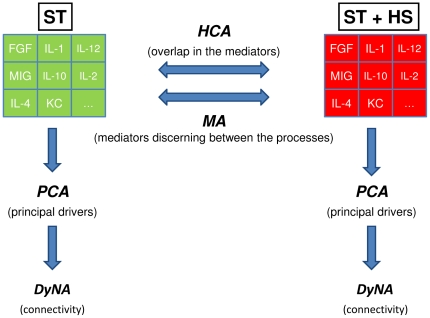
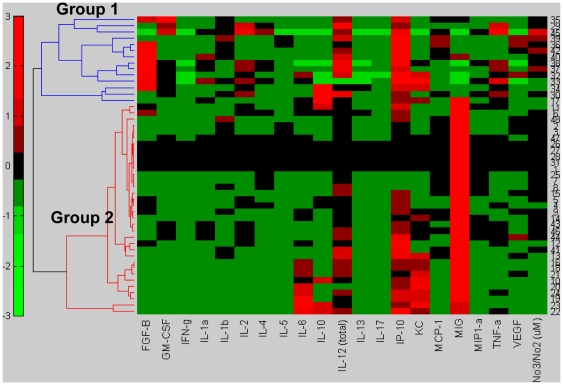
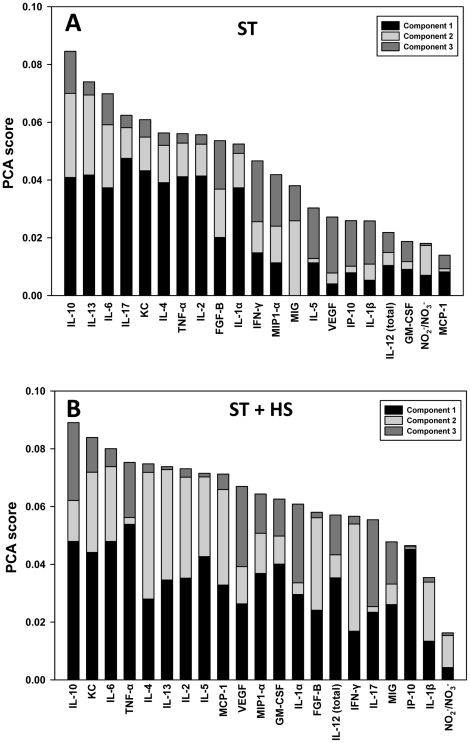
METHODOLOGY/PRINCIPAL FINDINGS: Mice were subjected to surgical cannulation trauma (ST) ± hemorrhagic shock (HS; 25 mmHg), and followed for 1, 2, 3, or 4 h in each case. Serum was assayed for 20 cytokines and NO(2) (-)/NO(3) (-). These data were analyzed using four data-driven methods (Hierarchical Clustering Analysis [HCA], multivariate analysis [MA], Principal Component Analysis [PCA], and Dynamic Network Analysis [DyNA]). Using HCA, animals subjected to ST vs. ST + HS could be partially segregated based on inflammatory mediator profiles, despite a large overlap. Based on MA, interleukin [IL]-12p40/p70 (IL-12.total), monokine induced by interferon-γ (CXCL-9) [MIG], and IP-10 were the best discriminators between ST and ST/HS. PCA suggested that the inflammatory mediators found in the three main principal components in animals subjected to ST were IL-6, IL-10, and IL-13, while the three principal components in ST + HS included a large number of cytokines including IL-6, IL-10, keratinocyte-derived cytokine (CXCL-1) [KC], and tumor necrosis factor-α [TNF-α]. DyNA suggested that the circulating mediators produced in response to ST were characterized by a high degree of interconnection/complexity at all time points; the response to ST + HS consisted of different central nodes, and exhibited zero network density over the first 2 h with lesser connectivity vs. ST at all time points. DyNA also helped link the conclusions from MA and PCA, in that central nodes consisting of IP-10 and IL-12 were seen in ST, while MIG and IL-6 were central nodes in ST + HS.
CONCLUSIONS/SIGNIFICANCE: These studies help elucidate the dynamics of T/HS-induced inflammation, complementing other forms of dynamic mechanistic modeling. These methods should be applicable to the analysis of other complex biological processes.
创伤/出血性休克(T/HS)引起的急性炎症等复杂的生物学过程是动态的和多维的。我们利用多重细胞因子分析结合数据驱动的建模方法,从系统的角度研究 T/HS。
方法/主要发现:对小鼠进行手术插管创伤(ST)±出血性休克(HS;25mmHg),每种情况分别在 1、2、3 或 4 小时后进行后续检测。检测血清中的 20 种细胞因子和 NO2(-)/NO3(-)。使用四种数据驱动方法(层次聚类分析[HCA]、多元分析[MA]、主成分分析[PCA]和动态网络分析[DyNA])分析这些数据。使用 HCA,尽管存在很大的重叠,但根据炎症介质谱,ST 与 ST+HS 处理的动物可以部分分离。基于 MA,白细胞介素[IL]-12p40/p70(IL-12.total)、干扰素-γ诱导的单核细胞趋化蛋白[CXCL-9](MIG)和 IP-10 是 ST 与 ST/HS 之间最好的区分物。PCA 表明,ST 动物三个主要主成分中的炎症介质为 IL-6、IL-10 和 IL-13,而 ST+HS 中的三个主成分包括大量细胞因子,包括 IL-6、IL-10、角质形成细胞衍生的细胞因子[CXCL-1](KC)和肿瘤坏死因子-α[TNF-α]。DyNA 表明,对 ST 的反应所产生的循环介质在所有时间点都具有高度的互联/复杂性;ST+HS 的反应由不同的中心节点组成,在最初的 2 小时内网络密度为零,与所有时间点的 ST 相比连接性较低。DyNA 还帮助将 MA 和 PCA 的结论联系起来,即 IP-10 和 IL-12 组成的中心节点出现在 ST 中,而 MIG 和 IL-6 是 ST+HS 的中心节点。
结论/意义:这些研究有助于阐明 T/HS 诱导的炎症的动态变化,补充了其他形式的动态机制建模。这些方法应该适用于其他复杂生物学过程的分析。