Section of Bacterial Pathogenesis, Graduate School of Medical and Dental Sciences, Tokyo Medical and Dental University, Tokyo, Japan.
PLoS One. 2011 May 6;6(5):e19543. doi: 10.1371/journal.pone.0019543.
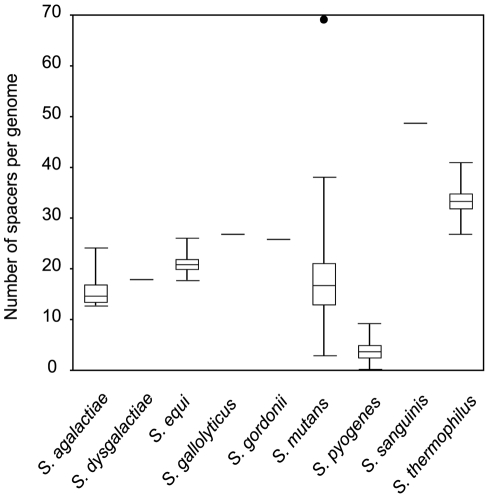
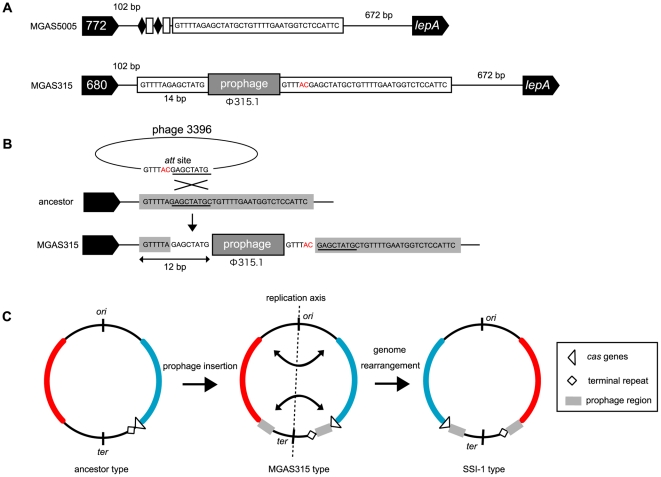
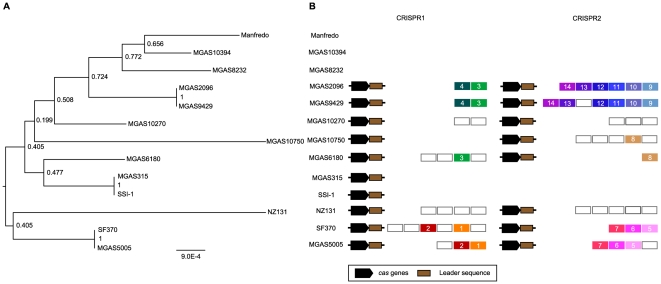
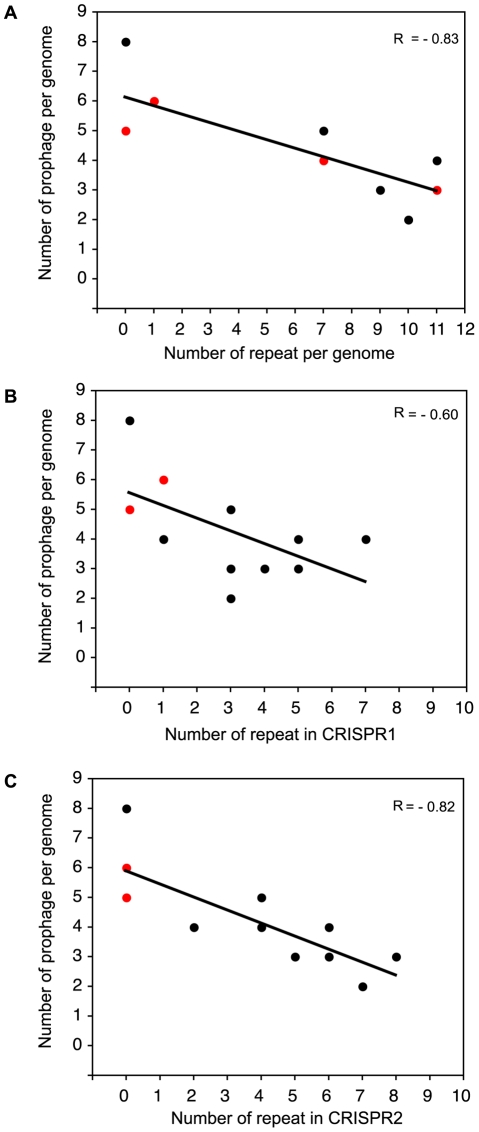
Streptococcus pyogenes, one of the major human pathogens, is a unique species since it has acquired diverse strain-specific virulence properties mainly through the acquisition of streptococcal prophages. In addition, S. pyogenes possesses clustered regularly interspaced short palindromic repeats (CRISPR)/Cas systems that can restrict horizontal gene transfer (HGT) including phage insertion. Therefore, it was of interest to examine the relationship between CRISPR and acquisition of prophages in S. pyogenes. Although two distinct CRISPR loci were found in S. pyogenes, some strains lacked CRISPR and these strains possess significantly more prophages than CRISPR harboring strains. We also found that the number of spacers of S. pyogenes CRISPR was less than for other streptococci. The demonstrated spacer contents, however, suggested that the CRISPR appear to limit phage insertions. In addition, we found a significant inverse correlation between the number of spacers and prophages in S. pyogenes. It was therefore suggested that S. pyogenes CRISPR have permitted phage insertion by lacking its own spacers. Interestingly, in two closely related S. pyogenes strains (SSI-1 and MGAS315), CRISPR activity appeared to be impaired following the insertion of phage genomes into the repeat sequences. Detailed analysis of this prophage insertion site suggested that MGAS315 is the ancestral strain of SSI-1. As a result of analysis of 35 additional streptococcal genomes, it was suggested that the influences of the CRISPR on the phage insertion vary among species even within the same genus. Our results suggested that limitations in CRISPR content could explain the characteristic acquisition of prophages and might contribute to strain-specific pathogenesis in S. pyogenes.
化脓链球菌是主要的人类病原体之一,它是一种独特的物种,因为它主要通过获得链球菌噬菌体获得了多样化的菌株特异性毒力特性。此外,化脓链球菌拥有成簇的规律间隔短回文重复序列(CRISPR)/Cas 系统,可限制包括噬菌体插入在内的水平基因转移(HGT)。因此,研究化脓链球菌中 CRISPR 与噬菌体获得之间的关系是很有意义的。尽管在化脓链球菌中发现了两个不同的 CRISPR 基因座,但有些菌株缺乏 CRISPR,这些菌株拥有的噬菌体明显多于携带 CRISPR 的菌株。我们还发现化脓链球菌 CRISPR 的间隔子数量少于其他链球菌。然而,所展示的间隔子含量表明 CRISPR 似乎限制了噬菌体的插入。此外,我们发现化脓链球菌中 CRISPR 的间隔子数量与噬菌体之间存在显著的负相关。因此,推测化脓链球菌 CRISPR 通过缺乏自身的间隔子允许噬菌体插入。有趣的是,在两个密切相关的化脓链球菌菌株(SSI-1 和 MGAS315)中,噬菌体基因组插入重复序列后,CRISPR 活性似乎受到了损害。对该噬菌体插入位点的详细分析表明,MGAS315 是 SSI-1 的原始菌株。通过对 35 个额外的链球菌基因组进行分析,表明 CRISPR 对噬菌体插入的影响在不同物种甚至同一属内都有所不同。我们的研究结果表明,CRISPR 含量的限制可以解释噬菌体获得的特征,并可能导致化脓链球菌中菌株特异性发病机制。