Department of Vertebrate Zoology and Anthropology and Center for Comparative Genomics, California Academy of Sciences, San Francisco, California, United States of America.
PLoS One. 2011 May 6;6(5):e19479. doi: 10.1371/journal.pone.0019479.
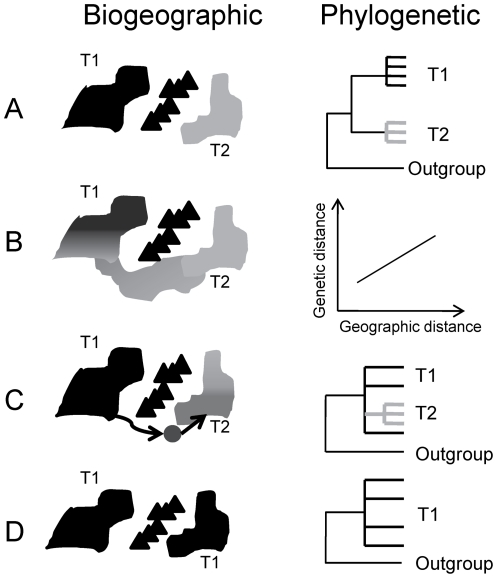
New Guinea is a biologically diverse island, with a unique geologic history and topography that has likely played a role in the evolution of species. Few island-wide studies, however, have examined the phylogeographic history of lowland species. The objective of this study was to examine patterns of phylogeographic variation of a common and widespread New Guinean bird species (Colluricincla megarhyncha). Specifically, we test the mechanisms hypothesized to cause geographic and genetic variation (e.g., vicariance, isolation by distance and founder-effect with dispersal). To accomplish this, we surveyed three regions of the mitochondrial genome and a nuclear intron and assessed differences among 23 of the 30 described subspecies from throughout their range. We found support for eight highly divergent lineages within C. megarhyncha. Genetic lineages were found within continuous lowland habitat or on smaller islands, but all individuals within clades were not necessarily structured by predicted biogeographic barriers. There was some evidence of isolation by distance and potential founder-effects. Mitochondrial DNA sequence divergence among lineages was at a level often observed among different species or even genera of birds (5-11%), suggesting lineages within regions have been isolated for long periods of time. When topographical barriers were associated with divergence patterns, the estimated divergence date for the clade coincided with the estimated time of barrier formation. We also found that dispersal distance and range size are positively correlated across lineages. Evidence from this research suggests that different phylogeographic mechanisms concurrently structure lineages of C. megarhyncha and are not mutually exclusive. These lineages are a result of evolutionary forces acting at different temporal and spatial scales concordant with New Guinea's geological history.
新几内亚是一个生物多样性丰富的岛屿,其独特的地质历史和地形可能在物种进化中发挥了作用。然而,很少有全岛范围的研究检查过低地物种的系统地理历史。本研究的目的是研究一种常见且广泛分布于新几内亚的鸟类(Colluricincla megarhyncha)的系统地理变异模式。具体来说,我们测试了导致地理和遗传变异的假设机制(例如,地理隔离、距离隔离和带有扩散的奠基者效应)。为此,我们调查了线粒体基因组的三个区域和一个核内含子,并评估了在其整个范围内的 30 个描述亚种中的 23 个亚种之间的差异。我们在 C. megarhyncha 内发现了 8 个高度分化的谱系的支持。遗传谱系存在于连续的低地生境或较小的岛屿上,但分支内的所有个体不一定按预测的生物地理障碍进行构建。有一些证据表明存在距离隔离和潜在的奠基者效应。谱系之间的线粒体 DNA 序列差异处于鸟类不同物种甚至属之间经常观察到的水平(5-11%),表明区域内的谱系已经隔离了很长时间。当地形障碍与分化模式相关时,分支的估计分化日期与屏障形成的估计时间相符。我们还发现,扩散距离和范围大小在谱系之间呈正相关。来自这项研究的证据表明,不同的系统地理机制同时构建了 C. megarhyncha 的谱系,而不是相互排斥的。这些谱系是新几内亚地质历史上不同时间和空间尺度上的进化力量作用的结果。