Feenstra V, Hodaie M, Johnson D C
Department of Pathology, McMaster University, Hamilton, Ontario, Canada.
J Virol. 1990 May;64(5):2096-102. doi: 10.1128/JVI.64.5.2096-2102.1990.
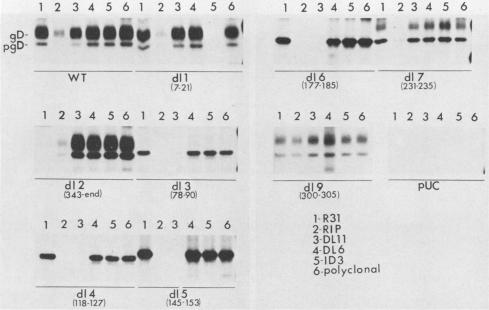
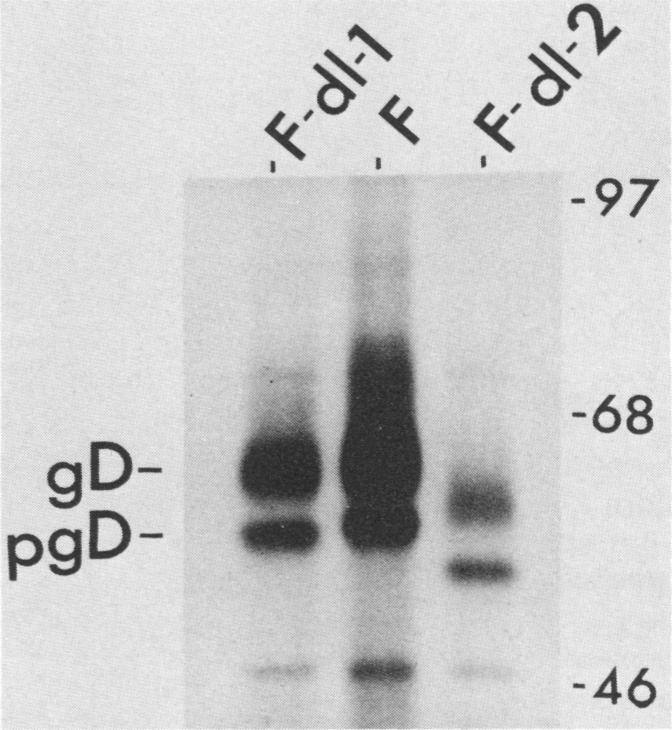
Herpes simplex virus glycoprotein D (gD) is a major component of the virion envelope and infected cell membranes and is essential for virus entry into cells. We have recently shown that gD interacts with a limited number of cell surface receptors which are required for virus penetration into cells. To define domains of gD which are required for aspects of virus replication including receptor binding, deletion mutations of 5 to 14 amino acids were constructed by using oligonucleotide-directed mutagenesis. Plasmids containing mutant genes for gD were assayed for the ability to rescue a recombinant virus, F-gD beta, in which beta-galactosidase sequences replace gD-coding sequences. Effects on global folding and posttranslational processing of the molecules were assessed by using a panel of monoclonal antibodies which recognize both continuous and discontinuous epitopes. A region near the amino terminus (residues 7 to 21) of gD which is recognized by monoclonal antibodies able to neutralize herpes simplex virus in the absence of complement was not essential for function. In addition, virtually all of the cytoplasmic domain of gD and an extracellular domain close to the membrane were dispensable. In contrast, deletion mutations in the central region of the molecule, save for one exception, led to alterations in global folding of the molecule and maturation of the protein was inhibited.
单纯疱疹病毒糖蛋白D(gD)是病毒粒子包膜和感染细胞膜的主要成分,对于病毒进入细胞至关重要。我们最近发现,gD与病毒穿透细胞所需的少数细胞表面受体相互作用。为了确定gD中病毒复制各方面(包括受体结合)所需的结构域,通过寡核苷酸定向诱变构建了5至14个氨基酸的缺失突变体。含有gD突变基因的质粒用于检测拯救重组病毒F-gDβ的能力,其中β-半乳糖苷酶序列取代了gD编码序列。通过使用一组识别连续和不连续表位的单克隆抗体评估对分子整体折叠和翻译后加工的影响。gD氨基末端附近(第7至21位氨基酸残基)的一个区域,可被在无补体情况下能够中和单纯疱疹病毒的单克隆抗体识别,但该区域对功能并非必需。此外,gD几乎所有的胞质结构域以及靠近膜的一个胞外结构域都是可有可无的。相反,分子中部区域的缺失突变(仅有一个例外)导致分子整体折叠发生改变,并且蛋白质成熟受到抑制。