Campadelli-Fiume G, Qi S, Avitabile E, Foà-Tomasi L, Brandimarti R, Roizman B
Department of Experimental Pathology, University of Bologna, Italy.
J Virol. 1990 Dec;64(12):6070-9. doi: 10.1128/JVI.64.12.6070-6079.1990.
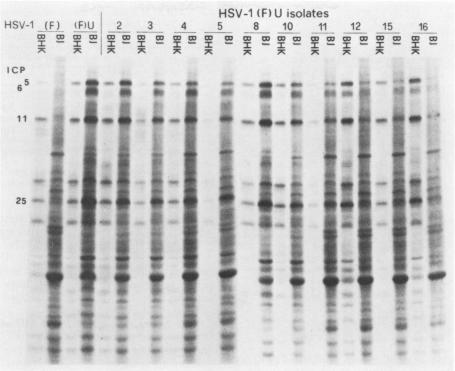
Earlier studies have shown that herpes simplex viruses adsorb to but do not penetrate permissive baby hamster kidney clonal cell lines designated the BJ series and constitutively expressing the herpes simplex virus 1 (HSV-1) glycoprotein D (gD). To investigate the mechanism of the restriction, the following steps were done. First, wild-type HSV-1 strain F [HSV-1(F)] virus was passaged blindly serially on clonal line BJ-1 and mutant viruses [HSV-1(F)U] capable of penetration were selected. The DNA fragment capable of transferring the capacity to infect BJ cells by marker transfer contains the gD gene. The mutant gD, designated gDU, differed from wild-type gD only in the substitution of Leu-25 by proline. gDU reacted with monoclonal antibodies which neutralize virus and whose epitopes encompass known functional domains involved in virus entry into cells. It did not react with the monoclonal antibody AP7 previously shown to react with an epitope which includes Leu-25. Second, cell lines expressing gDU constitutively were constructed and cloned. Unlike the clonal cell lines constitutively expressing gD (e.g., the BJ cell line), those expressing gDU were infectable by both HSV-1(F) and HSV-1(F)U. Lastly, exposure of BJ cells to monoclonal antibody AP7 rendered the cells capable of being infected with HSV-1(F). The results indicate that (i) gD expresses a specific function, determined by sequences at or around Leu-25, which blocks entry of virus into cells synthesizing gD, (ii) the gD which blocks penetration by superinfecting virus is located in the plasma membrane, (iii) the target of the restriction to penetration is the identical domain of the gD molecule contained in the envelope of the superinfecting virus, and (iv) the molecular basis of the restriction does not involve competition for a host protein involved in entry, as was previously thought.
早期研究表明,单纯疱疹病毒可吸附于但不能穿透指定为BJ系列的允许性幼仓鼠肾克隆细胞系,这些细胞系组成性表达单纯疱疹病毒1型(HSV-1)糖蛋白D(gD)。为了研究这种限制的机制,进行了以下步骤。首先,野生型HSV-1 F株[HSV-1(F)]病毒在克隆细胞系BJ-1上连续盲目传代,并筛选出能够穿透的突变病毒[HSV-1(F)U]。通过标记转移能够传递感染BJ细胞能力的DNA片段包含gD基因。突变型gD,命名为gDU,与野生型gD的区别仅在于亮氨酸-25被脯氨酸取代。gDU与中和病毒的单克隆抗体发生反应,其表位包含参与病毒进入细胞的已知功能域。它不与先前显示与包含亮氨酸-25的表位发生反应的单克隆抗体AP7发生反应。其次,构建并克隆了组成性表达gDU的细胞系。与组成性表达gD的克隆细胞系(如BJ细胞系)不同,那些表达gDU的细胞系可被HSV-1(F)和HSV-1(F)U感染。最后,将BJ细胞暴露于单克隆抗体AP7使细胞能够被HSV-1(F)感染。结果表明:(i)gD表达一种由亮氨酸-25或其周围序列决定的特定功能,该功能可阻止病毒进入合成gD的细胞;(ii)阻止超感染病毒穿透的gD位于质膜中;(iii)对穿透的限制靶点是超感染病毒包膜中所含gD分子的相同结构域;(iv)限制的分子基础并不像先前认为的那样涉及对参与进入的宿主蛋白的竞争。