Department of Brain and Cognitive Sciences, Massachusetts Institute of Technology, Cambridge, Massachusetts, United States of America.
PLoS One. 2011 May 12;6(5):e19551. doi: 10.1371/journal.pone.0019551.
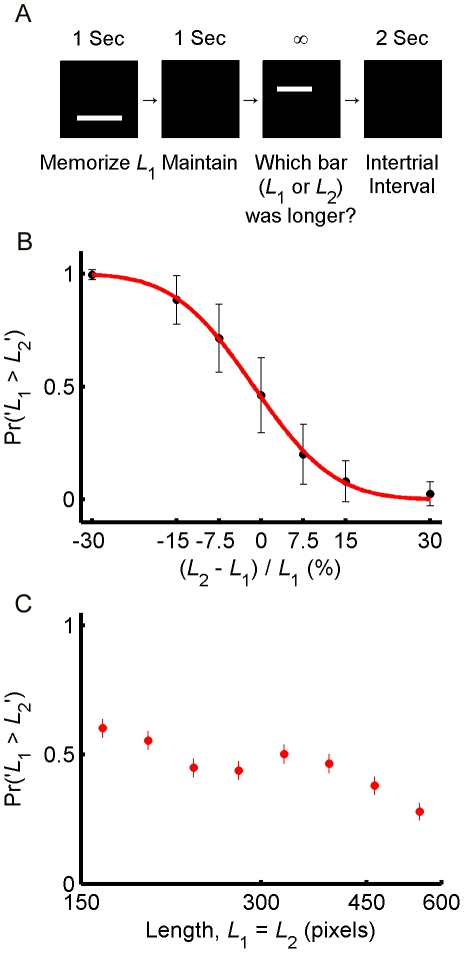
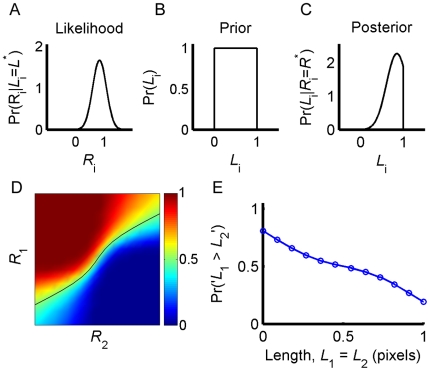
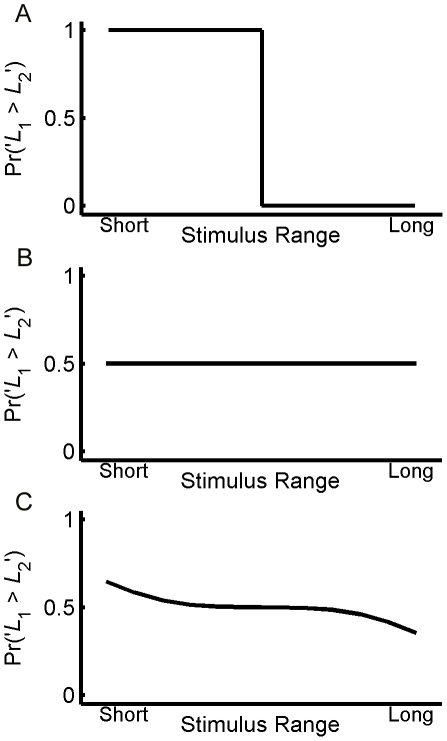
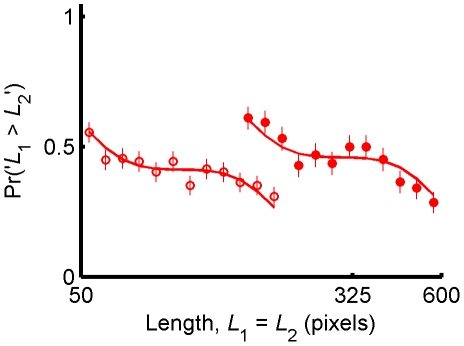
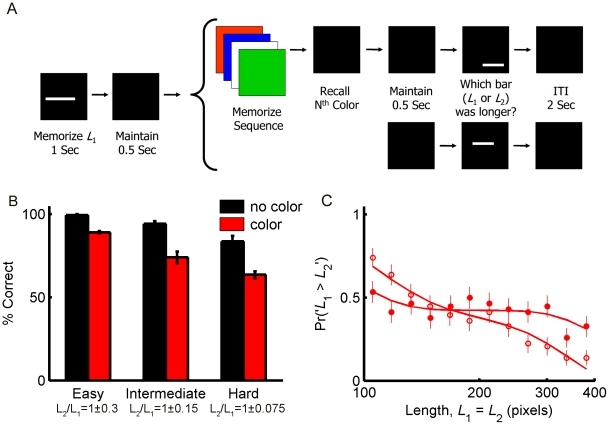
Delayed comparison tasks are widely used in the study of working memory and perception in psychology and neuroscience. It has long been known, however, that decisions in these tasks are biased. When the two stimuli in a delayed comparison trial are small in magnitude, subjects tend to report that the first stimulus is larger than the second stimulus. In contrast, subjects tend to report that the second stimulus is larger than the first when the stimuli are relatively large. Here we study the computational principles underlying this bias, also known as the contraction bias. We propose that the contraction bias results from a Bayesian computation in which a noisy representation of a magnitude is combined with a-priori information about the distribution of magnitudes to optimize performance. We test our hypothesis on choice behavior in a visual delayed comparison experiment by studying the effect of (i) changing the prior distribution and (ii) changing the uncertainty in the memorized stimulus. We show that choice behavior in both manipulations is consistent with the performance of an observer who uses a Bayesian inference in order to improve performance. Moreover, our results suggest that the contraction bias arises during memory retrieval/decision making and not during memory encoding. These results support the notion that the contraction bias illusion can be understood as resulting from optimality considerations.
延迟比较任务在心理学和神经科学中被广泛用于研究工作记忆和感知。然而,人们早就知道,这些任务中的决策存在偏差。当延迟比较试验中的两个刺激强度较小时,受试者往往会报告第一个刺激比第二个刺激大。相比之下,当刺激相对较大时,受试者往往会报告第二个刺激比第一个刺激大。在这里,我们研究了这种偏差(也称为收缩偏差)的计算原理。我们提出,收缩偏差是由贝叶斯计算产生的,其中对大小的噪声表示与关于大小分布的先验信息相结合,以优化性能。我们通过研究视觉延迟比较实验中的(i)改变先验分布和(ii)改变记忆刺激的不确定性来检验我们的假设。我们表明,这两种操作中的选择行为都与使用贝叶斯推理来提高性能的观察者的表现一致。此外,我们的结果表明,收缩偏差是在记忆检索/决策过程中产生的,而不是在记忆编码过程中产生的。这些结果支持了这样一种观点,即收缩偏差错觉可以被理解为源自最优性考虑。