Department of General Practice/Family Medicine, University of Marburg, Germany.
BMC Med Res Methodol. 2011 May 18;11:71. doi: 10.1186/1471-2288-11-71.
The correspondence of satisfaction ratings between physicians and patients can be assessed on different dimensions. One may examine whether they differ between the two groups or focus on measures of association or agreement. The aim of our study was to evaluate methodological difficulties in calculating the correspondence between patient and physician satisfaction ratings and to show the relevance for shared decision making research.
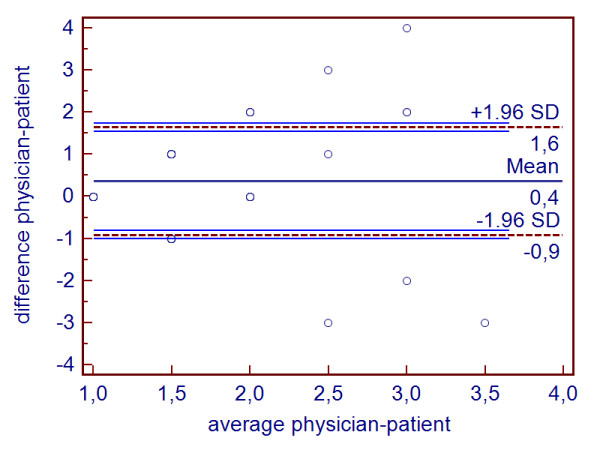
We utilised a structured tool for cardiovascular prevention (arriba™) in a pragmatic cluster-randomised controlled trial. Correspondence between patient and physician satisfaction ratings after individual primary care consultations was assessed using the Patient Participation Scale (PPS). We used the Wilcoxon signed-rank test, the marginal homogeneity test, Kendall's tau-b, weighted kappa, percentage of agreement, and the Bland-Altman method to measure differences, associations, and agreement between physicians and patients.
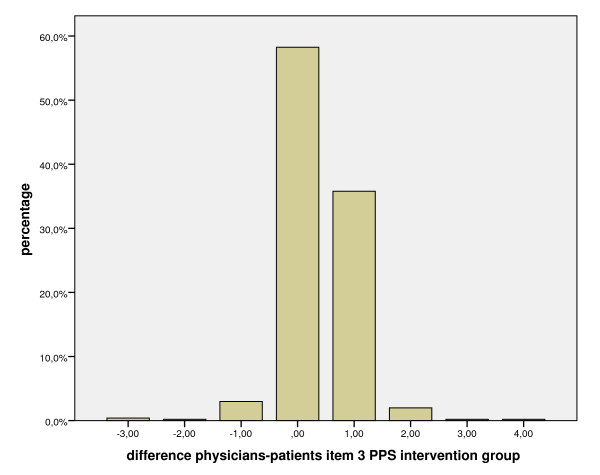
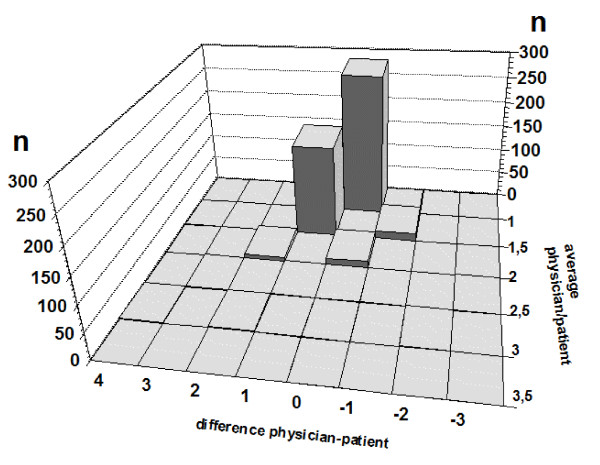
Statistical measures signal large differences between patient and physician satisfaction ratings with more favourable ratings provided by patients and a low correspondence regardless of group allocation. Closer examination of the raw data revealed a high ceiling effect of satisfaction ratings and only slight disagreement regarding the distributions of differences between physicians' and patients' ratings.
Traditional statistical measures of association and agreement are not able to capture a clinically relevant appreciation of the physician-patient relationship by both parties in skewed satisfaction ratings. Only the Bland-Altman method for assessing agreement augmented by bar charts of differences was able to indicate this.
ISRCTN: ISRCT71348772.
医生和患者满意度评分的一致性可以从不同维度进行评估。可以检验两组之间是否存在差异,或者侧重于关联或一致性的度量。我们的研究目的是评估计算患者和医生满意度评分一致性的方法学困难,并展示其对共享决策研究的相关性。
我们在一项实用的集群随机对照试验中使用了心血管预防的结构化工具(arriba™)。在个体初级保健咨询后,使用患者参与量表(PPS)评估患者和医生满意度评分之间的一致性。我们使用 Wilcoxon 符号秩检验、边缘同质性检验、Kendall's tau-b、加权 kappa、一致性百分比和 Bland-Altman 方法来衡量医生和患者之间的差异、关联和一致性。
统计指标表明患者和医生满意度评分之间存在较大差异,患者的评分更有利,且无论分组如何,一致性较低。对原始数据的更仔细检查显示满意度评分存在很高的天花板效应,且仅对医生和患者评分之间差异的分布存在轻微分歧。
在倾斜的满意度评分中,传统的关联和一致性统计指标无法捕捉到双方对医患关系的临床相关评估。只有通过差异条形图增强的 Bland-Altman 方法才能表明这一点。
ISRCTN:ISRCT71348772。