Department of Health Sciences, Free University, Amsterdam, The Netherlands.
Int J Behav Nutr Phys Act. 2011 May 18;8:42. doi: 10.1186/1479-5868-8-42.
Chinese individuals who have immigrated to a Western country initially tend to have a lower risk of cardiovascular disease (CVD) compared to people who are already living there. Some studies have found, however, that CVD risk increases over time in immigrants and that immigration to a western country is associated with changes in dietary patterns. This could have unfavourable effects on the risk of CVD. There is limited knowledge on the food patterns, awareness and knowledge about healthy nutrition among Chinese immigrants. The objective for this study is to explore changes in food patterns, and levels of awareness and knowledge of healthy nutrition by length of residence among Chinese immigrants to Canada.
120 Chinese individuals born in China but currently living in Canada completed an assessment on socio-demographic characteristics, changes in dietary patterns and variables of awareness and knowledge about healthy foods. With ordinal logistic regression the associations between the quartiles of length of residence and dietary patterns, variables of awareness and knowledge about healthy foods were explored, adjusting for age, sex, education and body mass index.
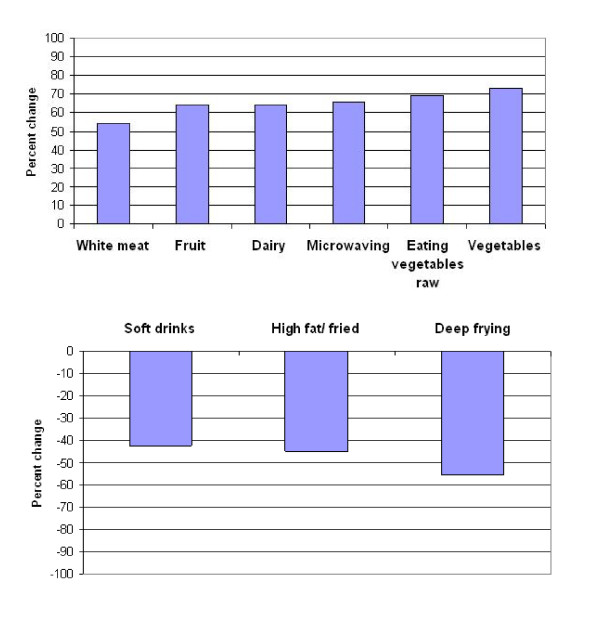
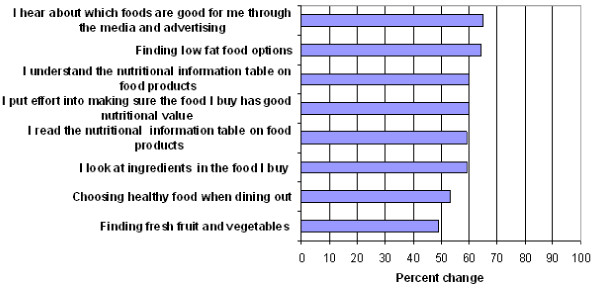
More than 50% of the participants reported increasing consumption of fruits and vegetables, decreasing the use of deep-frying after immigration. Increased awareness and knowledge about healthy foods was reported by more than 50% of the participants. Ordinal regression indicated that Chinese immigrants who lived in Canada the longest, compared to Chinese immigrants who lived in Canada the shortest, consumed significant greater portion sizes (OR: 9.9; 95% CI: 3.11 - 31.15), dined out more frequently (OR: 15.8; 95% CI: 5.0 - 49.85), and consumed convenience foods more often (OR: 3.5; 95% CI: 1.23 - 10.01).
Chinese immigrants reported some favourable changes in their dietary intake and greater awareness and more knowledge about healthy foods after immigration. However, an increase in portion size, an increased frequency of dining out and an increased consumption of convenience foods could indicate some unfavourable changes. These results suggest that health promotion strategies should build on the observed benefits of improved nutritional knowledge and target areas of portion size and convenience eating.
与已经居住在西方国家的人相比,移居到西方国家的中国人最初患心血管疾病 (CVD) 的风险较低。然而,一些研究发现,移民的 CVD 风险会随着时间的推移而增加,而且移民到西方国家与饮食模式的改变有关。这可能对 CVD 的风险产生不利影响。关于中国移民的食物模式、对健康营养的认识和知识,我们的了解是有限的。本研究的目的是探讨加拿大华裔移民的居住时间长短对食物模式的变化以及对健康营养的认识和知识水平的影响。
120 名出生在中国但目前居住在加拿大的中国人完成了一项关于社会人口特征、饮食模式变化以及对健康食品的认识和知识变量的评估。通过有序逻辑回归,探讨了居住时间长短与饮食模式、对健康食品的认识和知识变量的四分位与之间的关系,同时调整了年龄、性别、教育程度和体重指数。
超过 50%的参与者报告说,他们在移民后增加了水果和蔬菜的摄入量,减少了油炸食品的使用。超过 50%的参与者报告说,他们对健康食品的认识和知识有所提高。有序回归表明,与居住在加拿大时间最短的中国移民相比,居住在加拿大时间最长的中国移民摄入的食物份量明显更大(OR:9.9;95% CI:3.11 - 31.15),外出就餐更频繁(OR:15.8;95% CI:5.0 - 49.85),并且更经常食用方便食品(OR:3.5;95% CI:1.23 - 10.01)。
中国移民在移民后报告说他们的饮食摄入有一些有利的变化,对健康食品的认识和知识也有所提高。然而,食物份量的增加、外出就餐频率的增加以及方便食品的消费增加可能表明存在一些不利的变化。这些结果表明,健康促进策略应该建立在观察到的营养知识改善的益处之上,并针对份量和方便食品摄入的领域进行目标定位。