Department of Epidemiology and Public Health, Yong Loo Lin School of Medicine, National University of Singapore, Singapore.
Trials. 2011 May 19;12:127. doi: 10.1186/1745-6215-12-127.
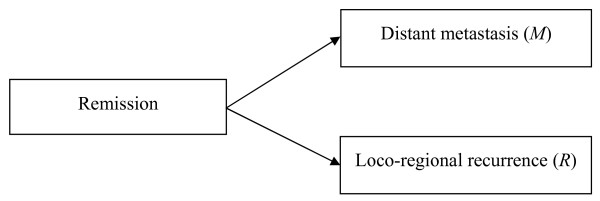
In randomised clinical trials involving time-to-event outcomes, the failures concerned may be events of an entirely different nature and as such define a classical competing risks framework. In designing and analysing clinical trials involving such endpoints, it is important to account for the competing events, and evaluate how each contributes to the overall failure. An appropriate choice of statistical model is important for adequate determination of sample size.
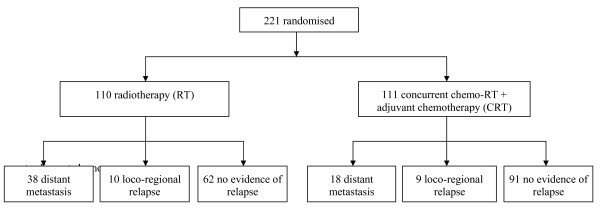
We describe how competing events may be summarised in such trials using cumulative incidence functions and Gray's test. The statistical modelling of competing events using proportional cause-specific and subdistribution hazard functions, and the corresponding procedures for sample size estimation are outlined. These are illustrated using data from a randomised clinical trial (SQNP01) of patients with advanced (non-metastatic) nasopharyngeal cancer.
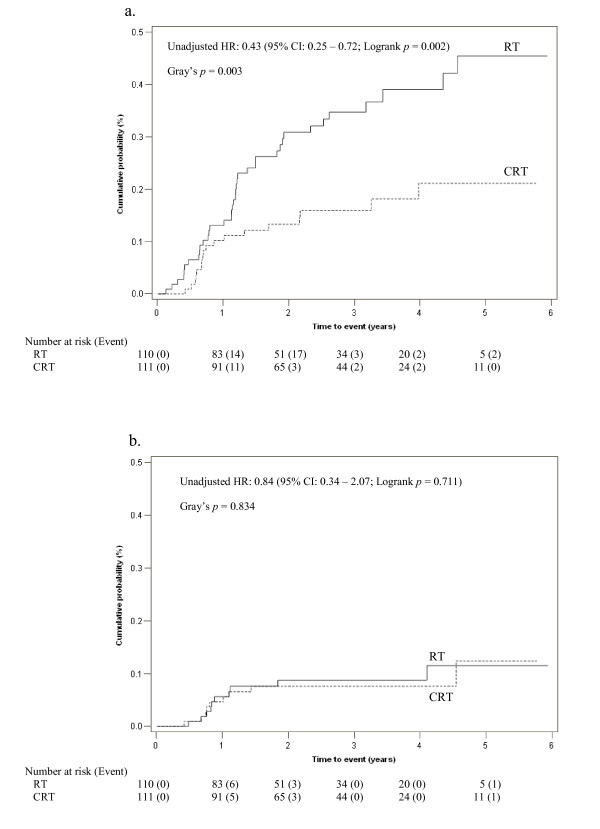
In this trial, treatment has no effect on the competing event of loco-regional recurrence. Thus the effects of treatment on the hazard of distant metastasis were similar via both the cause-specific (unadjusted csHR = 0.43, 95% CI 0.25 - 0.72) and subdistribution (unadjusted subHR 0.43; 95% CI 0.25 - 0.76) hazard analyses, in favour of concurrent chemo-radiotherapy followed by adjuvant chemotherapy. Adjusting for nodal status and tumour size did not alter the results. The results of the logrank test (p = 0.002) comparing the cause-specific hazards and the Gray's test (p = 0.003) comparing the cumulative incidences also led to the same conclusion. However, the subdistribution hazard analysis requires many more subjects than the cause-specific hazard analysis to detect the same magnitude of effect.
The cause-specific hazard analysis is appropriate for analysing competing risks outcomes when treatment has no effect on the cause-specific hazard of the competing event. It requires fewer subjects than the subdistribution hazard analysis for a similar effect size. However, if the main and competing events are influenced in opposing directions by an intervention, a subdistribution hazard analysis may be warranted.
在涉及生存时间结局的随机临床试验中,失败事件可能属于完全不同性质的事件,因此构成了经典的竞争风险框架。在设计和分析涉及此类终点的临床试验时,重要的是要考虑竞争事件,并评估每个事件对总失败的贡献。适当选择统计模型对于充分确定样本量很重要。
我们描述了如何使用累积发生率函数和 Gray 检验来总结此类试验中的竞争事件。使用比例原因特异性和亚分布风险函数对竞争事件进行统计建模,以及概述了相应的样本量估计程序。使用来自晚期(非转移性)鼻咽癌患者的随机临床试验(SQNP01)的数据说明了这些内容。
在这项试验中,治疗对局部区域复发的竞争事件没有影响。因此,治疗对远处转移风险的影响通过原因特异性(未调整 csHR = 0.43,95%CI 0.25 - 0.72)和亚分布(未调整 subHR 0.43;95%CI 0.25 - 0.76)风险分析是相似的,有利于同期放化疗后辅助化疗。调整淋巴结状态和肿瘤大小并没有改变结果。原因特异性风险分析的对数秩检验(p = 0.002)和 Gray 检验(p = 0.003)比较累积发生率也得出了相同的结论。然而,亚分布风险分析需要比原因特异性风险分析多得多的受试者来检测相同大小的效果。
当治疗对竞争事件的原因特异性风险没有影响时,原因特异性风险分析适合分析竞争风险结局。对于类似的效果大小,它需要比亚分布风险分析更少的受试者。但是,如果主要和竞争事件受到干预的影响呈相反方向,则可能需要进行亚分布风险分析。