Department of Medicine III, University Hospital Aachen, RWTH-Aachen, Pauwelsstrasse 30, 52074 Aachen, Germany.
BMC Cancer. 2011 May 20;11:185. doi: 10.1186/1471-2407-11-185.
Immunohistochemical detection of cold shock proteins is predictive for deleterious outcome in various malignant diseases. We recently described active secretion of a family member, denoted Y-box (YB) protein-1. We tested the clinical and diagnostic value of YB-1 protein fragment p18 (YB-1/p18) detection in blood for malignant diseases.
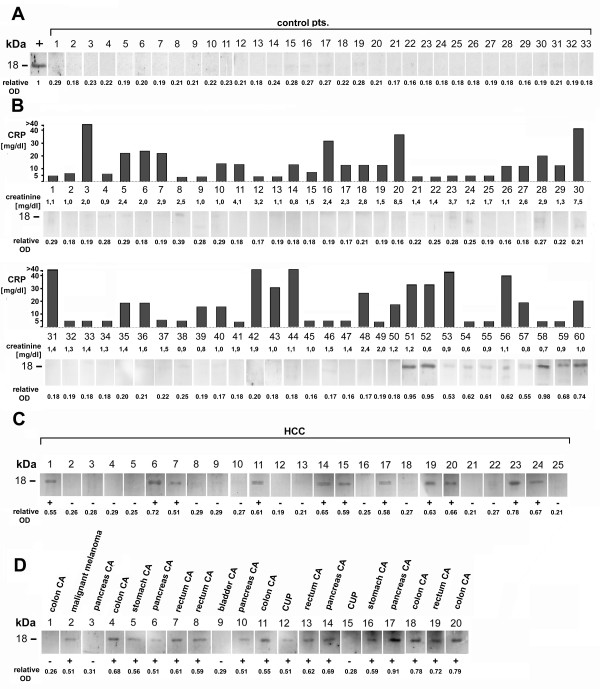
We used a novel monoclonal anti-YB-1 antibody to detect YB-1/p18 by immunoblotting in plasma samples of healthy volunteers (n=33), patients with non-cancerous, mostly inflammatory diseases (n=60), hepatocellular carcinoma (HCC; n=25) and advanced solid tumors (n=20). YB-1/p18 was then tested in 111 patients with chronic liver diseases, alongside established tumor markers and various diagnostic measures, during evaluation for potential liver transplantation.
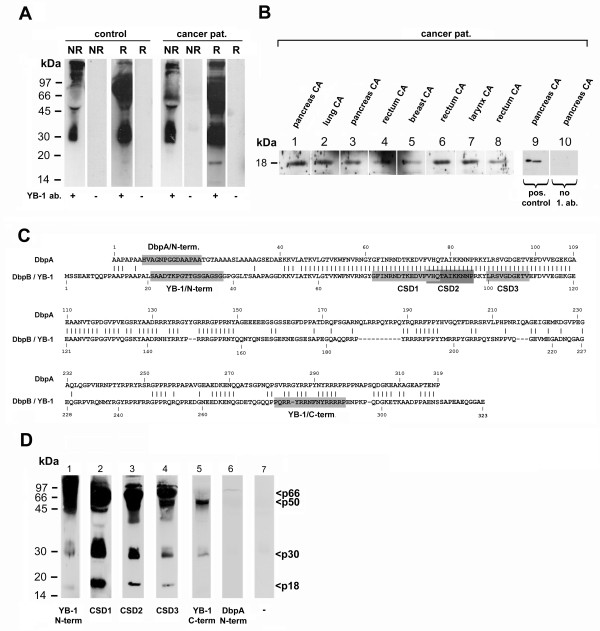
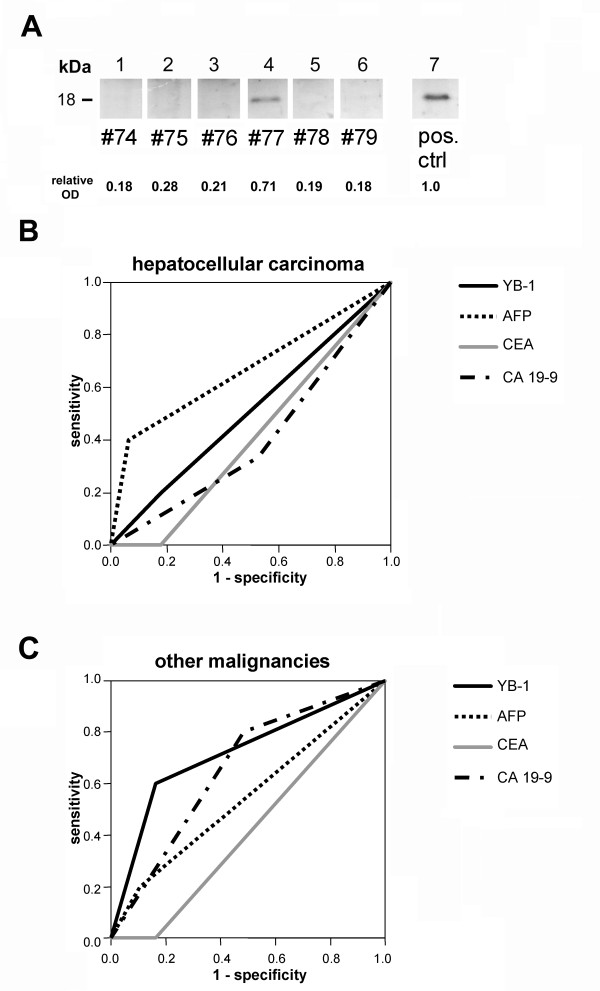
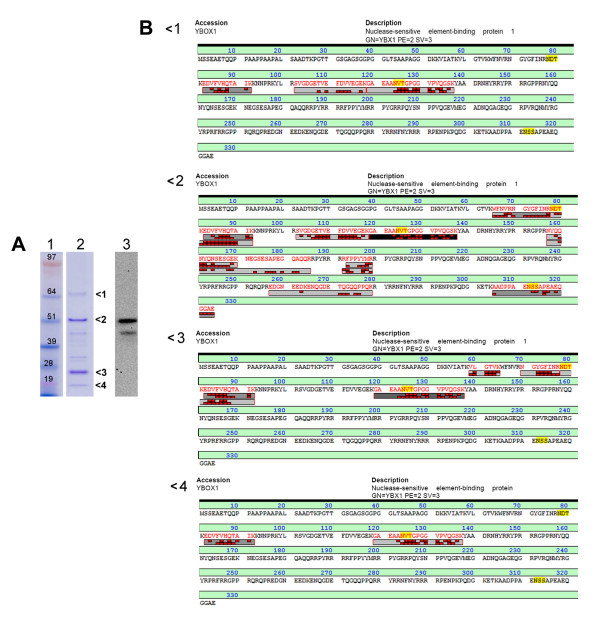
We developed a novel immunoblot to detect the 18 kD fragment of secreted YB-1 in human plasma (YB-1/p18) that contains the cold-shock domains (CSD) 1-3 of the full-length protein. YB-1/p18 was detected in 11/25 HCC and 16/20 advanced carcinomas compared to 0/33 healthy volunteers and 10/60 patients with non-cancerous diseases. In 111 patients with chronic liver disease, YB-1/p18 was detected in 20 samples. Its occurrence was not associated with advanced Child stages of liver cirrhosis or liver function. In this cohort, YB-1/p18 was not a good marker for HCC, but proved most powerful in detecting malignancies other than HCC (60% positive) with a lower rate of false-positive results compared to established tumor markers. Alpha-fetoprotein (AFP) was most sensitive in detecting HCC, but simultaneous assessment of AFP, CA19-9 and YB-1/p18 improved overall identification of HCC patients.
Plasma YB-1/p18 can identify patients with malignancies, independent of acute inflammation, renal impairment or liver dysfunction. The detection of YB-1/p18 in human plasma may have potential as a tumor marker for screening of high-risk populations, e.g. before organ transplantation, and should therefore be evaluated in larger prospective studies.
免疫组织化学检测冷休克蛋白对各种恶性疾病的不良预后具有预测作用。我们最近描述了一种家族成员,即 Y 盒(YB)蛋白-1 的主动分泌。我们测试了血液中恶性疾病中 YB-1 蛋白片段 p18(YB-1/p18)检测的临床和诊断价值。
我们使用一种新型的单克隆抗 YB-1 抗体通过免疫印迹检测健康志愿者(n=33)、非癌性、主要为炎症性疾病(n=60)、肝细胞癌(HCC;n=25)和晚期实体瘤(n=20)患者的血浆样本中的 YB-1/p18。然后,在评估潜在肝移植时,我们在 111 名慢性肝病患者中测试了 YB-1/p18,同时还测试了已建立的肿瘤标志物和各种诊断措施。
我们开发了一种新的免疫印迹法来检测人类血浆中分泌的 YB-1 的 18kD 片段(YB-1/p18),该片段包含全长蛋白的冷休克结构域(CSD)1-3。与 33 名健康志愿者和 60 名非癌症患者相比,在 25 名 HCC 患者和 20 名晚期癌症患者中检测到了 YB-1/p18。在 111 名慢性肝病患者中,在 20 个样本中检测到了 YB-1/p18。其发生与肝硬化晚期儿童期或肝功能无关。在该队列中,YB-1/p18 不是 HCC 的良好标志物,但与已建立的肿瘤标志物相比,它在检测 HCC 以外的恶性肿瘤(阳性率为 60%)方面最有效,且假阳性率较低。甲胎蛋白(AFP)在检测 HCC 方面最敏感,但同时评估 AFP、CA19-9 和 YB-1/p18 可提高 HCC 患者的总体识别率。
血浆 YB-1/p18 可在无急性炎症、肾功能不全或肝功能障碍的情况下识别恶性肿瘤患者。在人类血浆中检测到 YB-1/p18 可能具有作为高危人群筛查的肿瘤标志物的潜力,例如在器官移植前,因此应在更大的前瞻性研究中进行评估。