Max Planck Institute for Molecular Cell Biology and Genetics, Pfotenhauerstr. 108, 01307 Dresden, Germany.
Bioinformatics. 2011 Jul 15;27(14):2011-2. doi: 10.1093/bioinformatics/btr311. Epub 2011 May 19.
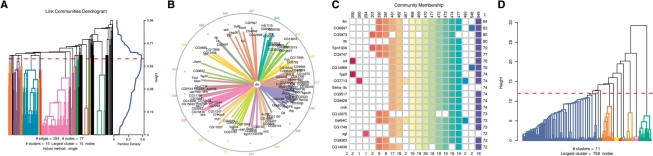
An essential element when analysing the structure, function, and dynamics of biological networks is the identification of communities of related nodes. An algorithm proposed recently enhances this process by clustering the links between nodes, rather than the nodes themselves, thereby allowing each node to belong to multiple overlapping or nested communities. The R package 'linkcomm' implements this algorithm and extends it in several aspects: (i) the clustering algorithm handles networks that are weighted, directed, or both weighted and directed; (ii) several visualization methods are implemented that facilitate the representation of the link communities and their relationships; (iii) a suite of functions are included for the downstream analysis of the link communities including novel community-based measures of node centrality; (iv) the main algorithm is written in C++ and designed to handle networks of any size; and (v) several clustering methods are available for networks that can be handled in memory, and the number of communities can be adjusted by the user.
The program is freely available from the Comprehensive R Archive Network (http://cran.r-project.org/) under the terms of the GNU General Public License (version 2 or later).
在分析生物网络的结构、功能和动态时,一个关键要素是识别相关节点的社区。最近提出的一种算法通过对节点之间的链接进行聚类,而不是对节点本身进行聚类,从而增强了这一过程,从而允许每个节点属于多个重叠或嵌套的社区。R 包“linkcomm”实现了该算法,并在几个方面进行了扩展:(i)聚类算法可处理加权、有向或同时加权和有向的网络;(ii)实现了几种可视化方法,便于表示链接社区及其关系;(iii)包括一套用于链接社区下游分析的功能,包括基于社区的节点中心度新度量;(iv)主要算法用 C++编写,旨在处理任何大小的网络;(v)对于可以在内存中处理的网络,提供了几种聚类方法,并且用户可以调整社区的数量。
该程序根据 GNU 通用公共许可证(第 2 版或更高版本)的条款,可从 Comprehensive R Archive Network(http://cran.r-project.org/)免费获得。