Department of Psychology, Ben-Gurion University of the Negev, Beer-Sheva, Israel.
Neuropsychologia. 2011 Jul;49(9):2541-52. doi: 10.1016/j.neuropsychologia.2011.05.002. Epub 2011 May 12.
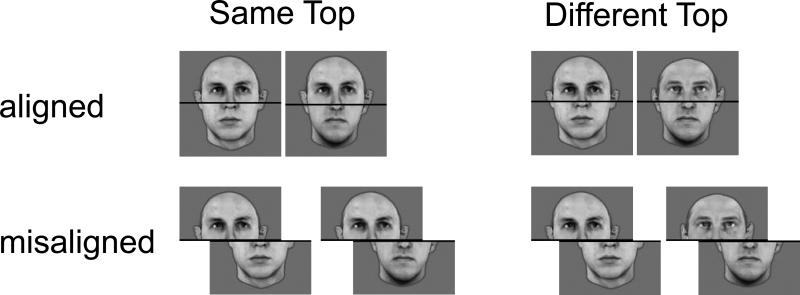
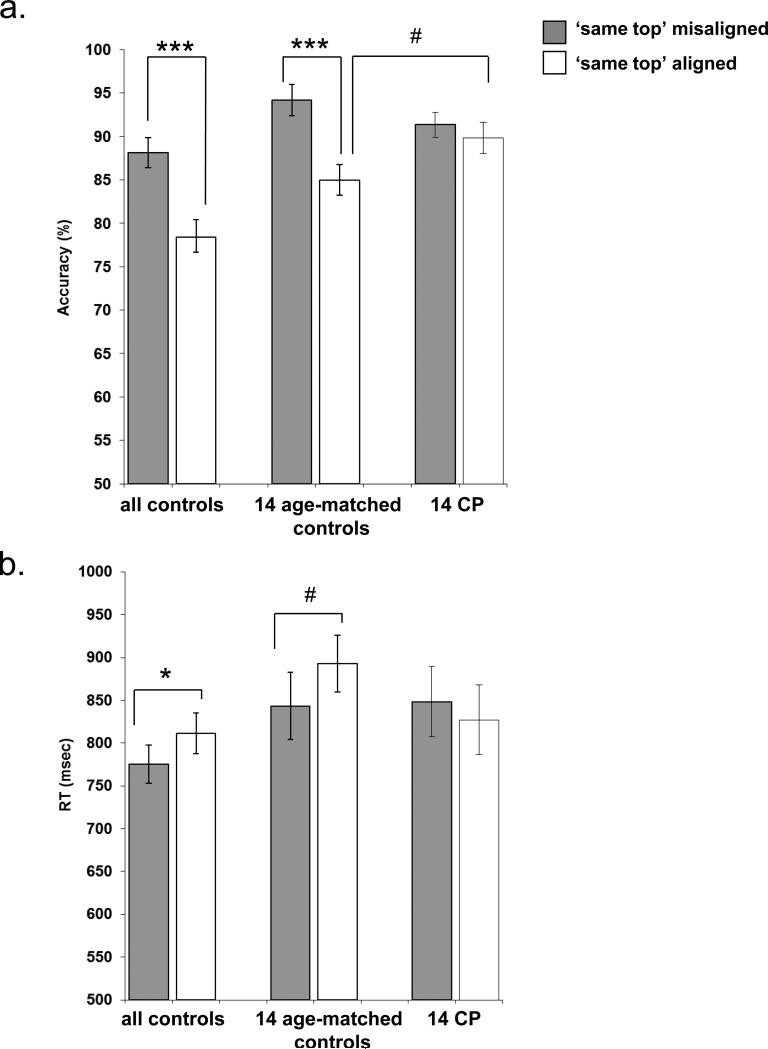
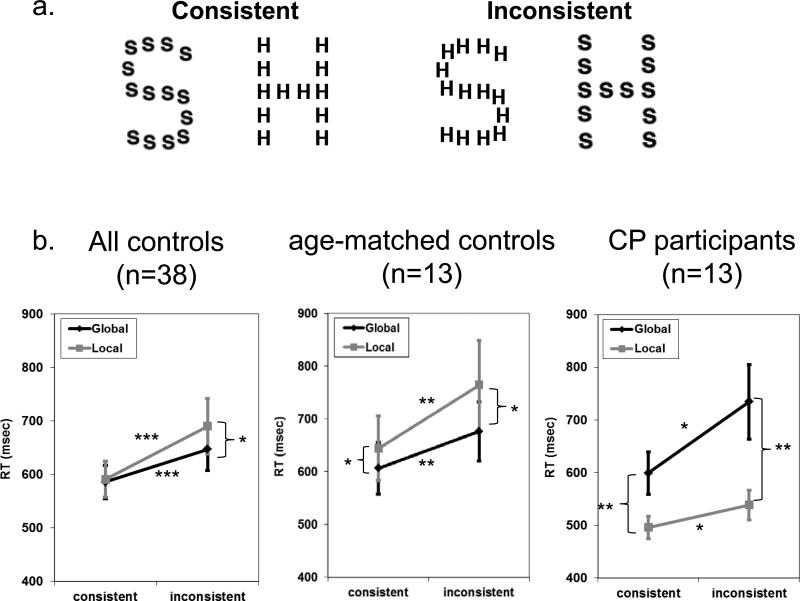
It has long been argued that face processing requires disproportionate reliance on holistic or configural processing, relative to that required for non-face object recognition, and that a disruption of such holistic processing may be causally implicated in prosopagnosia. Previously, we demonstrated that individuals with congenital prosopagnosia (CP) did not show the normal face inversion effect (better performance for upright compared to inverted faces) and evinced a local (rather than the normal global) bias in a compound letter global/local (GL) task, supporting the claim of disrupted holistic processing in prosopagnosia. Here, we investigate further the nature of holistic processing impairments in CP, first by confirming, in a large sample of CP individuals, the absence of the normal face inversion effect and the presence of the local bias on the GL task, and, second, by employing the composite face paradigm, often regarded as the gold standard for measuring holistic face processing. In this last task, we show that, in contrast with controls, the CP group perform equivalently with aligned and misaligned faces and was impervious to (the normal) interference from the task-irrelevant bottom part of faces. Interestingly, the extent of the local bias evident in the composite task is correlated with the abnormality of performance on diagnostic face processing tasks. Furthermore, there is a significant correlation between the magnitude of the local bias in the GL and performance on the composite task. These results provide further evidence for impaired holistic processing in CP and, moreover, corroborate the critical role of this type of processing for intact face recognition.
长期以来,人们一直认为,与非面部物体识别相比,面部处理需要过度依赖整体或整体处理,并且这种整体处理的中断可能与面孔失认症有关。先前,我们证明了先天性面孔失认症(CP)患者没有表现出正常的面孔倒置效应(与倒置面孔相比,直立面孔的表现更好),并且在复合字母全局/局部(GL)任务中表现出局部(而不是正常的全局)偏向,这支持了 CP 中整体处理中断的说法。在这里,我们首先通过在大量 CP 个体中确认正常的面孔倒置效应缺失和 GL 任务中的局部偏向存在,进一步研究 CP 中整体处理障碍的性质,其次通过采用复合面孔范式,通常被认为是衡量整体面孔处理的黄金标准。在最后一项任务中,我们表明,与对照组相比,CP 组在对齐和未对齐的面孔上表现相同,并且不受面孔的任务无关底部(正常)干扰的影响。有趣的是,复合任务中明显的局部偏向程度与诊断面孔处理任务的异常表现相关。此外,GL 中的局部偏向程度与复合任务的表现之间存在显著相关性。这些结果为 CP 中受损的整体处理提供了进一步的证据,而且,证实了这种类型的处理对于完整的面孔识别的关键作用。