Harvard-MIT Division of Health Sciences and Technology, Cambridge, Massachusetts, USA.
Nat Biotechnol. 2011 May 22;29(6):535-41. doi: 10.1038/nbt.1856.
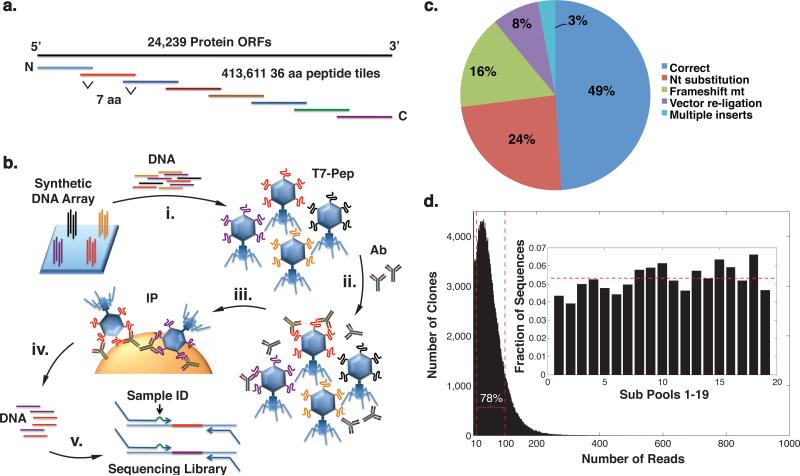
Immune responses targeting self-proteins (autoantigens) can lead to a variety of autoimmune diseases. Identification of these antigens is important for both diagnostic and therapeutic reasons. However, current approaches to characterize autoantigens have, in most cases, met only with limited success. Here we present a synthetic representation of the complete human proteome, the T7 peptidome phage display library (T7-Pep), and demonstrate its application to autoantigen discovery. T7-Pep is composed of >413,000 36-residue, overlapping peptides that cover all open reading frames in the human genome, and can be analyzed using high-throughput DNA sequencing. We developed a phage immunoprecipitation sequencing (PhIP-Seq) methodology to identify known and previously unreported autoantibodies contained in the spinal fluid of three individuals with paraneoplastic neurological syndromes. We also show how T7-Pep can be used more generally to identify peptide-protein interactions, suggesting the broader utility of our approach for proteomic research.
针对自身蛋白(自身抗原)的免疫反应可导致多种自身免疫性疾病。出于诊断和治疗原因,鉴定这些抗原非常重要。然而,目前鉴定自身抗原的方法在大多数情况下仅取得了有限的成功。在这里,我们展示了一种完整人类蛋白质组的合成表示,即 T7 肽噬菌体展示文库 (T7-Pep),并证明了其在自身抗原发现中的应用。T7-Pep 由 >413,000 个 36 个残基的重叠肽组成,覆盖了人类基因组中的所有开放阅读框,并且可以使用高通量 DNA 测序进行分析。我们开发了噬菌体免疫沉淀测序 (PhIP-Seq) 方法,以鉴定来自三名副肿瘤性神经系统综合征患者的脊髓液中包含的已知和以前未报道的自身抗体。我们还展示了如何更广泛地使用 T7-Pep 来鉴定肽-蛋白相互作用,这表明我们的方法在蛋白质组学研究中有更广泛的应用。