Gastroenterology Division, Yokohama City University School of Medicine, Yokohama, Japan.
J Neurogastroenterol Motil. 2011 Apr;17(2):174-9. doi: 10.5056/jnm.2011.17.2.174. Epub 2011 Apr 27.
BACKGROUND/AIMS: There are few reports on the correlation between chewing gum and the gastrointestinal functions. But previous report showed use of chewing gum to be an effective method for controlling gastrointestinal symptoms. The aim of this study was to determine the correlation between chewing gum and gastric emptying using the continuous real time (13)C breath test (BreathID system).
Ten healthy male volunteers participated in this randomized, 2-way crossover study. The subjects fasted overnight and were randomly assigned to chewing gum (Xylish, 2-3/1 tablet) for an hour following intake of a test meal (200 kcal/200 mL) or intake of the test meal alone. Gastric emptying was monitored for 4 hours after administration of the test meal by the (13)C-acetic acid breath test performed continually using the BreathID system.
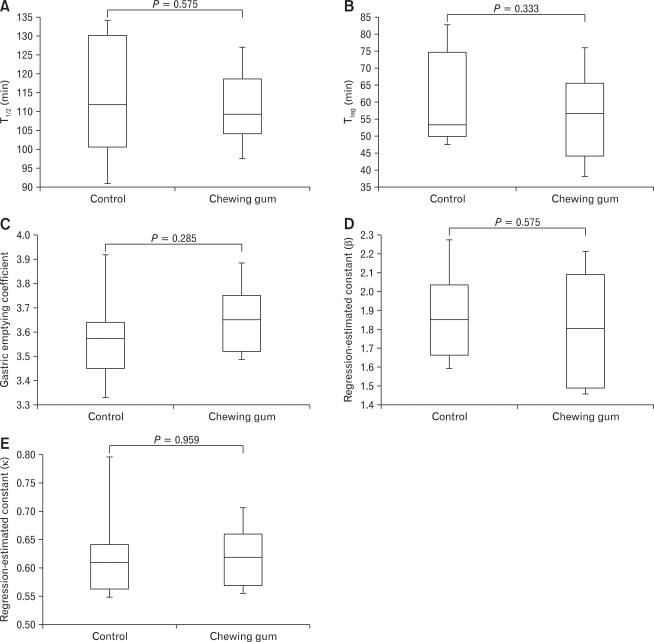
No significant differences in the calculated parameters, namely, T(1/2) (median, 111.82 vs 109.26 minutes; P = 0.575), T(lag) (median, 53.28 vs 56.53 minutes; P = 0.333), gastric emptying coefficient (median, 3.58 vs 3.65; P = 0.285), regression-estimated constant β (median, 1.85 vs 1.80; P = 0.575) and regression-estimated constant κ (median, 0.61 vs 0.62; P = 0.959) were observed between the test meal alone group and the test meal and chewing gum group.
This study showed that chewing gum had no effect on the rate of gastric emptying. Therefore, since chewing gum did not enhance the speed of gastric emptying, it may ameliorate gastrointestinal symptoms through other mechanisms, such as saliva and autonomic nervous system.
背景/目的:关于口香糖与胃肠功能之间的相关性,目前仅有少数报道。但既往研究表明,咀嚼口香糖是控制胃肠症状的有效方法。本研究旨在使用连续实时(13)C 呼气试验(BreathID 系统)确定口香糖与胃排空之间的相关性。
10 名健康男性志愿者参与了这项随机、双交叉研究。这些受试者禁食过夜,并随机分为两组,一组在摄入试验餐后 1 小时内咀嚼口香糖(Xylish,2-3/1 片),另一组仅摄入试验餐。在摄入试验餐后 4 小时内,通过使用 BreathID 系统连续进行的(13)C-乙酸呼气试验监测胃排空情况。
两组计算参数(T1/2[中位数,111.82 分钟比 109.26 分钟;P=0.575]、T(lag)[中位数,53.28 分钟比 56.53 分钟;P=0.333]、胃排空系数[中位数,3.58 比 3.65;P=0.285]、回归估计常数β[中位数,1.85 比 1.80;P=0.575]和回归估计常数κ[中位数,0.61 比 0.62;P=0.959])均无显著差异。
本研究表明,口香糖对胃排空速率没有影响。因此,由于咀嚼口香糖并没有加速胃排空,它可能通过其他机制,如唾液和自主神经系统,来改善胃肠症状。