Baker David A, Pressley Andrea, Meek Lillian, Figueroa Reinaldo, Yates Barbara, Dix Lynn
Division of Infectious Diseases, Department of Obstetrics, Gynecology, and Reproductive Medicine, School of Medicine, State University of New York at Stony Brook, Stony Brook, NY 11794-8091, USA.
Infect Dis Obstet Gynecol. 2011;2011:874820. doi: 10.1155/2011/874820. Epub 2011 Apr 10.
This prospective study was undertaken to evaluate pregnant women's willingness to undergo HSV type-specific serologic testing and factors affecting willingness in an obstetrics/gynecology ambulatory unit.
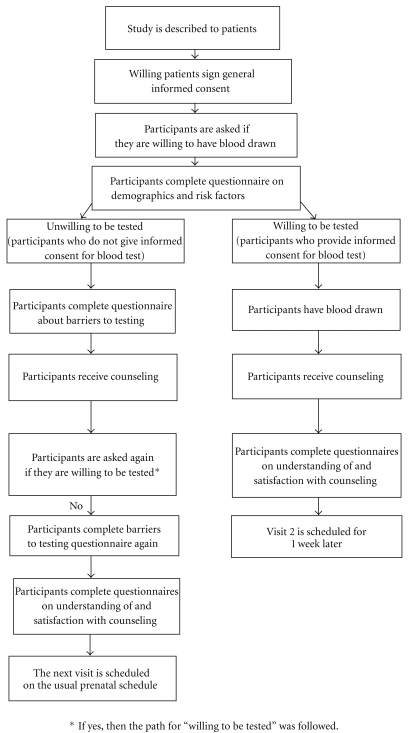
At prenatal Visit 1, pregnant women (n = 303) with no history of HSV-2 were tested for HSV-1/HSV-2 before and after they received counseling on genital and neonatal herpes.
In both the Unwilling Subgroup and the group that changed from being willing to being unwilling, the most common reasons for choosing not to be tested were not being at risk for genital herpes, being tested is too personal, and concern about what will be done with the results. Of the 134 participants in the Willing/Tested Subgroup, 27 (20%) were HSV-2 seropositive and 81 (60%) were HSV-1 seropositive. Conclusions. These results support the feasibility of HSV serologic testing and counseling in pregnant women.
本前瞻性研究旨在评估孕妇接受单纯疱疹病毒(HSV)分型血清学检测的意愿以及影响妇产科门诊单位孕妇意愿的因素。
在产前第一次就诊时,对303名无HSV - 2病史的孕妇在接受生殖器和新生儿疱疹咨询前后进行HSV - 1/HSV - 2检测。
在不愿意检测亚组和从愿意变为不愿意检测的组中,选择不检测的最常见原因是无生殖器疱疹风险、检测过于私密以及担心检测结果的用途。在愿意检测/已检测亚组的134名参与者中,27名(20%)为HSV - 2血清阳性,81名(60%)为HSV - 1血清阳性。结论。这些结果支持对孕妇进行HSV血清学检测和咨询的可行性。