Laboratory of Molecular Function of Food, Division of Food Science and Biotechnology, Graduate School of Agriculture, Kyoto University, Uji 611-0011, Japan.
Biochem J. 2011 Aug 15;438(1):111-9. doi: 10.1042/BJ20101939.
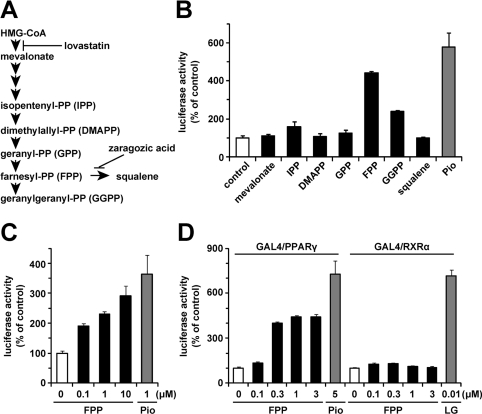
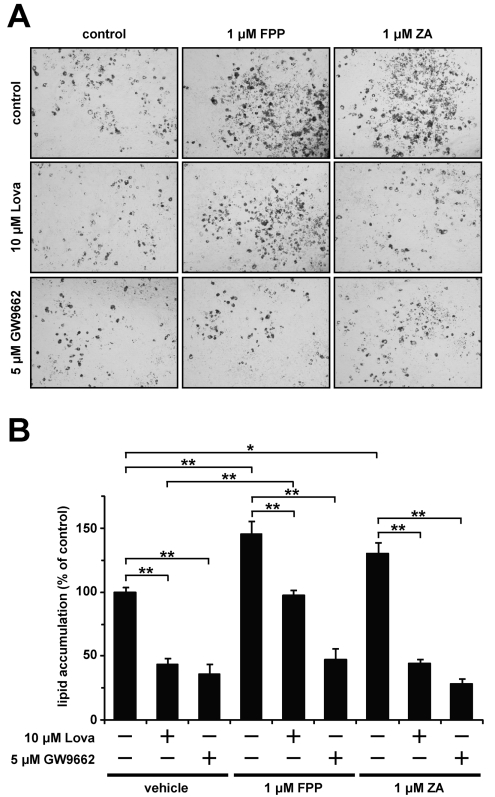
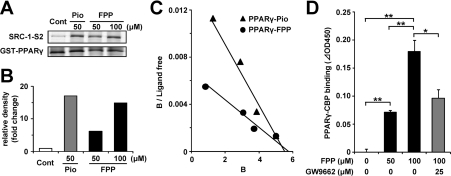
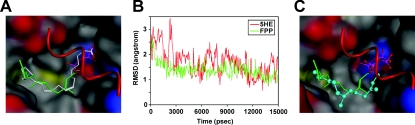
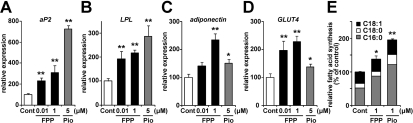
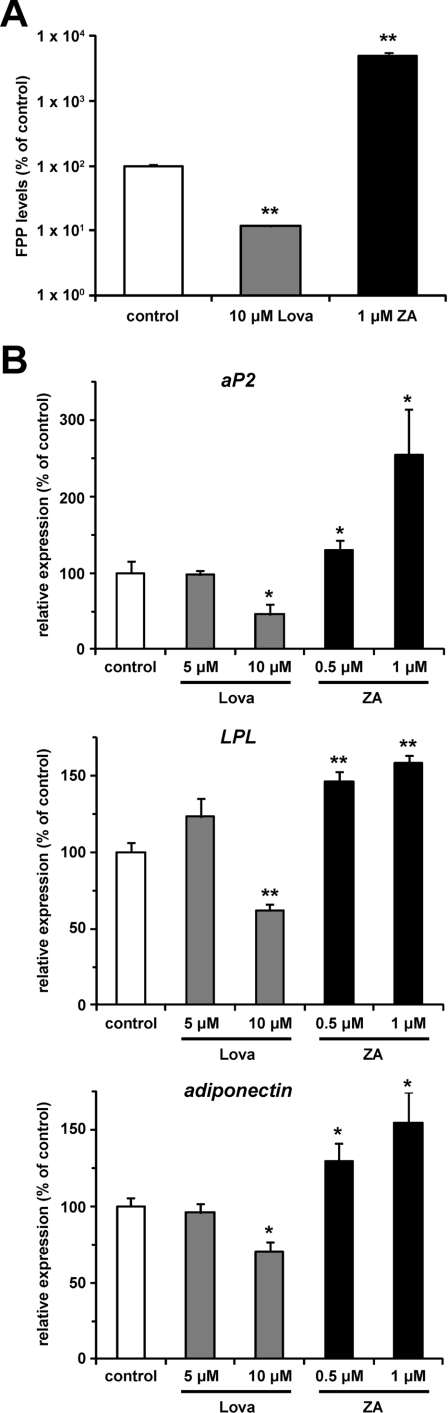
The cholesterol biosynthetic pathway produces not only sterols but also non-sterol mevalonate metabolites involved in isoprenoid synthesis. Mevalonate metabolites affect transcriptional and post-transcriptional events that in turn affect various biological processes including energy metabolism. In the present study, we examine whether mevalonate metabolites activate PPARγ (peroxisome-proliferator-activated receptor γ), a ligand-dependent transcription factor playing a central role in adipocyte differentiation. In the luciferase reporter assay using both GAL4 chimaera and full-length PPARγ systems, a mevalonate metabolite, FPP (farnesyl pyrophosphate), which is the precursor of almost all isoprenoids and is positioned at branch points leading to the synthesis of other longer-chain isoprenoids, activated PPARγ in a dose-dependent manner. FPP induced the in vitro binding of a co-activator, SRC-1 (steroid receptor co-activator-1), to GST (glutathione transferase)-PPARγ. Direct binding of FPP to PPARγ was also indicated by docking simulation studies. Moreover, the addition of FPP up-regulated the mRNA expression levels of PPARγ target genes during adipocyte differentiation induction. In the presence of lovastatin, an HMG-CoA (3-hydroxy-3-methylglutaryl-CoA) reductase inhibitor, both intracellular FPP levels and PPARγ-target gene expressions were decreased. In contrast, the increase in intracellular FPP level after the addition of zaragozic acid, a squalene synthase inhibitor, induced PPARγ-target gene expression. The addition of FPP and zaragozic acid promotes lipid accumulation during adipocyte differentiation. These findings indicated that FPP might function as an endogenous PPARγ agonist and regulate gene expression in adipocytes.
胆固醇生物合成途径不仅产生固醇,还产生参与异戊烯基合成的非固醇甲羟戊酸代谢物。甲羟戊酸代谢物影响转录和转录后事件,进而影响各种生物过程,包括能量代谢。在本研究中,我们研究了甲羟戊酸代谢物是否激活 PPARγ(过氧化物酶体增殖物激活受体 γ),PPARγ 是一种配体依赖性转录因子,在脂肪细胞分化中起着核心作用。在使用 GAL4 嵌合体和全长 PPARγ 系统的荧光素酶报告基因检测中,甲羟戊酸代谢物 FPP(法呢基焦磷酸),它是几乎所有异戊烯基的前体,位于导致其他长链异戊烯基合成的分支点,以剂量依赖的方式激活 PPARγ。FPP 诱导体外共激活因子 SRC-1(类固醇受体共激活因子-1)与 GST(谷胱甘肽转移酶)-PPARγ 的结合。对接模拟研究也表明 FPP 直接与 PPARγ 结合。此外,FPP 的添加在脂肪细胞分化诱导过程中上调了 PPARγ 靶基因的 mRNA 表达水平。在 HMG-CoA(3-羟-3-甲基戊二酰辅酶 A)还原酶抑制剂 lovastatin 的存在下,细胞内 FPP 水平和 PPARγ 靶基因表达均降低。相比之下,鲨烯合酶抑制剂扎拉格酸添加后细胞内 FPP 水平的增加诱导了 PPARγ 靶基因的表达。FPP 和扎拉格酸的添加促进了脂肪细胞分化过程中的脂质积累。这些发现表明 FPP 可能作为内源性 PPARγ 激动剂发挥作用,并调节脂肪细胞中的基因表达。