Department of Medicine, Faculty of Medicine, Imperial College London, United Kingdom.
J Infect Dis. 2011 Jun 15;203(12):1775-83. doi: 10.1093/infdis/jir173.
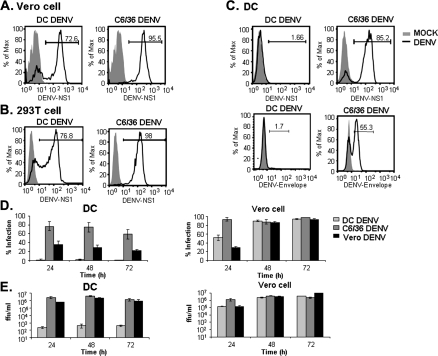
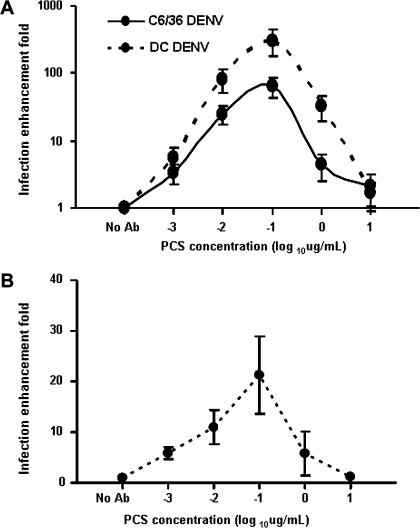
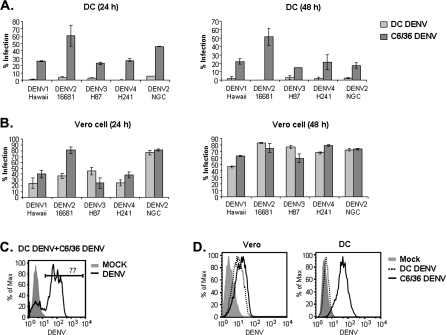
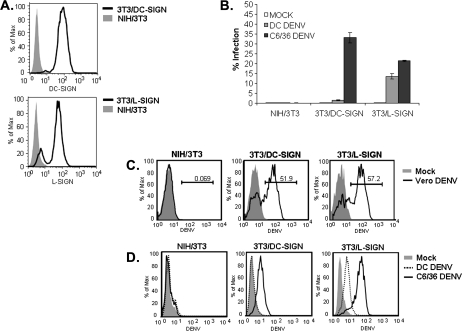
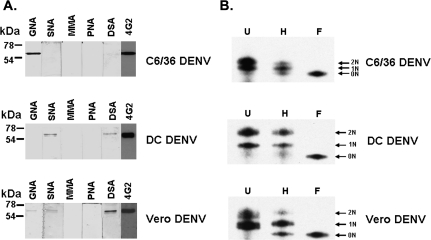
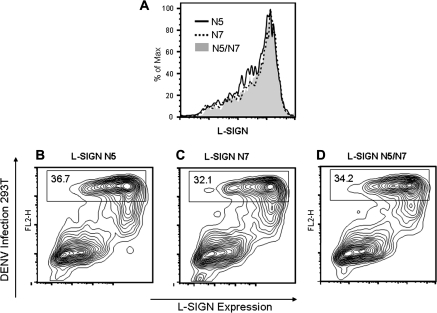
Dengue virus receptors are relatively poorly characterized, but there has been recent interest in 2 C-type lectin molecules, dendritic cell-specific intercellular adhesion molecule 3 (ICAM-3)-grabbing nonintegrin (DC-SIGN) and its close homologue liver/lymph node-specific ICAM-3-grabbing integrin (L-SIGN), which can both bind dengue and promote infection. In this report we have studied the interaction of dengue viruses produced in insect cells, tumor cell lines, and primary human dendritic cells (DCs) with DC-SIGN and L-SIGN. Virus produced in primary DCs is unable to interact with DC-SIGN but remains infectious for L-SIGN-expressing cells. Skin-resident DCs may thus be a site of initial infection by insect-produced virus, but DCs will likely not participate in large-scale virus replication during dengue infection. These results reveal that differential glycosylation of dengue virus envelope protein is highly dependent on cell state and suggest that studies of virus tropism using virus prepared in insect cells or tumor cell lines should be interpreted with caution.
登革热病毒受体的特征相对较差,但最近人们对 2 种 C 型凝集素分子(树突状细胞特异性细胞间黏附分子 3(ICAM-3)抓取非整合素(DC-SIGN)及其密切同源物肝/淋巴结特异性 ICAM-3 抓取整合素(L-SIGN))产生了兴趣,这两种分子都可以结合登革热病毒并促进感染。在本报告中,我们研究了在昆虫细胞、肿瘤细胞系和原代人树突状细胞(DC)中产生的登革热病毒与 DC-SIGN 和 L-SIGN 的相互作用。在原代 DC 中产生的病毒无法与 DC-SIGN 相互作用,但仍然可以感染表达 L-SIGN 的细胞。因此,皮肤驻留的 DC 可能是昆虫产生的病毒最初感染的部位,但在登革热感染期间,DC 不太可能参与大规模的病毒复制。这些结果表明,登革热病毒包膜蛋白的差异糖基化高度依赖于细胞状态,并表明使用昆虫细胞或肿瘤细胞系制备的病毒进行病毒嗜性研究时应谨慎解释。