Department of Surgical Sciences, Section of Orthopaedics, Uppsala University, Uppsala, Sweden.
BMJ. 2011 May 24;342:d1473. doi: 10.1136/bmj.d1473.
To investigate associations between long term dietary intake of calcium and risk of fracture of any type, hip fractures, and osteoporosis.
A longitudinal and prospective cohort study, based on the Swedish Mammography Cohort, including a subcohort, the Swedish Mammography Cohort Clinical.
A population based cohort in Sweden established in 1987.
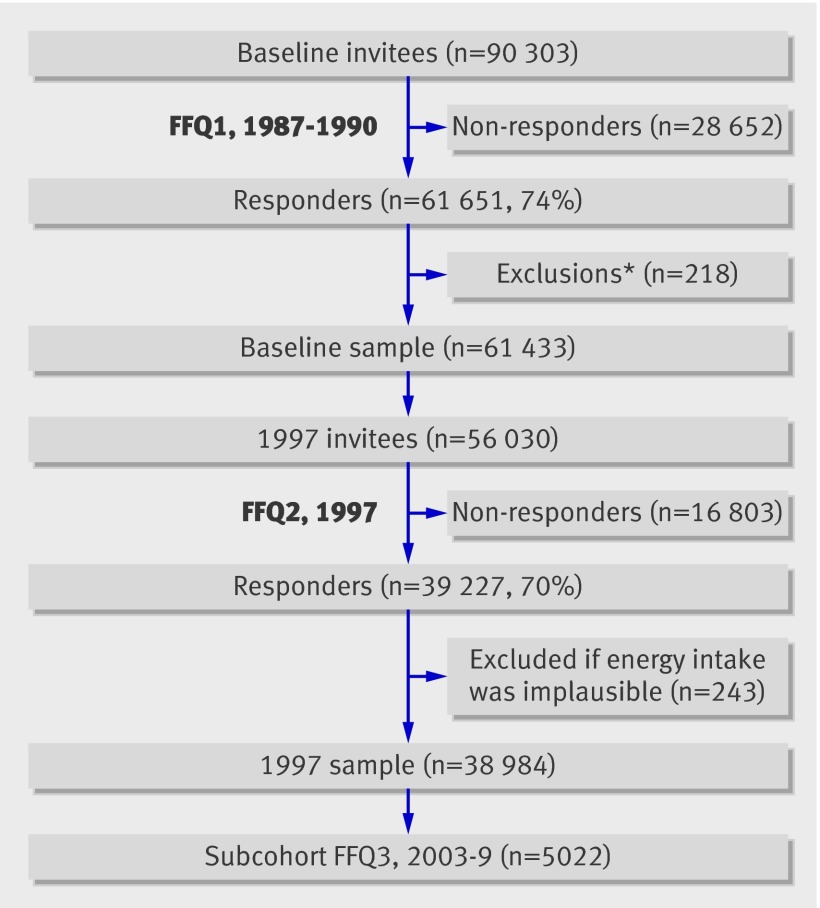
61,433 women (born between 1914 and 1948) were followed up for 19 years. 5022 of these women participated in the subcohort.
Primary outcome measures were incident fractures of any type and hip fractures, which were identified from registry data. Secondary outcome was osteoporosis diagnosed by dual energy x ray absorptiometry in the subcohort. Diet was assessed by repeated food frequency questionnaires.
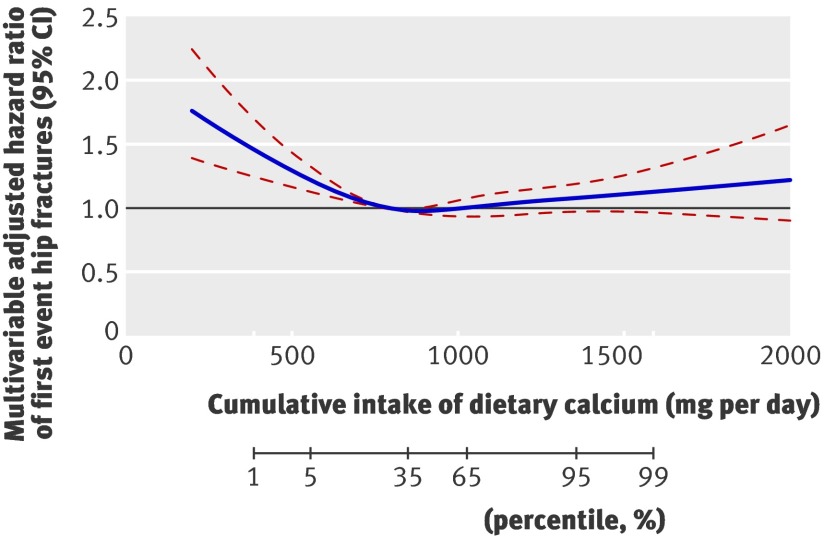
During follow-up, 14,738 women (24%) experienced a first fracture of any type and among them 3871 (6%) a first hip fracture. Of the 5022 women in the subcohort, 1012 (20%) were measured as osteoporotic. The risk patterns with dietary calcium were non-linear. The crude rate of a first fracture of any type was 17.2/1000 person years at risk in the lowest quintile of calcium intake, and 14.0/1000 person years at risk in the third quintile, corresponding to a multivariable adjusted hazard ratio of 1.18 (95% confidence interval 1.12 to 1.25). The hazard ratio for a first hip fracture was 1.29 (1.17 to 1.43) and the odds ratio for osteoporosis was 1.47 (1.09 to 2.00). With a low vitamin D intake, the rate of fracture in the first calcium quintile was more pronounced. The highest quintile of calcium intake did not further reduce the risk of fractures of any type, or of osteoporosis, but was associated with a higher rate of hip fracture, hazard ratio 1.19 (1.06 to 1.32).
Gradual increases in dietary calcium intake above the first quintile in our female population were not associated with further reductions in fracture risk or osteoporosis.
研究长期摄入钙与任何类型骨折、髋部骨折和骨质疏松症风险之间的关联。
基于瑞典乳腺队列的纵向和前瞻性队列研究,包括一个子队列,即瑞典乳腺队列临床。
1987 年在瑞典建立的基于人群的队列。
61433 名女性(1914 年至 1948 年出生)随访 19 年。其中 5022 名女性参加了子队列。
主要观察指标是任何类型的新发骨折和髋部骨折,这些骨折通过登记数据确定。次要结局是子队列中通过双能 X 射线吸收法诊断的骨质疏松症。通过反复的食物频率问卷评估饮食。
在随访期间,14738 名女性(24%)经历了第一次任何类型的骨折,其中 3871 名(6%)经历了第一次髋部骨折。在子队列的 5022 名女性中,有 1012 名(20%)被测量为骨质疏松症。膳食钙的风险模式呈非线性。最低钙摄入量五分位组的任何类型骨折的粗发生率为 17.2/1000 人年风险,第三五分位组为 14.0/1000 人年风险,相应的多变量调整后的危险比为 1.18(95%置信区间 1.12 至 1.25)。首次髋部骨折的风险比为 1.29(1.17 至 1.43),骨质疏松症的比值比为 1.47(1.09 至 2.00)。维生素 D 摄入量低时,第一钙五分位组的骨折发生率更为明显。钙摄入量最高五分位组并不能进一步降低任何类型骨折或骨质疏松症的风险,但与髋部骨折发生率较高相关,危险比为 1.19(1.06 至 1.32)。
在我们的女性人群中,逐渐增加膳食钙摄入量超过第一五分位与进一步降低骨折风险或骨质疏松症无关。