UMR 5244 CNRS/UPVD/EPHE, Biologie et Ecologie Tropicale et Méditerranéenne, Université de Perpignan Via Domitia, Perpignan, France.
PLoS Negl Trop Dis. 2011 May;5(5):e1045. doi: 10.1371/journal.pntd.0001045. Epub 2011 May 17.
Chagas disease is a major neglected tropical disease with deep socio-economical effects throughout Central and South America. Vector control programs have consistently reduced domestic populations of triatomine vectors, but non-domiciliated vectors still have to be controlled efficiently. Designing control strategies targeting these vectors is challenging, as it requires a quantitative description of the spatio-temporal dynamics of village infestation, which can only be gained from combinations of extensive field studies and spatial population dynamic modelling.
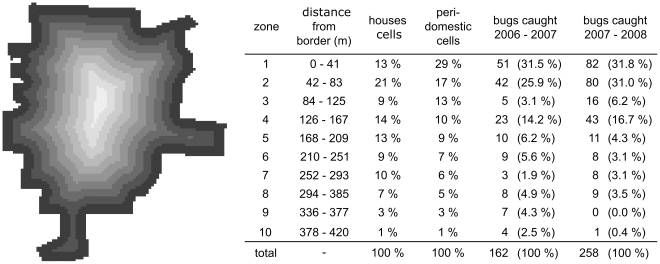
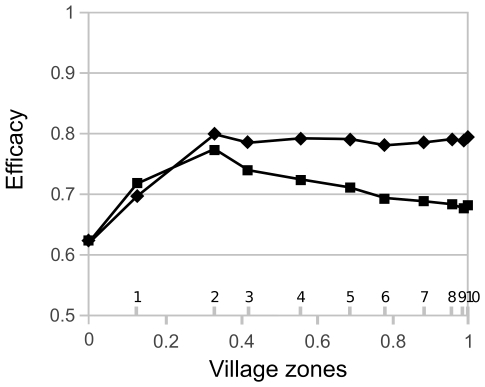
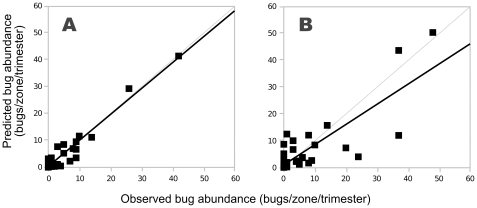
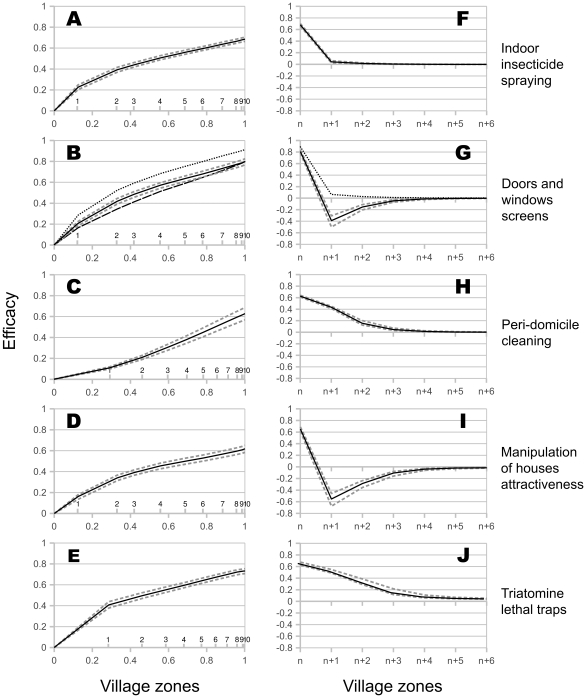
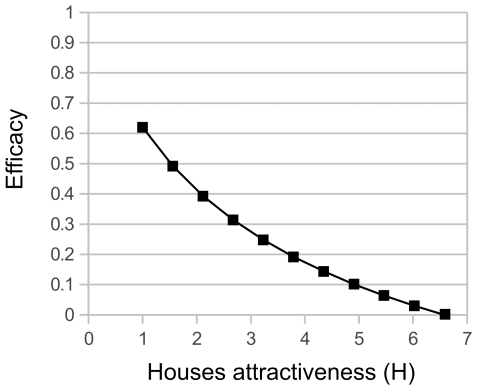
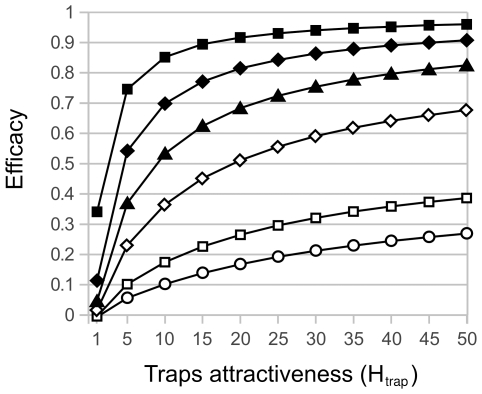
METHODOLOGY/PRINCIPAL FINDINGS: A spatially explicit population dynamic model was combined with a two-year field study of T. dimidiata infestation dynamics in the village of Teya, Mexico. The parameterized model fitted and predicted accurately both intra-annual variation and the spatial gradient in vector abundance. Five different control strategies were then applied in concentric rings to mimic spatial design targeting the periphery of the village, where vectors were most abundant. Indoor insecticide spraying and insect screens reduced vector abundance by up to 80% (when applied to the whole village), and half of this effect was obtained when control was applied only to the 33% of households closest to the village periphery. Peri-domicile cleaning was able to eliminate up to 60% of the vectors, but at the periphery of the village it has a low effect, as it is ineffective against sylvatic insects. The use of lethal traps and the management of house attractiveness provided similar levels of control. However this required either house attractiveness to be null, or ≥ 5 lethal traps, at least as attractive as houses, to be installed in each household.
CONCLUSION/SIGNIFICANCE: Insecticide and insect screens used in houses at the periphery of the village can contribute to reduce house infestation in more central untreated zones. However, this beneficial effect remains insufficient to allow for a unique spatially targeted strategy to offer protection to all households. Most efficiently, control should combine the use of insect screens in outer zones to reduce infestation by both sylvatic and peri-domiciliated vectors, and cleaning of peri-domicile in the centre of the village where sylvatic vectors are absent. The design of such spatially mixed strategies of control offers a promising avenue to reduce the economic cost associated with the control of non-domiciliated vectors.
恰加斯病是一种主要的被忽视热带病,在中美洲和南美洲造成了深远的社会经济影响。病媒控制项目一直在减少三带喙库蚊的国内种群,但仍需有效控制非 domiciliated 媒介。设计针对这些媒介的控制策略具有挑战性,因为它需要对村庄感染的时空动态进行定量描述,而这只能通过广泛的实地研究和空间种群动态建模相结合来获得。
方法/主要发现:一个空间显式的种群动态模型与在墨西哥 Teya 村进行的为期两年的三带喙库蚊感染动态的实地研究相结合。参数化模型准确地拟合和预测了年内变化和媒介丰度的空间梯度。然后,在以同心圆的方式模拟针对村庄周边地区的空间设计,即媒介最丰富的地方,应用了五种不同的控制策略。室内杀虫剂喷洒和防虫网可将媒介丰度降低多达 80%(当应用于整个村庄时),而当仅对离村庄周边最近的 33%的家庭进行控制时,可获得一半的效果。围场清洁可以消除多达 60%的媒介,但在村庄的周边地区效果较低,因为它对森林昆虫无效。使用致命陷阱和房屋吸引力管理提供了类似水平的控制。然而,这需要房屋吸引力为零,或者在每个家庭中安装至少 5 个与房屋一样有吸引力的致命陷阱。
结论/意义:在村庄周边的房屋中使用杀虫剂和防虫网可以有助于减少更中心未处理区域的房屋感染。然而,这种有益的效果仍然不足以允许采用独特的空间靶向策略为所有家庭提供保护。最有效的方法是结合在外围区域使用防虫网来减少森林和围场媒介的感染,以及在没有森林媒介的村庄中心进行围场清洁。这种空间混合控制策略的设计为降低与非 domiciliated 媒介控制相关的经济成本提供了一个有前途的途径。