Laboratorio de Parasitología, Centro de Investigaciones Regionales "Dr. Hideyo Noguchi", Universidad Autónoma de Yucatán, Mérida, Yucatán, Mexico.
Departamento de Control de Vectores, Servicios de Salud de Yucatán, Mérida, Yucatán, Mexico.
PLoS Negl Trop Dis. 2018 Jul 2;12(7):e0006605. doi: 10.1371/journal.pntd.0006605. eCollection 2018 Jul.
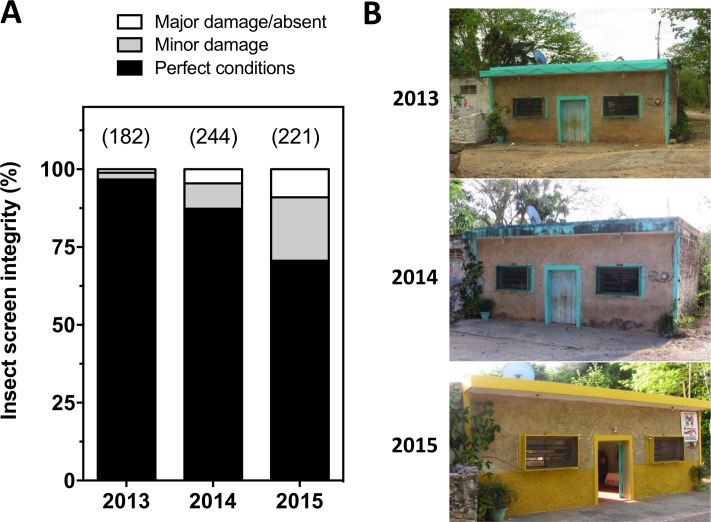
Non-domiciliated intrusive triatomine vectors are responsible for a low but significant transmission of Trypanosoma cruzi to humans. Their control is a challenge as insecticide spraying is of limited usefulness, and alternative strategies need to be developed for a sustainable control. We performed a non-randomized controlled trial of an Ecohealth intervention based on window insect screens and community participation to reduce house infestation by Triatoma dimidiata in two rural villages in Yucatan, Mexico. Efficacy of the intervention was measured over a three years follow-up period and entomological indicators showed that the proportion of triatomines found inside houses was significantly reduced in houses with insect screens, which effectively kept more bugs on the outside of houses. Using a previously developed model linking entomological data to the prevalence of infection in human, we predicted that the intervention would lead to a 32% reduction in yearly incidence and in the prevalence of T. cruzi infection. The cost for the coverage of all the windows of a house was of comparable magnitude to what families currently spend on various domestic insecticide, and most screens were still in good conditions after three years. In conclusion, the Ecohealth approach proposed here is effective for the long-term and sustainable control of intrusive T. dimidiata vectors in the Yucatan peninsula, Mexico. This strategy may also be easily adapted to other intrusive triatomine species as well as other regions/countries with comparable eco-epidemiological settings, and would be an excellent component of a larger integrated program for the control of a variety of other vector-borne diseases, bringing additional benefits to the communities. Our results should encourage a further scaling-up of our implementation strategy in additional villages in the region.
非定栖性侵入性锥蝽传播媒介对人类传播克氏锥虫的作用虽低,但意义重大。由于杀虫剂的喷洒效果有限,因此控制这些媒介是一个挑战,需要开发替代策略以实现可持续控制。我们在墨西哥尤卡坦半岛的两个农村村庄进行了一项基于窗纱和社区参与的生态健康干预的非随机对照试验,以减少 Triatoma dimidiata 对房屋的侵扰。在三年的随访期间,评估了干预措施的效果,昆虫学指标表明,带有防虫网的房屋内发现的锥蝽比例明显降低,这有效地将更多的虫子挡在房屋外面。使用之前开发的将昆虫学数据与人类感染流行率联系起来的模型,我们预测该干预措施将导致每年发病率和 T. cruzi 感染流行率降低 32%。为房屋所有窗户覆盖防虫网的费用与家庭目前用于各种家用杀虫剂的费用相当,并且经过三年后,大多数防虫网仍状况良好。总之,这里提出的生态健康方法对于在墨西哥尤卡坦半岛长期和可持续控制侵入性 T. dimidiata 媒介是有效的。这种策略也可以很容易地适应其他侵入性锥蝽物种以及具有类似生态流行病学背景的其他地区/国家,并且将成为控制各种其他媒介传播疾病的综合计划的重要组成部分,为社区带来额外的好处。我们的结果应鼓励在该地区的其他村庄进一步扩大我们的实施策略。