Social Psychology Unit, Université Libre de Bruxelles, Brussels, Belgium.
BMC Musculoskelet Disord. 2011 May 25;12:111. doi: 10.1186/1471-2474-12-111.
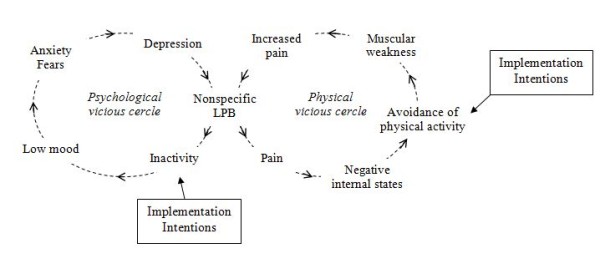
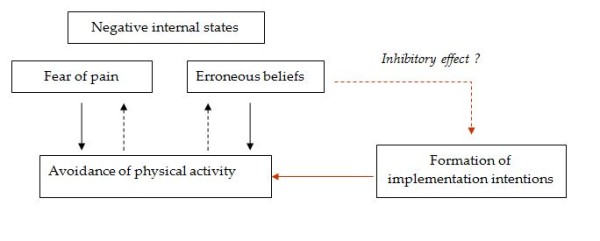
Motivation has long been emphasized as the most important determinant of action. However, there is a substantial gap between people's goals and their attainment. Patients may be motivated and yet unable to take action if their volitional competencies are insufficient. One of the important tasks of volition is goal-maintenance. Research has stressed the importance of a volitional tool, the implementation intentions. Implementation intentions indicate where, when, and how the action leading to the goal will be performed. Forming implementation intentions favours the execution of goal-directed efforts, and reinforces the relationship between intentions and behaviours. Results from various studies clearly suggest that volitional competencies and implementation intentions could play a role in low back pain (LBP) patients. However, there is at present no questionnaire allowing assessing the capacity of implementation intentions of physical activities in LBP patients.
METHODS/DESIGN: This study will develop such a questionnaire, using a 3-step approach. A first qualitative step to build categories and generate items; 30 patients suffering chronic LBP will be invited to participate in semi-structured interviews; verbatim and derived items will then be submitted to a panel of experts, using a Delphi method; a second quantitative step to examine the properties of items, and determine the factorial structure of the questionnaire; 100 patients suffering chronic LBP will be recruited to respond to this phase; and third, preliminary psychometric analyses (item-scale correlations, construct validity, reliability); 180 chronic LBP patients will be recruited for this phase of the study. The relationships between implementation intentions and variables affecting physical activity on chronic LBP patients, i.e. pain, physical capacities, fear-avoidance beliefs, kinesiophobia, work status, and level of physical activity will be considered.
Developing a questionnaire to assess implementation intentions would allow investigating the role of these intentions in the transition from acute to chronic LBP. The results of this study should contribute to the understanding of the psychological processes at stake in the development of chronic LBP, and in particular to the identification of factors eventually favouring patients' participation in and adherence to active physical treatments.
动机一直被强调为行动的最重要决定因素。然而,人们的目标和实现目标之间存在着很大的差距。如果患者的意志能力不足,他们可能有动力但无法采取行动。意志的一个重要任务是目标维持。研究强调了意志工具——实施意向的重要性。实施意向表明了行动将在何处、何时以及如何进行,以实现目标。制定实施意向有利于执行目标导向的努力,并加强意图和行为之间的关系。来自各种研究的结果清楚地表明,意志能力和实施意向可能在慢性腰痛(LBP)患者中发挥作用。然而,目前还没有问卷可以评估 LBP 患者进行身体活动的实施意向能力。
方法/设计:本研究将使用三步法开发这样的问卷。第一步是定性步骤,用于构建类别和生成项目;将邀请 30 名患有慢性 LBP 的患者参加半结构式访谈;然后将逐字记录和衍生的项目提交给专家小组,使用 Delphi 方法;第二步是检验项目的特性,并确定问卷的因子结构;将招募 100 名患有慢性 LBP 的患者来完成这一阶段;第三步是初步心理测量分析(项目-量表相关性、构念效度、信度);将招募 180 名慢性 LBP 患者完成这一阶段的研究。将考虑实施意向与影响慢性 LBP 患者身体活动的变量之间的关系,即疼痛、身体能力、回避恐惧信念、运动恐惧症、工作状况和身体活动水平。
开发评估实施意向的问卷将允许研究这些意图在从急性到慢性 LBP 的转变中的作用。这项研究的结果应该有助于理解导致慢性 LBP 发展的心理过程,特别是确定有利于患者参与和坚持积极的身体治疗的因素。