Epicentre, Paris, France.
BMC Public Health. 2011 May 25;11:389. doi: 10.1186/1471-2458-11-389.
Diarrhea remains the second leading cause of death in children under 5 years of age in sub-Saharan Africa. Health care seeking behavior for diarrhea varies by context and has important implications for developing appropriate care strategies and estimating burden of disease. The objective of this study was to determine the proportion of children under five with diarrhea who consulted at a health structure in order to identify the appropriate health care levels to set up surveillance of severe diarrheal diseases.
A cluster survey was done on 35 clusters of 21 children under 5 years of age in each of four districts of the Maradi Region, Niger. Caretakers were asked about diarrhea of the child during the recall period and their health seeking behavior in case of diarrhea. A weighted cluster analysis was conducted to determine the prevalence of diarrhea, as well as the proportion of consultations and types of health structures consulted.
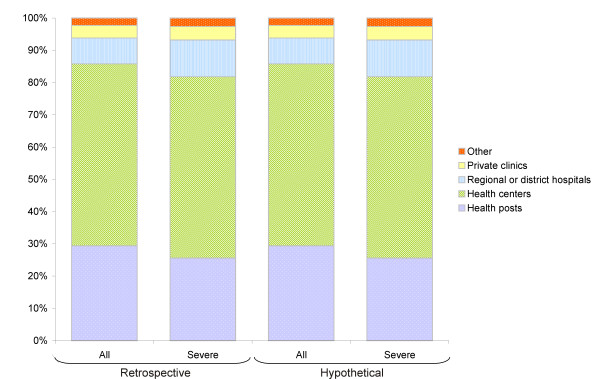
In total, the period prevalence of diarrhea and severe diarrhea between April 24th and May 21st 2009 were 36.8% (95% CI: 33.7 - 40.0) and 3.4% (95% CI: 2.2-4.6), respectively. Of those reporting an episode of diarrhea during the recall period, 70.4% (95% CI: 66.6-74.1) reported seeking care at a health structure. The main health structures visited were health centers, followed by health posts both for simple or severe diarrhea. Less than 10% of the children were brought to the hospital. The proportion of consultations was not associated with the level of education of the caretaker, but increased with the number of children in the household.
The proportion of consultations for diarrhea cases in children under 5 years old was higher than those reported in previous surveys in Niger and elsewhere. Free health care for under 5 years old might have participated in this improvement. In this type of decentralized health systems, the WHO recommended hospital-based surveillance of severe diarrheal diseases would capture only a fraction of severe diarrhea. Lower levels of health structures should be considered to obtain informative data to ensure appropriate care and burden estimates.
在撒哈拉以南非洲,腹泻仍然是 5 岁以下儿童的第二大死因。在不同背景下,儿童腹泻的就医行为存在差异,这对制定合适的医疗策略和评估疾病负担具有重要意义。本研究旨在确定患有腹泻的 5 岁以下儿童中有多少人在医疗机构就诊,以确定适当的医疗保健级别,从而对严重腹泻疾病进行监测。
在尼日尔马里地区的四个区的 35 个 21 名 5 岁以下儿童的聚类中进行了一项聚类调查。在回忆期内,询问看护者儿童腹泻的情况以及在腹泻情况下的就医行为。采用加权聚类分析来确定腹泻的流行率,以及就诊的比例和就诊的卫生机构类型。
2009 年 4 月 24 日至 5 月 21 日期间,腹泻和严重腹泻的时期流行率分别为 36.8%(95%CI:33.7-40.0)和 3.4%(95%CI:2.2-4.6)。在回忆期内报告腹泻发作的儿童中,70.4%(95%CI:66.6-74.1)在卫生机构就诊。主要就诊的卫生机构是保健中心,其次是保健站,用于治疗简单或严重的腹泻。不到 10%的儿童被送往医院。就诊比例与看护者的教育程度无关,但随着家庭中儿童人数的增加而增加。
5 岁以下儿童腹泻病例的就诊比例高于尼日尔和其他地方以前调查的报告比例。为 5 岁以下儿童提供免费医疗可能促进了这一改善。在这种分散的卫生系统中,世界卫生组织建议基于医院的严重腹泻疾病监测只能捕获一小部分严重腹泻。应考虑较低级别的卫生机构,以获取信息性数据,确保提供适当的护理和疾病负担估计。