Bin Masroni Muhammad Sufyan, Koay Evelyn Siew-Chuan, Lee Victor Kwan Min, Ng Siok Bian, Tan Soo Yong, Tan Karen Meiling, Archetti Marco, Leong Sai Mun
Department of Pathology, Yong Loo Lin School of Medicine, National University of Singapore, Singapore, Singapore.
NUS Centre for Cancer Research (N2CR), National University of Singapore, Singapore, Singapore.
Exp Mol Med. 2025 Feb;57(1):30-40. doi: 10.1038/s12276-024-01387-9. Epub 2025 Jan 7.
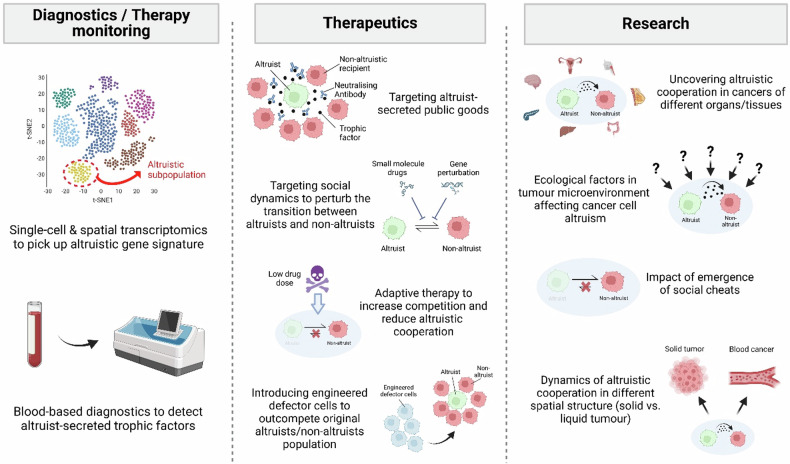
Altruism, an act of benefiting others at a cost to the self, challenges our understanding of evolution. This Perspective delves into the importance of altruism in cancer cells and its implications for therapy. Against the backdrop of existing knowledge on various social organisms found in nature, we explore the mechanisms underlying the manifestation of altruism within breast tumors, revealing a complex interplay of seemingly counteracting cancer signaling pathways and processes that orchestrate the delicate balance between cost and benefit underlying altruistic cooperation. We also discuss how evolutionary game theory, coupled with contemporary molecular tools, may shed light on understudied mechanisms governing the dynamics of altruistic cooperation in cancer cells. Finally, we discuss how molecular insights gleaned from these mechanistic dissections may fuel advancements in our comprehension of altruism among cancer cells, with implications across multiple disciplines, offering innovative prospects for therapeutic strategies, molecular discoveries, and evolutionary investigations.
利他主义,即以自我付出为代价使他人受益的行为,挑战了我们对进化的理解。本观点探讨了利他主义在癌细胞中的重要性及其对治疗的影响。在自然界中各种社会生物体现有知识的背景下,我们探究了乳腺肿瘤中利他主义表现背后的机制,揭示了看似相互抵消的癌症信号通路和过程之间复杂的相互作用,这些通路和过程协调了利他合作中成本与收益之间的微妙平衡。我们还讨论了进化博弈论与当代分子工具相结合,如何能够揭示癌细胞中利他合作动态的未被充分研究的机制。最后,我们讨论了从这些机制剖析中获得的分子见解如何推动我们对癌细胞间利他主义理解的进步,这涉及多个学科,为治疗策略、分子发现和进化研究提供了创新前景。