Jayasinghe Caren, Simiantonaki Nektaria, Habedank Sylvia, Kirkpatrick Charles James
Institute of Pathology, University Medical Center, Johannes Gutenberg University, Langenbeckstr. 1, 55101, Mainz, Germany.
Department of Pathology, Laboratory Dr. Wisplinghoff, Geibelstr. 2, 50931, Cologne, Germany.
J Exp Clin Cancer Res. 2015 May 13;34(1):42. doi: 10.1186/s13046-015-0162-5.
For the successful therapeutic use of inhibitors of the vascular endothelial growth factor receptor (VEGFR) pathway detailed knowledge of the mechanisms leading to tumor progression is indispensable. The main goal of this study was to determine the relevance of the VEGFR-2 activating pathway for colon carcinoma (CC) metastasis. The initial event is ligand-induced receptor activation through tyrosine autophosphorylation.
VEGFR-2, its ligands VEGF-C and VEGF-D and the phosphorylated (activated) receptor forms pVEGFR-2(Tyr1175) and pVEGFR-2(Tyr1214) were investigated immunohistochemically in different tumor compartments (intratumoral (zone 1) - invasive front (zone 2) - extratumoral soft tissue (zone 3)) and various cell types (tumor cells, inflammatory cells, macro- and microvasculature) in 84 non-metastatic, lymphogenous-metastatic and haematogenous-metastatic CC.
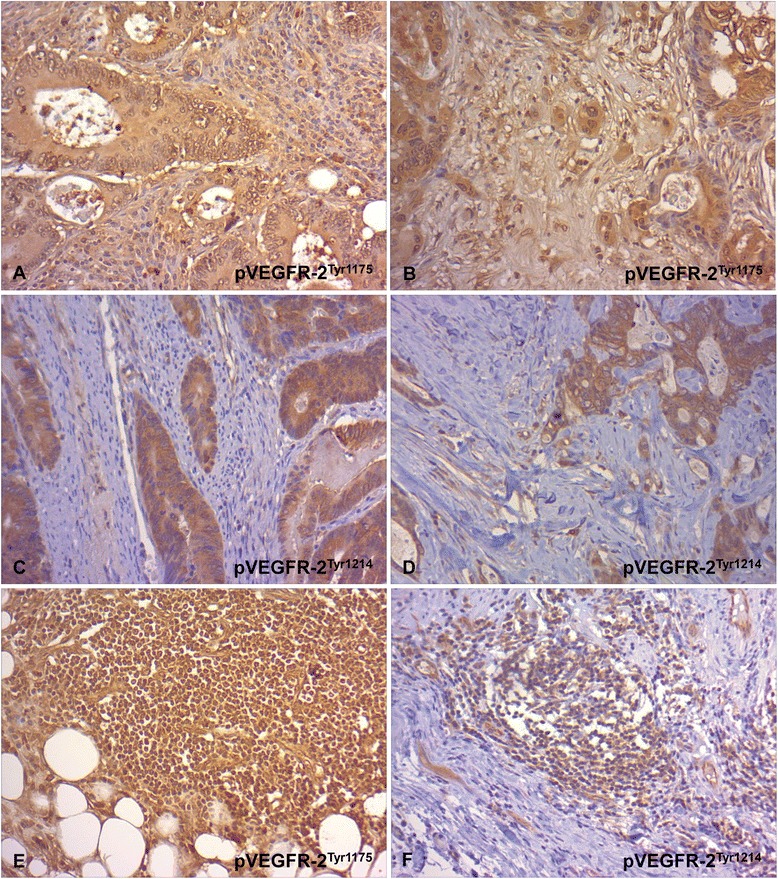
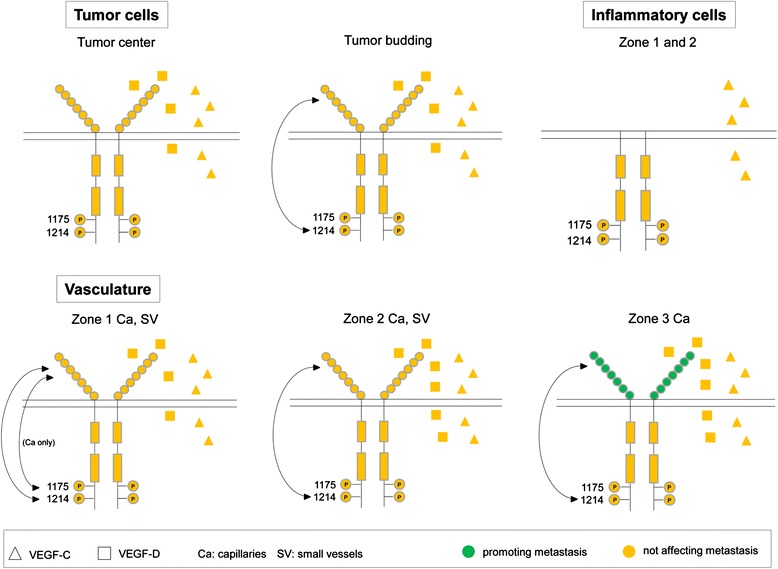
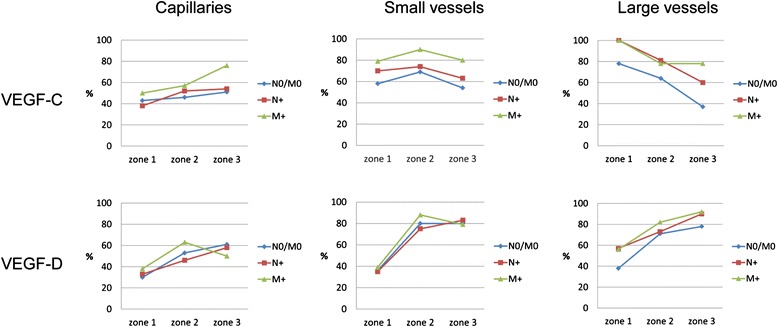
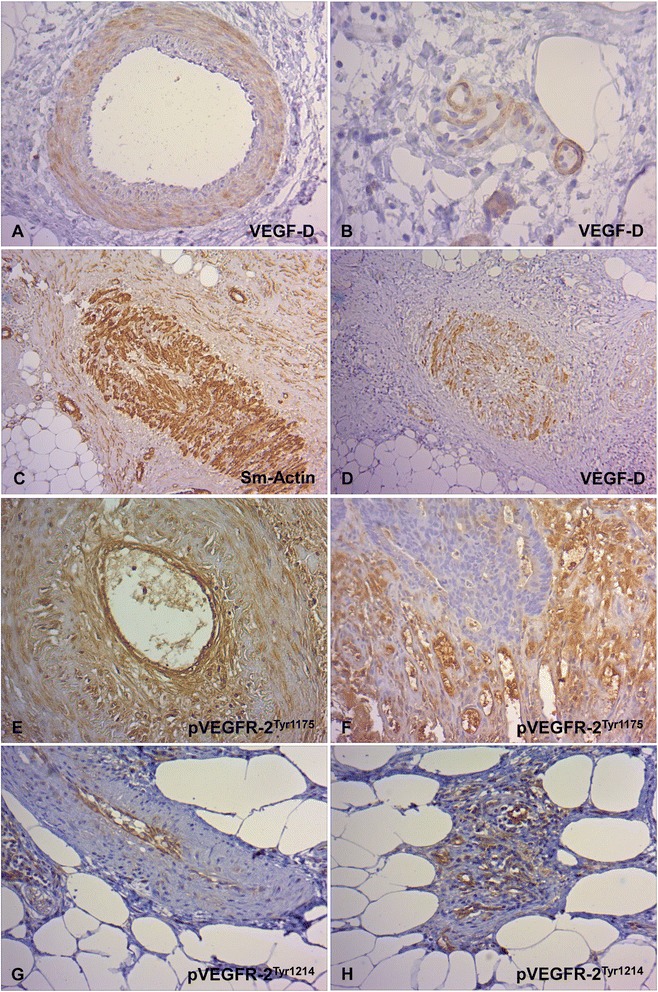
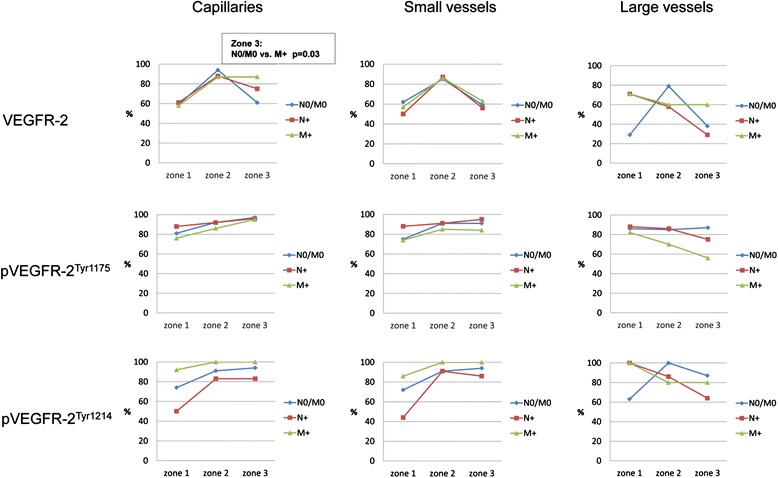
VEGF-D produced by tumor cells has an autocrine affinity for its receptor VEGFR-2. In tumor budding regions VEGF-D-induced receptor activation by autophosphorylation at Tyr1214 seems to be a possible initial event of the VEGFR-2-mediated signaling pathway, but without effect on metastatic behaviour. In inflammatory cells of almost all CC VEGFR-2 phosphorylation at Tyr 1175 and Tyr 1214 was detectable without accompanying receptor expression, suggesting receptor activation without cell surface expression. Peritumoral inflammatory cells also expressed paracrine acting VEGF-C. The autocrine VEGF-D/VEGFR-2 signaling axis and receptor autophosphorylation at Tyr1214 appear to be main events for capillaries in all three tumor zones and for small vessels in zone 1 and 2. Independent of the metastatic status a large number of cases with capillary immunopositivity in the angiogenically active invasive front was documented, especially for VEGF-D, VEGFR-2 and pVEGFR-2(Tyr1214). VEGFR-2 positive extratumoral capillaries were significantly more common in distant metastatic CC. In all tumor compartments the investigated biomolecules were also detected in different frequencies in the macrovasculature, which is responsible for sufficient tumor vascularization. In addition, vascular paracrine-acting VEGF-C production was widely detected, but without zone and vessel-type dependence.
The VEGFR-2 activating pathway is closely involved in tumor cell-associated, vessel-mediated and immuno-inflammatory processes in colon carcinoma and appears to contribute to tumor survival and growth as well as maintenance of the infiltrative phenotype rather than to promote metastasis.
为了成功地将血管内皮生长因子受体(VEGFR)途径抑制剂用于治疗,详细了解导致肿瘤进展的机制是必不可少的。本研究的主要目的是确定VEGFR-2激活途径与结肠癌(CC)转移的相关性。初始事件是配体通过酪氨酸自磷酸化诱导受体激活。
采用免疫组织化学方法,对84例非转移性、淋巴源性转移性和血源性转移性CC的不同肿瘤区域(瘤内(区域1)-浸润前沿(区域2)-瘤外软组织(区域3))和各种细胞类型(肿瘤细胞、炎性细胞、大血管和微血管)中的VEGFR-2、其配体VEGF-C和VEGF-D以及磷酸化(激活)受体形式pVEGFR-2(Tyr1175)和pVEGFR-2(Tyr1214)进行研究。
肿瘤细胞产生 的VEGF-D对其受体VEGFR-2具有自分泌亲和力。在肿瘤芽生区域,VEGF-D通过Tyr1214处的自磷酸化诱导受体激活似乎是VEGFR-2介导的信号通路的一个可能初始事件,但对转移行为没有影响。在几乎所有CC的炎性细胞中,均可检测到Tyr 1175和Tyr 1214处的VEGFR-2磷酸化,而无伴随的受体表达,提示受体激活但无细胞表面表达。瘤周炎性细胞也表达旁分泌作用的VEGF-C。自分泌VEGF-D/VEGFR-2信号轴和Tyr1214处的受体自磷酸化似乎是所有三个肿瘤区域的毛细血管以及区域1和2中的小血管的主要事件。无论转移状态如何,均记录到大量在血管生成活跃的浸润前沿毛细血管免疫阳性的病例,尤其是VEGF-D、VEGFR-2和pVEGFR-2(Tyr1214)。VEGFR-2阳性的瘤外毛细血管在远处转移性CC中明显更常见。在所有肿瘤区域,所研究的生物分子在负责肿瘤充分血管化的大血管中也以不同频率被检测到。此外,广泛检测到血管旁分泌作用的VEGF-C产生,但无区域和血管类型依赖性。
VEGFR-2激活途径密切参与结肠癌中肿瘤细胞相关、血管介导和免疫炎症过程,似乎有助于肿瘤存活和生长以及维持浸润表型,而不是促进转移。