Departments of Crop Science, Faculty of Agriculture, Universiti Putra Malaysia, Serdang, Selangor 43400, Malaysia.
Molecules. 2011 May 27;16(6):4438-50. doi: 10.3390/molecules16064438.
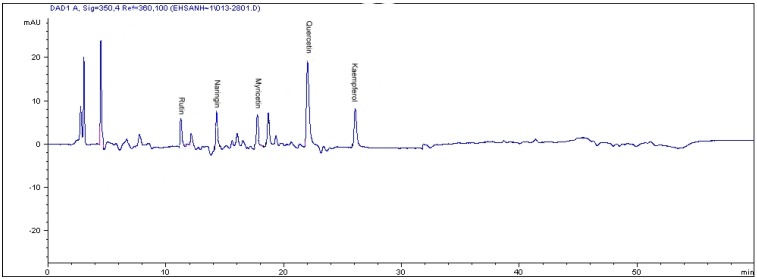
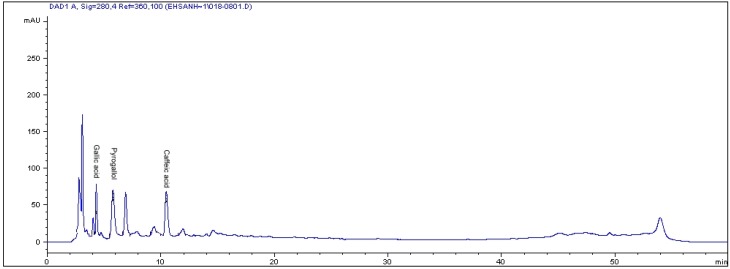
A local herb, Kacip Fatimah, is famous amongst Malay women for its uses in parturition; however, its phytochemical contents have not been fully documented. Therefore, a study was performed to evaluate the phenolics, flavonoids, and total saponin contents, and antibacterial and antifungal properties of the leaf, stem and root of three varieties of Labisia pumila Benth. Total saponins were found to be higher in the leaves of all three varieties, compared to the roots and stems. Leaves of var. pumila exhibited significantly higher total saponin content than var. alata and lanceolata, with values of 56.4, 43.6 and 42.3 mg diosgenin equivalent/g dry weight, respectively. HPLC analyses of phenolics and flavonoids in all three varieties revealed the presence of gallic acid, caffeic acid, rutin, and myricetin in all plant parts. Higher levels of flavonoids (rutin, quercitin, kaempferol) were observed in var. pumila compared with alata and lanceolata, whereas higher accumulation of phenolics (gallic acid, pyrogallol) was recorded in var. alata, followed by pumila and lanceolata. Antibacterial activities of leaf, stem and root extracts of all varieties determined against both Gram positive (Micrococcus luteus, Bacillus subtilis B145, Bacillus cereus B43, Staphylococcus aureus S1431) and Gram negative (Enterobacter aerogenes, Klebsiella pneumonia K36, Escherichia coli E256, Pseudomonas aeruginosa PI96) pathogens showed that crude methanolic extracts are active against these bacteria at low concentrations, albeit with lower antibacterial activity compared to kanamycin used as the control. Antifungal activity of methanolic extracts of all plant parts against Fusarium sp., Candida sp. and Mucor using the agar diffusion disc exhibited moderate to appreciable antifungal activities compared to streptomycin used as positive control.
一种本地草药,即卡奇·法蒂玛(Kacip Fatimah),因其在分娩中的用途而在马来妇女中广为人知;然而,其植物化学成分尚未得到充分记录。因此,进行了一项研究,以评估三叶香茶菜(Labisia pumila Benth.)的三种变种的叶、茎和根中的酚类、类黄酮和总皂苷含量,以及其抗菌和抗真菌特性。与根和茎相比,三种变种的叶子中的总皂苷含量均较高。与 alata 和 lanceolata 变种相比,var. pumila 的叶子表现出更高的总皂苷含量,其值分别为 56.4、43.6 和 42.3 mg 薯蓣皂苷元/g 干重。三种变种的酚类和类黄酮的 HPLC 分析表明,所有植物部分均存在没食子酸、咖啡酸、芦丁和杨梅素。与 alata 和 lanceolata 变种相比,var. pumila 中观察到更高水平的类黄酮(芦丁、槲皮素、山奈酚),而在 alata 变种中记录到更高水平的酚类(没食子酸、焦性没食子酸),其次是 pumila 和 lanceolata。测定三种变种的叶、茎和根提取物对革兰氏阳性(藤黄微球菌、枯草芽孢杆菌 B145、蜡状芽孢杆菌 B43、金黄色葡萄球菌 S1431)和革兰氏阴性(产气肠杆菌、肺炎克雷伯菌 K36、大肠杆菌 E256、铜绿假单胞菌 PI96)病原体的抗菌活性表明,粗甲醇提取物在低浓度下对这些细菌具有活性,尽管与用作对照的卡那霉素相比,其抗菌活性较低。三种变种的叶、茎和根的甲醇提取物对真菌(镰刀菌、念珠菌和毛霉)的琼脂扩散盘的抗真菌活性显示,与用作阳性对照的链霉素相比,其具有中等至可观的抗真菌活性。