Huang J H, Rienhoff H Y, Liao W S
Department of Biochemistry and Molecular Biology, University of Texas M. D. Anderson Cancer Center, Houston 77030.
Mol Cell Biol. 1990 Jul;10(7):3619-25. doi: 10.1128/mcb.10.7.3619-3625.1990.
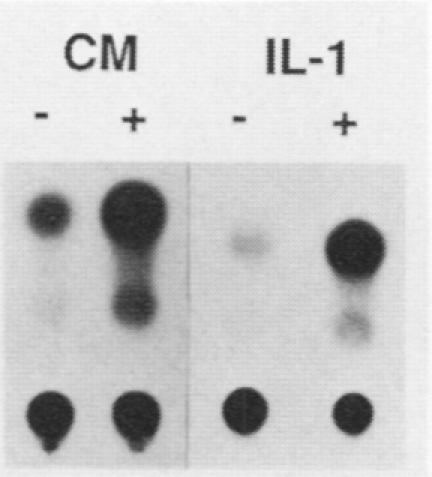
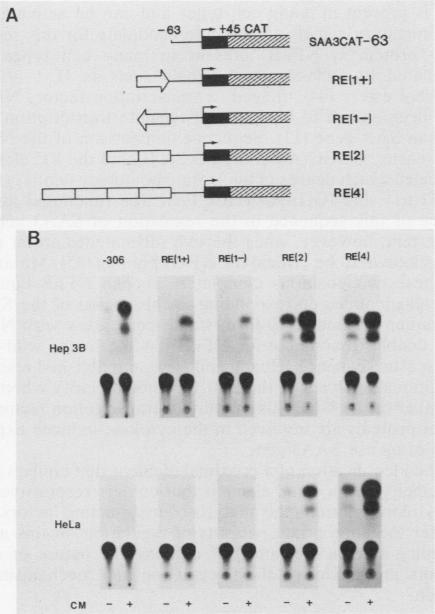
Expression of mouse serum amyloid A (SAA1, -2, and -3) mRNAs can be induced up to 1,000-fold in the liver in response to acute inflammation. This large increase is primarily the result of a 200-fold increase in the rates of SAA gene transcription. To analyze the cis-acting regulatory element(s) responsible for regulating transcription, we fused 306 base pairs of the mouse SAA3 promoter to a reporter gene, the chloramphenicol acetyltransferase (CAT) gene, and transfected this chimeric DNA into cultured cells. In transient expression assays, this 5' sequence was sufficient to confer cell-specific expression: CAT activity was readily detectable when the construct was transfected into liver-derived cells but was not detectable in nonliver cells. Furthermore, when liver cells transfected with this construct were treated with conditioned media prepared from activated mixed lymphocyte cultures or with recombinant interleukin-1, a 10- to 15-fold increase in CAT activity was detected. Deletion analyses showed two regions of interest: a proximal region that enhanced CAT expression in a cell-specific manner and a distal region that conferred responsiveness to both conditioned media and recombinant interleukin-1. This distal responsive element had properties of an inducible transcriptional enhancer, and deletion of the proximal cell-specific region rendered the distal element responsive to stimulation by conditioned media in nonliver cells.
小鼠血清淀粉样蛋白A(SAA1、-2和-3)mRNA的表达在急性炎症反应时,可在肝脏中被诱导升高至1000倍。这种大幅增加主要是SAA基因转录速率增加200倍的结果。为了分析负责调节转录的顺式作用调控元件,我们将小鼠SAA3启动子的306个碱基对与一个报告基因,即氯霉素乙酰转移酶(CAT)基因融合,并将这种嵌合DNA转染到培养细胞中。在瞬时表达分析中,这个5'序列足以赋予细胞特异性表达:当构建体转染到肝源性细胞中时,CAT活性很容易检测到,但在非肝细胞中则检测不到。此外,当用从活化的混合淋巴细胞培养物制备的条件培养基或重组白细胞介素-1处理转染了该构建体的肝细胞时,检测到CAT活性增加了10至15倍。缺失分析显示了两个感兴趣的区域:一个以细胞特异性方式增强CAT表达的近端区域和一个赋予对条件培养基和重组白细胞介素-1反应性的远端区域。这个远端反应元件具有可诱导转录增强子的特性,并且近端细胞特异性区域的缺失使远端元件在非肝细胞中对条件培养基的刺激有反应。