Seong Yoon Jae, Lee Jung Sub, Suh Kuen Tak, Kim Jeung Il, Lim Jong Min, Goh Tae Sik
Medical Research Institute, Pusan National University School of Medicine, Busan, Korea.
Asian Spine J. 2011 Jun;5(2):100-6. doi: 10.4184/asj.2011.5.2.100. Epub 2011 May 2.
This is a prospective study.
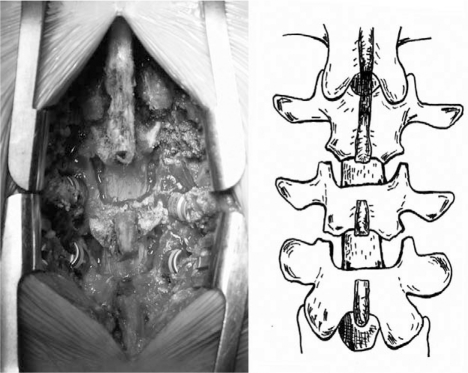
We compared the outcomes of segmental decompression and wide decompression in patients who had multilevel lumbar foraminal stenosis with back pain.
Wide decompression and fusion in patients with multilevel lumbar foraminal stenosis may increase the risk of perioperative complications.
From March 2005 to December 2007, this study prospectively examined 87 patients with multilevel lumbar foraminal stenosis and who were treated by segmental or wide decompression along with posterior fusion using pedicle screw fixation, and these patients could be followed-up for a minimum of 2 years. Of the 87 patients, 45 and 42 patients were assigned to the segmental decompression group (group 1) and the wide decompression group (group 2), respectively. We compared the clinical and radiological outcomes of the patients in these two groups.
There were no significant differences between groups 1 and 2 in terms of the levels of postoperative pain based on the visual analogue scale, the Oswestry Disability Score, the clinical results based on the Kirkaldy-Willis Criteria, the complication rate or the posterior fusion rate. On the other hand, the mean operating times in groups 1 and 2 were 153 ± 32 minutes and 187 ± 36 minutes, respectively (p < 0.05). The amount of blood loss during surgery and on the first postoperative day was 840 ± 236 ml and 1,040 ± 301 ml in groups 1 and 2, respectively (p < 0.05).
These results suggest that segmental decompression offers promising and reproducible clinical and radiological results for patients suffering from multilevel lumbar foraminal stenosis.
这是一项前瞻性研究。
我们比较了节段性减压和广泛减压对伴有背痛的多节段腰椎椎间孔狭窄患者的治疗效果。
多节段腰椎椎间孔狭窄患者进行广泛减压和融合术可能会增加围手术期并发症的风险。
从2005年3月至2007年12月,本研究前瞻性地检查了87例多节段腰椎椎间孔狭窄患者,这些患者接受了节段性或广泛减压以及使用椎弓根螺钉固定的后路融合术,并且这些患者至少随访了2年。在这87例患者中,分别有45例和42例患者被分配到节段性减压组(第1组)和广泛减压组(第2组)。我们比较了这两组患者的临床和影像学结果。
基于视觉模拟量表的术后疼痛水平、Oswestry功能障碍评分、基于Kirkaldy-Willis标准的临床结果、并发症发生率或后路融合率方面,第1组和第2组之间没有显著差异。另一方面,第1组和第2组的平均手术时间分别为153±32分钟和187±36分钟(p<0.05)。第1组和第2组手术期间及术后第一天的失血量分别为840±236毫升和1040±301毫升(p<0.05)。
这些结果表明,节段性减压为多节段腰椎椎间孔狭窄患者提供了有前景且可重复的临床和影像学结果。