Knudsen Ann Kristen, Omenås Anne Nagelgaard, Harvey Samuel B, Løvvik Camilla Ms, Lervik Linn V, Mykletun Arnstein
Department of Health Promotion and Development, Faculty of Psychology, University of Bergen , Bergen , Norway.
JRSM Short Rep. 2011 May;2(5):42. doi: 10.1258/shorts.2011.011016. Epub 2011 May 25.
Although cognitive behavioural therapy and graded exercise treatment are recognized evidence-based treatments for chronic fatigue syndrome/myalgic encephalomyelitis (ME), their use is still considered controversial by some patient groups. This debate has been reflected in the media, where many patients gather health information. The aim of this study was to examine how treatment for chronic fatigue syndrome/ME is described in the newspaper media.
Content analysis of newspaper articles.
The digitalized media archive Atekst was used to identify Norwegian newspaper articles where chronic fatigue syndrome/ME was mentioned.
Norwegian newspaper articles published over a 20-month period, from 1 January 2008 to 31 August 2009.
Statements regarding efficiency of various types of treatment for chronic fatigue syndrome/ME and the related source of the treatment advice. Statements were categorized as being either positive or negative towards evidence-based or alternative treatment.
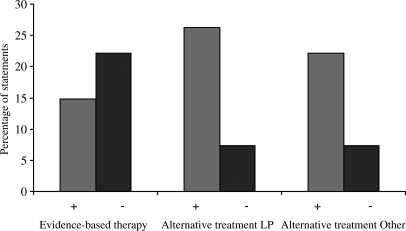
One hundred and twenty-two statements regarding treatment of chronic fatigue syndrome/ME were identified among 123 newspaper articles. The most frequent statements were positive statements towards alternative treatment Lightning Process (26.2%), negative statements towards evidence-based treatments (22.1%), and positive statements towards other alternative treatment interventions (22.1%). Only 14.8% of the statements were positive towards evidence-based treatment. Case-subjects were the most frequently cited sources, accounting for 35.2% of the statements, followed by physicians and the Norwegian ME association.
Statements regarding treatment for chronic fatigue syndrome/ME in newspapers are mainly pro-alternative treatment and against evidence-based treatment. The media has great potential to influence individual choices. The unbalanced reporting of treatment options for chronic fatigue syndrome/ME in the media is potentially harmful.
尽管认知行为疗法和分级运动疗法被公认为是治疗慢性疲劳综合征/肌痛性脑脊髓炎(ME)的循证疗法,但一些患者群体仍认为其使用存在争议。这场争论在媒体上有所体现,许多患者会在媒体上获取健康信息。本研究旨在探讨报纸媒体如何描述慢性疲劳综合征/ME的治疗方法。
报纸文章的内容分析。
利用数字化媒体档案Atekst来识别挪威报纸中提及慢性疲劳综合征/ME的文章。
2008年1月1日至2009年8月31日这20个月期间发表的挪威报纸文章。
关于慢性疲劳综合征/ME各种治疗方法的疗效陈述以及治疗建议的相关来源。陈述被分类为对循证治疗或替代治疗的积极或消极态度。
在123篇报纸文章中,共识别出122条关于慢性疲劳综合征/ME治疗的陈述。最常见的陈述是对替代治疗“闪电过程”的积极陈述(26.2%)、对循证治疗的消极陈述(22.1%)以及对其他替代治疗干预措施的积极陈述(22.1%)。只有14.8%的陈述对循证治疗持积极态度。病例主体是最常被引用的来源,占陈述的35.2%,其次是医生和挪威ME协会。
报纸上关于慢性疲劳综合征/ME治疗的陈述主要支持替代治疗而反对循证治疗。媒体有很大潜力影响个人选择。媒体对慢性疲劳综合征/ME治疗选择的不平衡报道可能有害。