King's College London, Department of Psychological Medicine, London, United Kingdom.
PLoS One. 2013 Jun 14;8(6):e65713. doi: 10.1371/journal.pone.0065713. Print 2013.
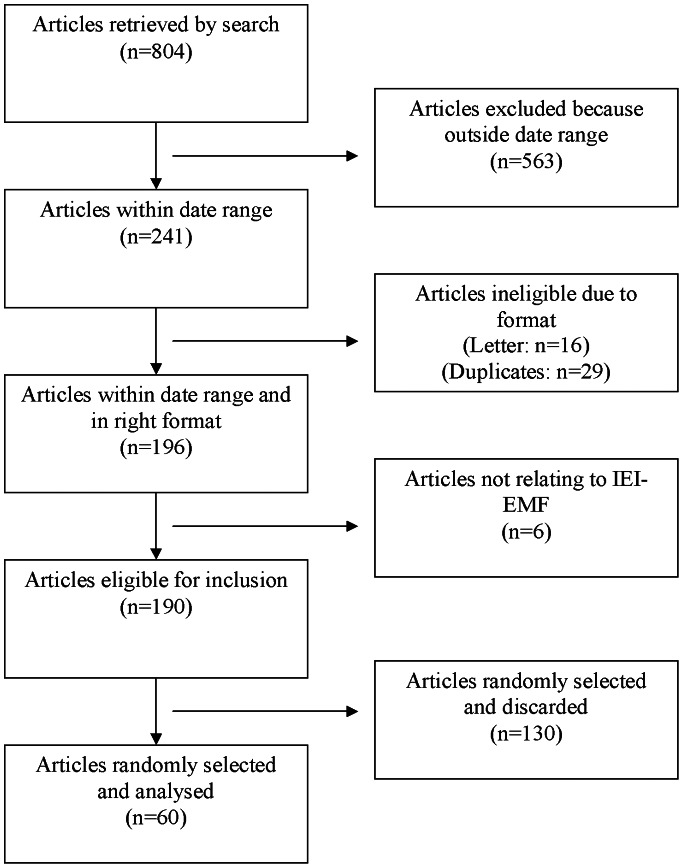
Idiopathic environmental intolerance attributed to electromagnetic fields (IEI-EMF) is a controversial condition in which people describe symptoms following exposure to electromagnetic fields from everyday electrical devices. However, double-blind experiments have found no convincing evidence that electromagnetic fields cause these symptoms. In this study, we assessed whether recent newspaper reporting in the UK reflected this scientific evidence. We searched a database of newspaper articles to identify all those that contained IEI-EMF related keywords and selected a random sample of 60 for content analysis. For our primary outcomes, we assessed how many articles mainly or wholly presented an electromagnetic cause for IEI-EMF and how many discussed unproven treatments for the condition such as strategies intended to reduce exposure to electromagnetic fields or the use of complementary and alternative therapies. We also assessed whether the type of information source used by a newspaper article (e.g. scientist, person with IEI-EMF, politician) or the type of newspaper (broadsheet, tabloid, local or regional) was associated with either outcome. Of the 60 articles, 43 (71.7%) presented a mainly electromagnetic cause, compared to 13 (21.7%) which presented mainly non-electromagnetic causes and 4 (6.7%) which did not discuss a cause. 29 (48.3%) did not mention any potential treatment, while 24 (40.0%) mentioned eletromagnetic field related strategies and 12 (20.0%) mentioned complementary or alternative therapies. Articles which quoted someone with IEI-EMF were significantly more likely to report an electromagnetic cause and to present unproven treatments. Those which used a scientist as a source were more likely to present a non-electromagnetic cause for the condition. The widespread poor reporting we identified is disappointing and has the potential for to encourage more people to misattribute their symptoms to electromagnetic fields. Scientists should remain engaged with the media to counteract this effect.
特发性环境电磁场敏感症(IEI-EMF)是一种有争议的病症,患者在接触日常电器产生的电磁场后会出现各种症状。然而,双盲实验并未发现有令人信服的证据表明电磁场会导致这些症状。在这项研究中,我们评估了英国最近的报纸报道是否反映了这一科学证据。我们搜索了一个报纸文章数据库,以确定所有包含 IEI-EMF 相关关键字的文章,并随机选择了 60 篇进行内容分析。对于我们的主要结果,我们评估了有多少文章主要或完全提出了电磁场是 IEI-EMF 的原因,以及有多少文章讨论了该病症未经证实的治疗方法,例如旨在减少电磁场暴露的策略或使用补充和替代疗法。我们还评估了报纸文章使用的信息来源类型(例如,科学家、患有 IEI-EMF 的人、政治家)或报纸类型(大报、小报、地方或地区报纸)是否与任何结果相关。在 60 篇文章中,43 篇(71.7%)提出了主要的电磁场原因,13 篇(21.7%)提出了主要的非电磁场原因,4 篇(6.7%)没有讨论原因。29 篇(48.3%)没有提到任何潜在的治疗方法,而 24 篇(40.0%)提到了电磁场相关策略,12 篇(20.0%)提到了补充或替代疗法。引用患有 IEI-EMF 的人的文章更有可能报告电磁场原因,并提出未经证实的治疗方法。那些使用科学家作为信息来源的文章更有可能提出非电磁场原因。我们发现的这种广泛的不良报道令人失望,有可能促使更多人将自己的症状错误归因于电磁场。科学家应该继续与媒体接触,以抵消这种影响。