Sha Yonggang, Marshall Harvey E
Division of Pulmonary, Allergy, and Critical Care Medicine, Department of Medicine, Duke University Medical Center, Durham, North Carolina, USA.
Biochim Biophys Acta. 2012 Jun;1820(6):701-11. doi: 10.1016/j.bbagen.2011.05.008. Epub 2011 May 24.
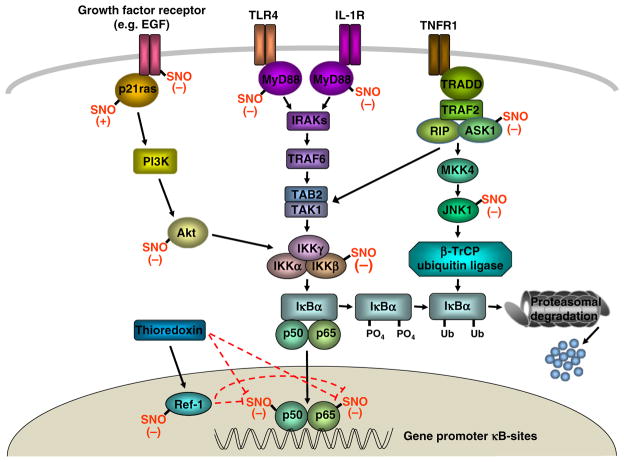
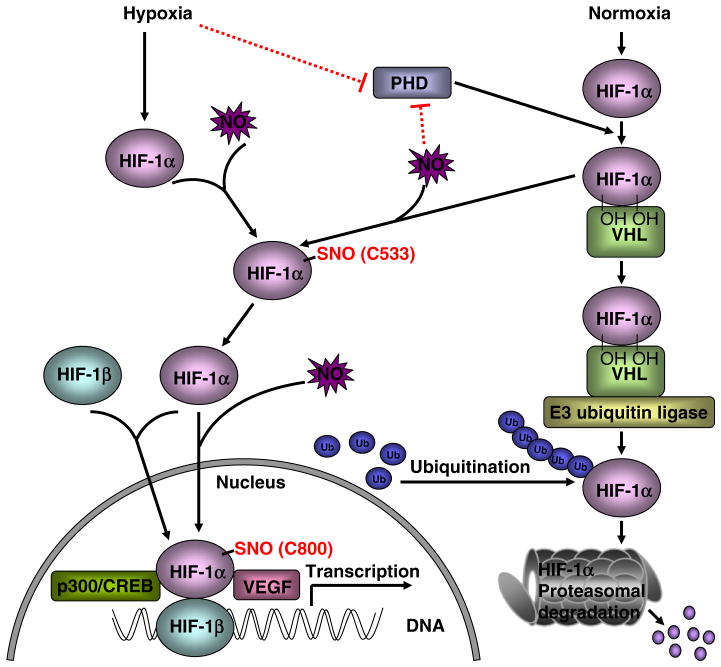
Post-translational modification of proteins by S-nitrosylation serves as a major mode of signaling in mammalian cells and a growing body of evidence has shown that transcription factors and their activating pathways are primary targets. S-nitrosylation directly modifies a number of transcription factors, including NF-κB, HIF-1, and AP-1. In addition, S-nitrosylation can indirectly regulate gene transcription by modulating other cell signaling pathways, in particular JNK kinase and ras.
The evolution of S-nitrosylation as a signaling mechanism in the regulation of gene transcription, physiological advantages of protein S-nitrosylation in the control of gene transcription, and discussion of the many transcriptional proteins modulated by S-nitrosylation is summarized.
S-nitrosylation plays a crucial role in the control of mammalian gene transcription with numerous transcription factors regulated by this modification. Many of these proteins serve as immunomodulators, and inducible nitric oxide synthase (iNOS) is regarded as a principal mediatiator of NO-dependent S-nitrosylation. However, additional targets within the nucleus (e.g. histone deacetylases) and alternative mechanisms of S-nitrosylation (e.g. GAPDH-mediated trans-nitrosylation) are thought to play a role in NOS-dependent transcriptional regulation.
Derangement of SNO-regulated gene transcription is an important factor in a variety of pathological conditions including neoplasia and sepsis. A better understanding of protein S-nitrosylation as it relates to gene transcription and the physiological mechanisms behind this process is likely to lead to novel therapies for these disorders. This article is part of a Special Issue entitled Regulation of Cellular Processes by S-nitrosylation.
蛋白质的S-亚硝基化修饰是哺乳动物细胞中一种主要的信号传导方式,越来越多的证据表明转录因子及其激活途径是主要靶点。S-亚硝基化直接修饰多种转录因子,包括核因子κB(NF-κB)、缺氧诱导因子-1(HIF-1)和活化蛋白-1(AP-1)。此外,S-亚硝基化可通过调节其他细胞信号通路间接调控基因转录,尤其是应激活化蛋白激酶(JNK)和原癌基因(ras)。
总结了S-亚硝基化作为一种信号机制在基因转录调控中的演变、蛋白质S-亚硝基化在基因转录控制中的生理优势,以及对许多受S-亚硝基化调节的转录蛋白的讨论。
S-亚硝基化在哺乳动物基因转录控制中起关键作用,许多转录因子受这种修饰调节。其中许多蛋白质作为免疫调节剂,诱导型一氧化氮合酶(iNOS)被认为是NO依赖性S-亚硝基化的主要介导因子。然而,细胞核内的其他靶点(如组蛋白去乙酰化酶)和S-亚硝基化的替代机制(如甘油醛-3-磷酸脱氢酶(GAPDH)介导的转亚硝基化)被认为在一氧化氮合酶(NOS)依赖性转录调控中发挥作用。
S-亚硝基化调节的基因转录紊乱是包括肿瘤形成和脓毒症在内的多种病理状况的重要因素。更好地理解与基因转录相关的蛋白质S-亚硝基化及其背后的生理机制,可能会为这些疾病带来新的治疗方法。本文是名为“S-亚硝基化对细胞过程的调控”的特刊的一部分。