Burnside Joan, Morgan Robin
Delaware Biotechnology Institute, University of Delaware, 15 Innovation Way, Newark, Delaware 19711, USA.
BMC Proc. 2011 Jun 3;5 Suppl 4(Suppl 4):S2. doi: 10.1186/1753-6561-5-S4-S2.
MicroRNAs are short RNAs (~22 nt) expressed by plants, animals and viruses that regulate gene expression post-transcriptionally, and their importance is highlighted by distinct patterns of expression in many physiological processes, including development, hematopoeisis, stress resistance, and disease. Our group has characterized the microRNAs encoded by the avian herpesviruses; namely, oncogenic Marek's disease (MD) virus (MDV1), non-oncogenic MDV (MDV2) herpesvirus of turkeys (HVT), and infectious laryngotracheitis virus (ILTV).
MicroRNAs encoded by the avian herpesviruses were identified using next generation sequencing technologies (454, Illumina).
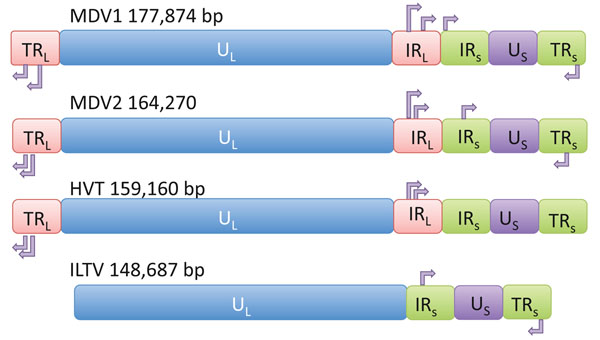
The microRNAs of each the avian herpesviruses have unique sequences, but the genomic locations are similar, in that the microRNAs tend to be clustered in the rapidly evolving repeat regions of the viral genomes. For a given viral species the microRNA sequence is highly conserved in different strains with the exception of a virulence-associated polymorphism in the putative promoter of the MDV1 microRNAs upstream of the meq oncogene. These microRNAs are relatively highly expressed in tumors produced by very virulent MDV1 isolates compared to tumors produced by less virulent strains. MDV1 and HVT encode homologs of the host microRNA, miR-221, which targets a gene important in cell cycle regulation. MDV1 encodes a microRNA (mdv1-miR-M4) that shares a seed sequence with miR-155, a microRNA important in immune function. Mdv-miR-M4 is highly expressed in MDV induced tumors, while miR-155 is present at very low levels.
MicroRNAs are highly conserved among different field strains of MDV1, and they are expressed in lytic and latent infections and in MDV1-derived tumors. This suggests that these small molecules are very important to the virus, and roles in immune evasion, anti-apoptosis, or proliferation are likely.
微小RNA是由植物、动物和病毒表达的短RNA(约22个核苷酸),可在转录后调节基因表达,其在包括发育、造血、抗逆性和疾病在内的许多生理过程中的独特表达模式凸显了其重要性。我们的研究小组已对禽疱疹病毒编码的微小RNA进行了特征分析;即致癌性马立克氏病(MD)病毒(MDV1)、非致癌性MDV(MDV2)、火鸡疱疹病毒(HVT)和传染性喉气管炎病毒(ILTV)。
利用下一代测序技术(454、Illumina)鉴定禽疱疹病毒编码的微小RNA。
每种禽疱疹病毒的微小RNA都有独特的序列,但基因组位置相似,即微小RNA倾向于聚集在病毒基因组快速进化的重复区域。对于给定的病毒种类,微小RNA序列在不同毒株中高度保守,但致癌性MDV1微小RNA在meq癌基因上游假定启动子中的毒力相关多态性除外。与低毒力毒株产生的肿瘤相比,这些微小RNA在高毒力MDV1分离株产生的肿瘤中相对高表达。MDV1和HVT编码宿主微小RNA miR-221的同源物,miR-221靶向细胞周期调节中一个重要的基因。MDV1编码一种微小RNA(mdv1-miR-M4),其与免疫功能中重要的微小RNA miR-155共享种子序列。mdv-miR-M4在MDV诱导的肿瘤中高表达,而miR-155的水平非常低。
微小RNA在MDV1的不同野外毒株中高度保守,它们在裂解性和潜伏性感染以及MDV1衍生的肿瘤中表达。这表明这些小分子对病毒非常重要,可能在免疫逃避、抗凋亡或增殖中发挥作用。