Malaria Research and Training Center/Faculty of Medicine, Pharmacy and Odontostomatology, Bamako, Mali.
Malar J. 2011 Jun 6;10:151. doi: 10.1186/1475-2875-10-151.
Persistence of African anophelines throughout the long dry season (4-8 months) when no surface waters are available remains one of the enduring mysteries of medical entomology. Recent studies demonstrated that aestivation (summer diapause) is one mechanism that allows the African malaria mosquito, Anopheles gambiae, to persist in the Sahel. However, migration from distant localities - where reproduction continues year-round - might also be involved.
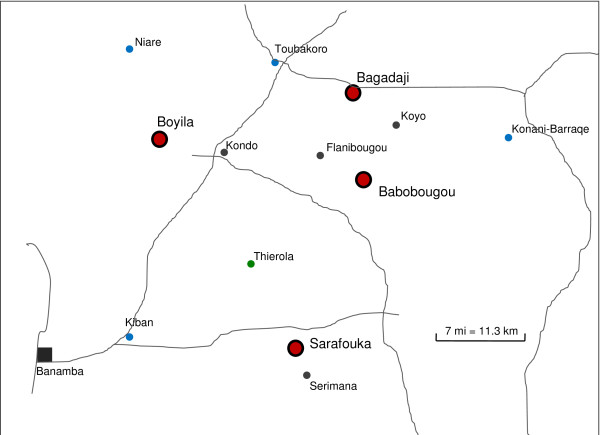
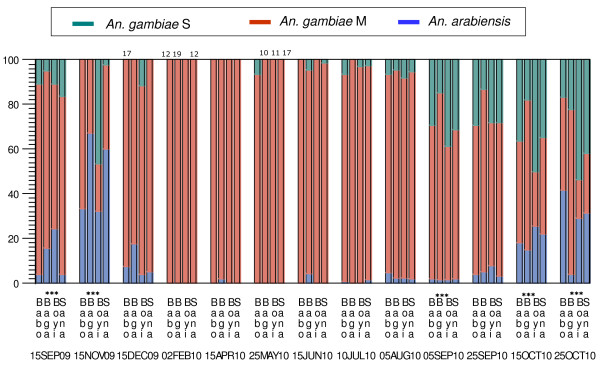
To assess the contribution of aestivating adults to the buildup of populations in the subsequent wet season, two villages subjected to weekly pyrethrum sprays throughout the dry season were compared with two nearby villages, which were only monitored. If aestivating adults are the main source of the subsequent wet-season population, then the subsequent wet-season density in the treated villages will be lower than in the control villages. Moreover, since virtually only M-form An. gambiae are found during the dry season, the reduction should be specific to the M form, whereas no such difference is predicted for S-form An. gambiae or Anopheles arabiensis. On the other hand, if migrants arriving with the first rain are the main source, no differences between treated and control villages are expected across all members of the An. gambiae complex.
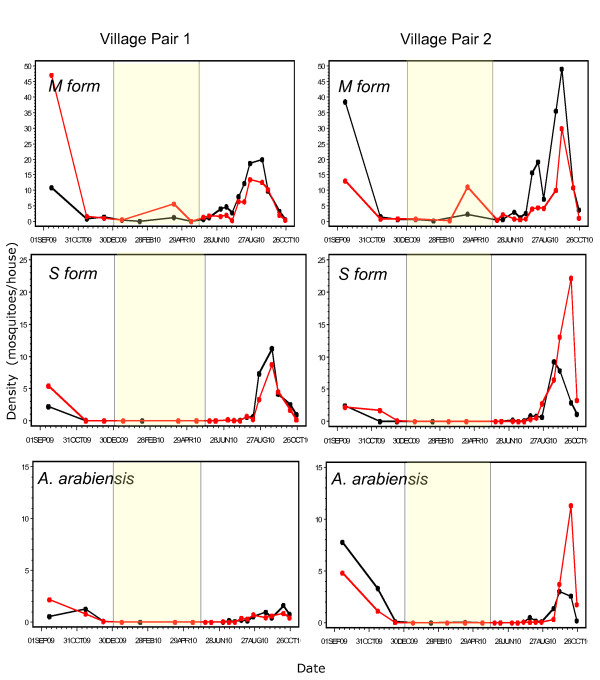
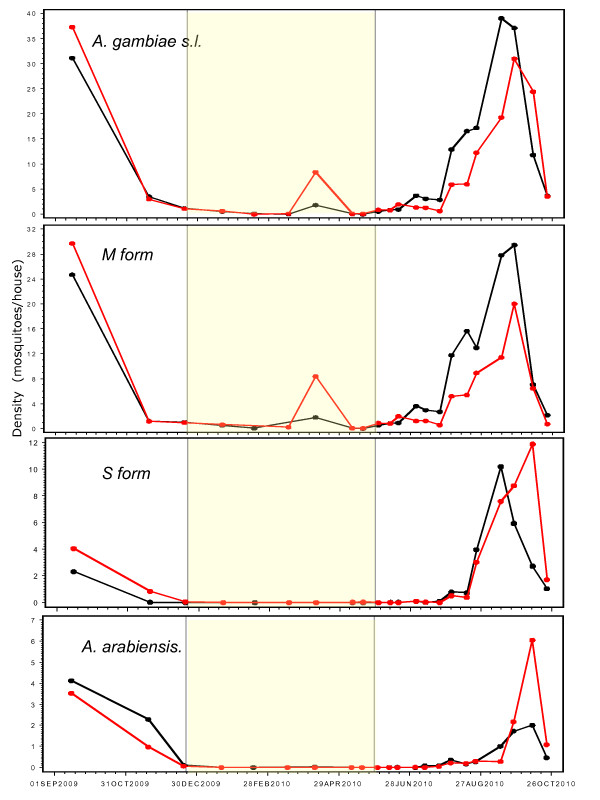
The wet-season density of the M form in treated villages was 30% lower than that in the control (P < 10-4, permutation test), whereas no significant differences were detected in the S form or An. arabiensis.
These results support the hypothesis that the M form persist in the arid Sahel primarily by aestivation, whereas the S form and An. arabiensis rely on migration from distant locations. Implications for malaria control are discussed.
在没有地表水的漫长旱季(4-8 个月)中,非洲按蚊持续存在,这仍然是医学昆虫学的一个未解之谜。最近的研究表明,夏眠(夏季休眠)是允许非洲疟蚊 Anopheles gambiae 在萨赫勒地区生存的一种机制。然而,从遥远的地方迁移——那里的繁殖全年都在继续——也可能涉及其中。
为了评估休眠成虫对随后雨季种群增长的贡献,我们比较了两个在旱季每周喷洒除虫菊酯的村庄与两个附近仅进行监测的村庄。如果休眠成虫是随后雨季种群的主要来源,那么处理过的村庄随后雨季的密度将低于对照村庄。此外,由于在旱季几乎只发现 M 型 An. gambiae,因此这种减少应该是 M 型特有的,而对于 S 型 An. gambiae 或 Anopheles arabiensis 则不会预测到这种差异。另一方面,如果第一批降雨带来的移民是主要来源,则预计处理过的村庄和对照村庄之间的所有 An. gambiae 复合体成员之间不会存在差异。
处理过的村庄中 M 型的雨季密度比对照村庄低 30%(P<10-4,置换检验),而 S 型或 An. arabiensis 则没有显著差异。
这些结果支持了这样一种假设,即 M 型在干旱的萨赫勒地区主要通过夏眠来维持,而 S 型和 An. arabiensis 则依赖于从遥远的地方迁移。讨论了对疟疾控制的影响。