Computational Biophysics and Bioinformatics, Department of Physics, Clemson University, Clemson, South Carolina, United States of America.
PLoS One. 2011;6(5):e20373. doi: 10.1371/journal.pone.0020373. Epub 2011 May 27.
Spermine synthase (SMS) is a key enzyme controlling the concentration of spermidine and spermine in the cell. The importance of SMS is manifested by the fact that single missense mutations were found to cause Snyder-Robinson Syndrome (SRS). At the same time, currently there are no non-synonymous single nucleoside polymorphisms, nsSNPs (harmless mutations), found in SMS, which may imply that the SMS does not tolerate amino acid substitutions, i.e. is not mutable.
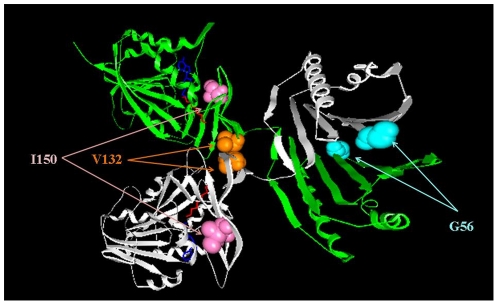
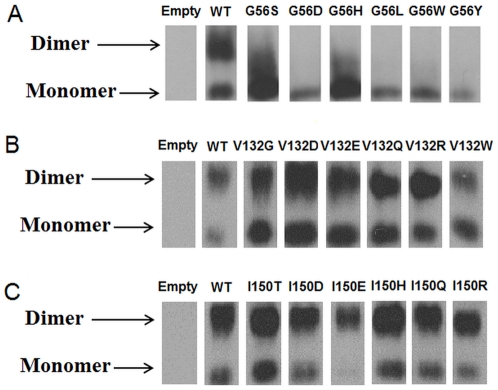
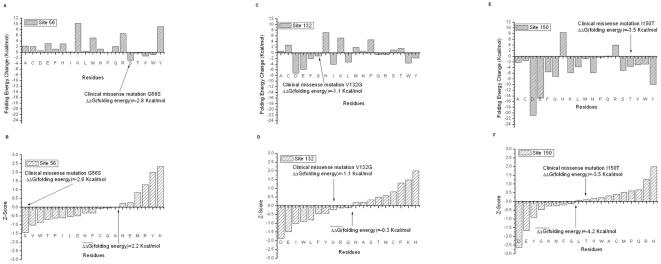
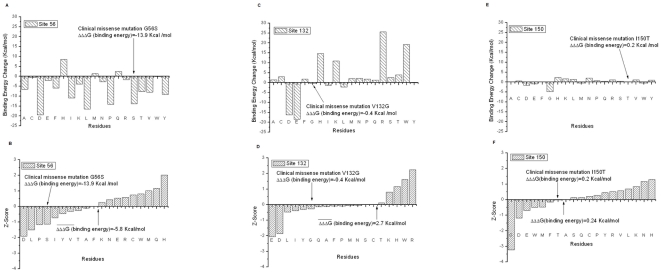
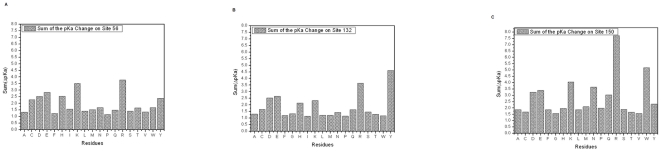
METHODOLOGY/PRINCIPAL FINDINGS: To investigate the mutability of the SMS, we carried out in silico analysis and in vitro experiments of the effects of amino acid substitutions at the missense mutation sites (G56, V132 and I150) that have been shown to cause SRS. Our investigation showed that the mutation sites have different degree of mutability depending on their structural micro-environment and involvement in the function and structural integrity of the SMS. It was found that the I150 site does not tolerate any mutation, while V132, despite its key position at the interface of SMS dimer, is quite mutable. The G56 site is in the middle of the spectra, but still quite sensitive to charge residue replacement.
CONCLUSIONS/SIGNIFICANCE: The performed analysis showed that mutability depends on the detail of the structural and functional factors and cannot be predicted based on conservation of wild type properties alone. Also, harmless nsSNPs can be expected to occur even at sites at which missense mutations were found to cause diseases.
精脒合酶(SMS)是控制细胞中精脒和精胺浓度的关键酶。SMS 的重要性体现在单个错义突变被发现导致 Snyder-Robinson 综合征(SRS)上。同时,目前在 SMS 中没有发现非同义单核苷酸多态性(nsSNP,无害突变),这可能意味着 SMS 不能容忍氨基酸取代,即不可变。
方法/主要发现:为了研究 SMS 的可变性,我们对已显示导致 SRS 的错义突变位点(G56、V132 和 I150)处的氨基酸取代进行了计算机分析和体外实验。我们的研究表明,突变位点的可变性程度取决于其结构微环境以及与 SMS 功能和结构完整性的关系。结果发现,I150 位点不能容忍任何突变,而 V132 尽管位于 SMS 二聚体界面的关键位置,但非常可变。G56 位点处于两者之间,但仍然对电荷残基取代非常敏感。
结论/意义:进行的分析表明,可变性取决于结构和功能因素的细节,不能仅基于野生型特性的保守性来预测。此外,即使在导致疾病的错义突变发现的位点,也可以预期发生无害的 nsSNP。