Yeates Keith Owen, Taylor H Gerry, Rusin Jerome, Bangert Barbara, Dietrich Ann, Nuss Kathryn, Wright Martha
Department of Pediatrics, The Ohio State University, Columbus, OH 43205, USA.
Int J Dev Neurosci. 2012 May;30(3):231-7. doi: 10.1016/j.ijdevneu.2011.05.008. Epub 2011 May 27.
This study sought to determine whether premorbid child and family functioning accounts for or moderates group differences in post-concussive symptoms following mild traumatic brain injury (TBI) in childhood.
This prospective, longitudinal cohort study recruited 8- to 15-year-old children, 186 with mild TBI and 99 with orthopedic injuries (OI), from consecutive emergency department admissions. Parents and children rated post-concussive symptoms within 3 weeks of injury and at 1, 3, and 12 months post injury. Parents also provided retrospective ratings of pre-injury symptoms, as well as of premorbid child behavioral adjustment, overall family functioning, and other stressors and resources in the family environment.
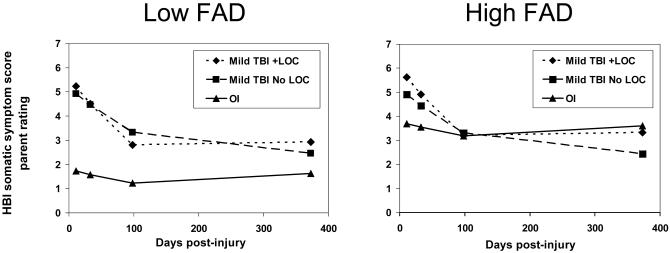
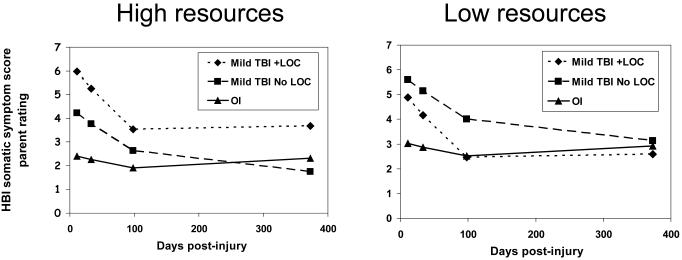
Children with mild TBI reported more post-concussive symptoms than those with OI, as did their parents, although premorbid child behavioral adjustment and symptoms also were significant predictors of post-concussive symptoms. Group differences in somatic symptoms as reported by parents were more pronounced among children from families that were higher functioning and had more environmental resources.
Mild TBI during childhood results in more post-concussive symptoms than OI, even after children's premorbid adjustment is taken into account. Counter to expectations, post-concussive symptoms following mild TBI may actually be more apparent among children from higher-functioning families with greater resources.
本研究旨在确定病前儿童及家庭功能是否可解释或调节儿童轻度创伤性脑损伤(TBI)后震荡后症状的组间差异。
这项前瞻性纵向队列研究从连续的急诊科入院患者中招募了8至15岁的儿童,其中186名患有轻度TBI,99名患有骨科损伤(OI)。父母和孩子在受伤后3周内以及受伤后1、3和12个月对震荡后症状进行评分。父母还提供了受伤前症状的回顾性评分,以及病前儿童行为调整、家庭整体功能以及家庭环境中的其他压力源和资源的评分。
轻度TBI儿童报告的震荡后症状比OI儿童更多,他们的父母也是如此,尽管病前儿童行为调整和症状也是震荡后症状的重要预测因素。在功能较高且环境资源较多的家庭的儿童中,父母报告的躯体症状的组间差异更为明显。
即使考虑到儿童的病前调整情况,儿童期轻度TBI导致的震荡后症状也比OI更多。与预期相反,轻度TBI后的震荡后症状在资源较多、功能较高的家庭的儿童中可能实际上更为明显。